The Role of FR4 Plate Keyboard in Mechanical Keyboard Structure
In the structural design of mechanical keyboards, the plate (positioning plate) is a crucial intermediate layer connecting the switches to the PCB. Its material selection directly impacts the overall feel, sound characteristics, and structural stability of the keyboard. In recent years, FR4 plate keyboards have gradually become one of the mainstream solutions in custom keyboards and mid-to-high-end mass-produced products. This is not only due to changing tactile preferences but also involves performance advantages at the material engineering level.
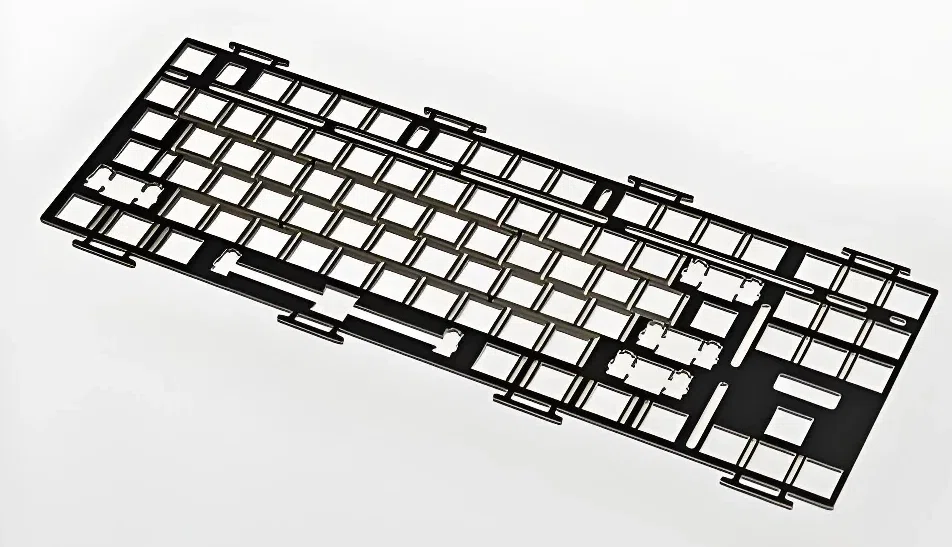
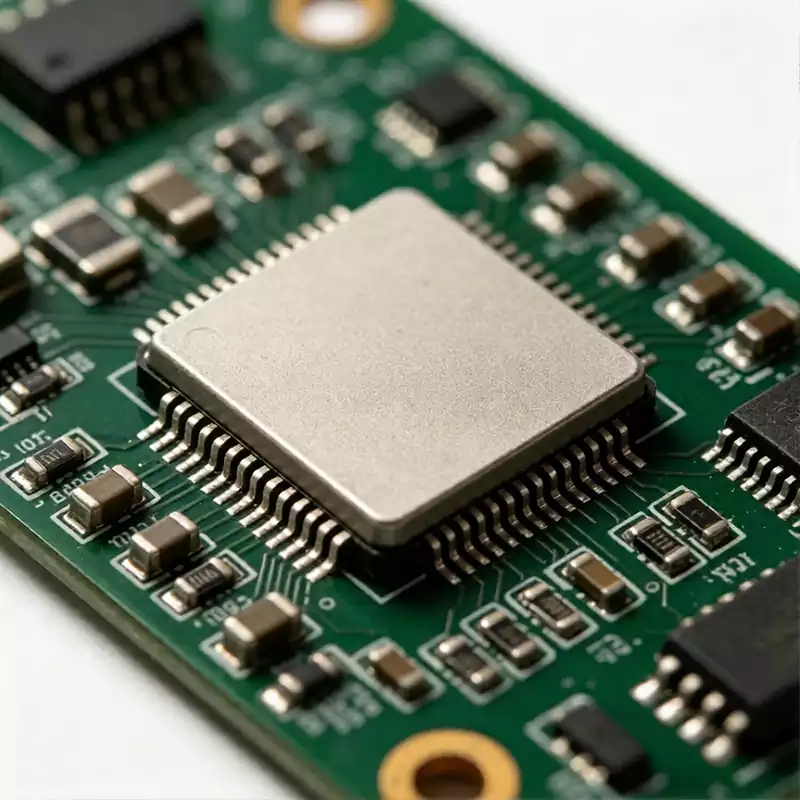
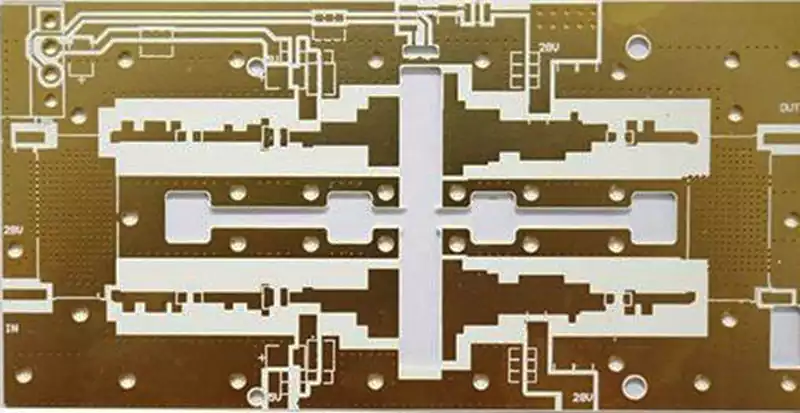
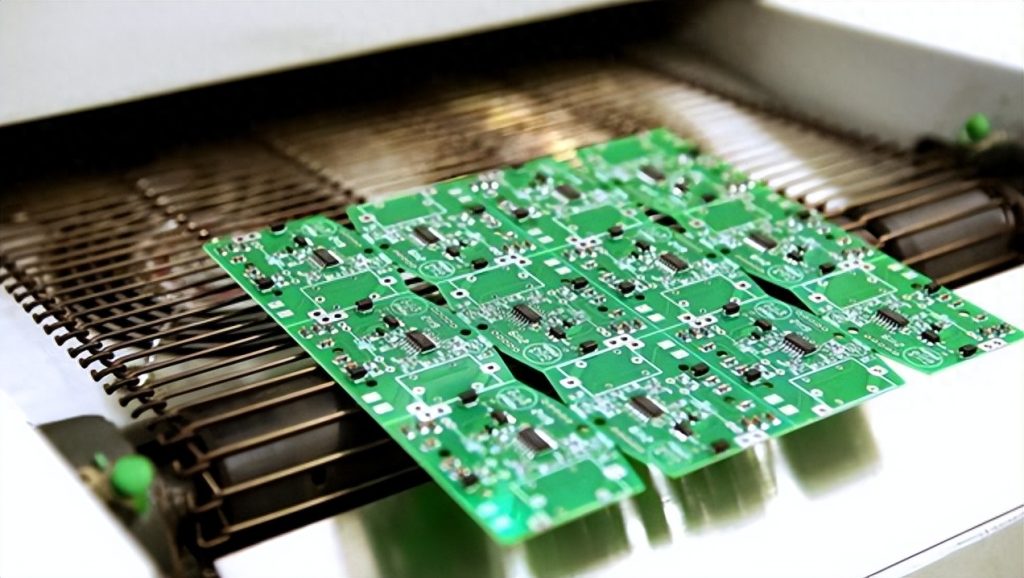
FR4 is essentially a laminate material composed of fiberglass cloth and epoxy resin, widely used in PCB manufacturing. Due to its excellent mechanical strength, electrical insulation properties, and processing stability, the application of FR4 in keyboard positioning plates has led to a shift in structural components from traditional metal materials (such as aluminum and steel) to composite materials.
Compared to metal plates, FR4 plate offers a more balanced mechanical property between rigidity and flexibility. During key actuation, the FR4 material can undergo moderate deformation, thereby reducing the feedback force during keystrokes. While these subtle elastic variations are imperceptible to the naked eye, they significantly impact finger fatigue and the overall typing experience during extended periods of typing.
Furthermore, the internal fibrous structure of FR4 material naturally dampens vibration propagation. Compared to the resonance issues prone to occur with metal plates, FR4 plate keyboards often exhibit a smoother, more stable sound during typing. This acoustic variation has made it widely popular in custom keyboard designs that aim for a “thock” feel.
From a manufacturing perspective, the similarity in material systems between FR4 plate and PCB also leads to greater consistency in processing. Standardized CNC or laser cutting processes allow for high-precision hole and edge control, reducing the risk of structural misalignment due to switch installation errors.
In conclusion, FR4 plate keyboards are not merely a matter of aesthetics or trendiness, but an engineering solution that strikes a balance between structural performance, typing experience, and manufacturing stability. Their increasing application reflects a shift in keyboard design from “material rigidity” to “comprehensive performance matching.”
Structural Performance Differences Between FR4 Plate and Metal Plate
In mechanical keyboard design, the choice of plate material is often considered a key variable for “feel tuning.” The rapid rise in popularity of FR4 plate keyboards in recent years is largely due to their significant structural performance differences compared to traditional metal plates.
Firstly, from a material rigidity perspective, aluminum or steel plates typically have a higher Young’s modulus, meaning they are less prone to deformation under stress. During key presses, this high rigidity allows the downward pressure on the switches to be quickly rebounded, resulting in a more direct and crisp typing feedback. However, excessive rigidity can also increase the impact force transmitted to the fingers, potentially leading to fatigue during prolonged use.
In contrast, FR4 material has relatively lower rigidity and a degree of elastic deformation capability. When a keycap is pressed, the FR4 plate can bend at a microscale, absorbing some of the impact energy. This energy buffering mechanism makes the bottoming-out feedback smoother, reducing the mechanical impact during keystrokes.
Secondly, regarding vibration propagation, metal materials typically have a lower internal damping coefficient, meaning they are prone to structural resonance upon impact. This resonance not only affects the striking sound but can also propagate throughout the plate, triggering secondary vibrations. FR4, due to its fiber-reinforced composite structure, possesses higher internal damping characteristics, dissipating more energy during vibration propagation and thus reducing resonance.
This difference is particularly evident in acoustic performance. Metal plates often produce a crisper, even slightly metallic, striking sound, while FR4 plate keyboards typically exhibit a more stable sound with a higher proportion of low frequencies. This is a key reason why FR4 plates are favored in designs seeking a quiet or “heavy” acoustic style.
Furthermore, in terms of manufacturing consistency, the similarity between FR4 and PCB material systems makes them more compatible in terms of thermal expansion coefficients and processing stability. This means that the relative deformation between the FR4 plate and the PCB is smaller after temperature changes or prolonged use, contributing to maintaining overall structural stability.
Overall, the FR4 plate is not a simple replacement for the metal plate, but rather offers a more balanced engineering choice between rigidity, damping, and structural fit. This balance makes it more adaptable to various application scenarios.
Typical Design Challenges of FR4 Plate Keyboard
While the FR4 plate keyboard boasts numerous advantages in material properties, it is not a “safe, no-brainer” option in actual design and mass production. Compared to metal plates, the FR4 structure has a lower design tolerance and demands more attention to engineering details.
First, the core issue lies in balancing structural strength and thickness control.
FR4 material is inherently less rigid than aluminum or steel, therefore, plate thickness design must be more cautious. If the thickness is too thin, the entire positioning plate may bend significantly in areas of concentrated pressure, leading to decreased axis stability and even uneven stress on the hot-swap connector. However, if the thickness is too thick, it weakens the original flexibility of FR4, making its feel closer to that of a metal plate, thus negating the purpose of the material choice.
Secondly, there are issues related to the accuracy of the shaft holes and the quality control of edge machining. FR4 is a glass fiber reinforced material. During CNC or laser cutting, improper tool parameter control can easily lead to burrs, delamination, or micro-cracks. These problems may not be visually apparent, but they affect the engagement stability of the snap-fit structure during switch installation. After prolonged use, even interlayer delamination may occur in areas of concentrated stress.
The third challenge stems from the directional differences in the laminated structure.
FR4 is made of multiple layers of laminated glass fiber cloth, and its mechanical properties are not entirely consistent in different directions. If the relationship between fiber direction and key layout is not considered during design, localized abnormal stress may occur in large key areas (such as the spacebar and Enter key). This problem is often not immediately apparent but gradually emerges after prolonged typing.
Furthermore, FR4 Plate Keyboards also involve matching the mounting method.
Different keyboard structures (Tray Mount, Top Mount, Gasket Mount, etc.) have different requirements for plate elasticity. FR4 material itself already possesses a certain degree of flexibility; if a highly elastic structural design is added on top, it may result in an overall overly soft feedback, affecting input clarity. Therefore, the installation method and material properties must be comprehensively considered during the design phase, rather than optimizing a single variable.
Finally, there’s the issue of surface treatment and visual consistency.
The raw surface of FR4 material typically exhibits a green or dark fiberglass texture. If used in a transparent case or open design, this visual effect will be directly exposed. Some manufacturers use sandblasting, coating, or dyeing processes to optimize this, but this increases manufacturing complexity and cost control.
In summary, the real challenge of FR4 Plate Keyboard lies not in the material itself, but in achieving a balance between structural design, manufacturing precision, and installation method. Only with a systematic design approach can FR4 truly realize its advantages; otherwise, it can easily turn from “enhancing the user experience” into “structural hazards.”
How to Optimize Keyboard Feel and Acoustic Performance with FR4 Plate
In mechanical keyboard design, the value of FR4 Plate lies not only in its material parameters but also in the more controllable space it provides for structural adjustments. If the plate thickness, installation method, and cushioning structure are properly matched, FR4 Plate Keyboard can achieve a more refined balance between feel and acoustic performance.
First, optimization should begin with the plate thickness. FR4 material itself has a certain degree of elasticity, providing significant deformation space at a thinner thickness, resulting in a smoother key bottom-out feedback. However, in practical design, excessive thinning should be avoided to prevent compromising overall structural stability. By employing differentiated support strategies in different key areas, the smoothness of the input can be maintained while preventing issues like localized collapse or inconsistent rebound.
Second, the choice of mounting structure has a significant impact on the performance of the FR4 plate. For example, in a gasket mount structure, the elasticity of the FR4 plate can combine with the cushioning pad to enhance overall input smoothness. However, if the cushioning material is too soft, the trigger feedback may become vague. Therefore, during the structural design phase, the plate elasticity and the stiffness of the cushioning components should be comprehensively evaluated, rather than pursuing only one indicator.
Third, the vibration damping characteristics of FR4 material give it a natural advantage in acoustic tuning. By properly controlling the contact area between the plate and the PCB, the propagation path of structural resonance can be further reduced, thereby reducing the generation of high-frequency noise. This method optimizes the typing sound to a certain extent without requiring additional sound-absorbing materials.
Furthermore, adding localized support or reinforcing ribs to the larger key areas (such as the spacebar) helps balance the stress on the FR4 plate across different key areas. Structural reinforcement improves the stability and consistency of the larger keys without significantly increasing overall rigidity.
Finally, during mass production, the plate’s manufacturing precision should be confirmed through prototype verification. The feel of the FR4 Plate Keyboard depends not only on the design itself but also on manufacturing quality. Hole tolerances, edge treatment, and lamination consistency all affect the final assembly stability.
Overall, the advantages of the FR4 Plate can only be truly realized when design, structure, and manufacturing are optimized in tandem. Properly utilizing its elasticity and damping characteristics can significantly improve the overall keyboard experience without adding extra complexity.
Summary
FR4 Plate Keyboard: An Engineering Solution Balancing Feel and Structural Stability
As mechanical keyboard design gradually shifts from a single-material approach to comprehensive performance optimization, the FR4 Plate Keyboard is becoming a key structural choice in an increasing number of product solutions. Compared to traditional metal positioning plates, FR4 offers a more balanced mechanical performance between rigidity and flexibility, allowing it to reduce impact feedback while maintaining necessary structural support.
In practical applications, the FR4 plate not only affects the typing experience but also directly relates to the vibration propagation path and the overall acoustic characteristics of the device. By properly controlling the plate thickness, mounting method, and local support structure, more stable input feedback and a more balanced sound performance can be achieved without adding extra complexity.
From a manufacturing perspective, the high degree of consistency between FR4 material and the PCB system also helps improve processing compatibility and assembly stability. This material-level compatibility gives the FR4 Plate Keyboard greater potential for consistency control during mass production.
Overall, the FR4 Plate is not merely a replacement material but offers a more engineering-valued solution balancing structural performance, user experience, and manufacturing stability. As users’ demands for input feel and sound performance continue to rise, its application prospects will continue to expand.