What is a four layer flexible board? FPC flexible boards can be used to manufacture four layer boards, but compared to double-layer or multi-layer FPC flexible boards, the manufacturing process is more complex and requires consideration of insulation performance, signal transmission, manufacturing process, and application areas. The four layer FPC flexible board has the advantages of high space utilization, good flexibility and light weight, and has a wide range of application prospects in high-end electronic products.
What is a 4-layer flexible PCB?
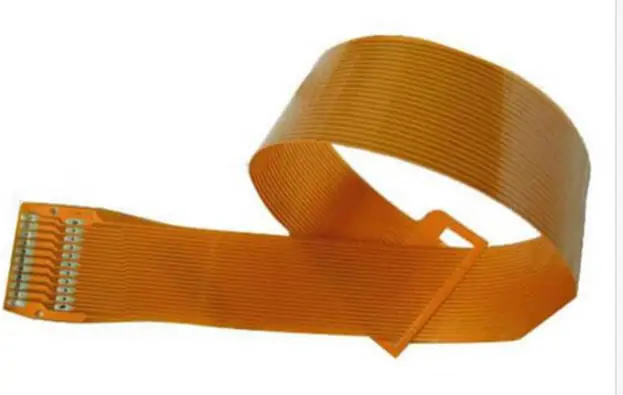
As the name suggests, a four layer board has four layers of wiring, consisting of an inner layer (double-sided substrate) and front and back outer layers (single-sided substrate). Each layer is made of copper surface wiring, which is conducted through conductive holes and finally coated with film. There are four conductive layers in a 4-layer flexible PCB made of polyimide. FR4 can also be used, but polyimide is the best choice because it has many advantages over FR4. Polyimide is a thermally stable material that allows four layer flexible printed circuit boards to withstand higher temperatures. This is why 4-layer flexible PCBs are widely used in high-temperature applications.
In flexible printed circuit boards, we assemble electronic circuits by mounting electrical components on flexible plastic substrates. Flexible circuit boards can also be screen printed with silver circuits on polyester.
In addition, polyimide provides considerable flexibility, making it easier to install electronic devices that are difficult to install on hard boards. This helps simplify the design. In addition, the flexibility of polyimide facilitates the creation of complex designs, which is not possible for rigid circuit boards.
What are the materials for a 4-layer flexible PCB?
Metal foil
In flexible laminates, conductive components are called metal foils. Circuit paths are usually carved with metal foil. There are various types of metal foils on the market, but copper foil is the most popular and accepted foil. The electrical properties of copper and its cost-effectiveness compared to other metals make it an automatic choice for producing four layer printed circuit boards. There are two basic types of copper foil: forged or rolled copper foil and electrolytic copper foil. These two types have different attributes. Usually, one side of the copper foil is treated with a thin surface to improve its adhesion to the base film.
Adhesive glue:
To manufacture laminated boards, we use adhesives as the bonding medium. If polyimide is the substrate, the adhesive will become the limiting factor for the performance of the laminated material.
There are many problems with polyimide adhesives. Newer thermoplastic polyimide adhesives are suitable, but now adhesives from different polymer series are also used.
Adhesive has different thicknesses, and its use depends on the application type of the four layer printed circuit board. Their thickness is usually determined according to the requirements of copper foil thickness
Ding.
Substrate:
The substrate is actually the material that provides the basis for the laminated board, which is a flexible polymer film. In a 4-layer flexible PCB, polyimide film is used as the substrate.
This is because polyimide does not soften when heated and remains flexible even after heat curing. When manufacturing adhesive flexible printed circuit boards, the substrate actually exhibits all basic characteristics. Adhesive polyimide can adhere to copper without the need for adhesive and reduce the thickness of the circuit board. It provides greater flexibility and lower damage tolerance.
What are the advantages of a 4-layer flexible PCB?
Good flexibility and bendability: FPC flexible board has good flexibility and bendability, and can adapt to complex product shapes and curved surface designs.
High space utilization: Four layer FPC flexible board can achieve more wire layers in limited space, thereby improving the integration and space utilization of the circuit.
Lightweight: FPC flexible board is lighter in weight compared to traditional rigid boards, which can reduce the overall weight of the product.
Application areas of 4-layer flexible PCB
4-layer flexible PCBs have many different applications, such as power supply, medical equipment, automotive, industrial control, smartphones, GPS systems, motion systems, and satellites. Compared to double-layer or multi-layer FPC flexible boards, four layer FPC flexible boards can provide more wire layers, thereby achieving more complex circuit designs and higher signal transmission rates. Therefore, the four layer FPC flexible board is in the high-end market
Electronic products have a wide range of application prospects.
Mobile phones and tablets: Flexible FPC is widely used in mobile phones and tablets, such as connecting display screens and motherboards, connecting monitors and motherboards, etc. 2. Digital camera: Flexible FPC has also been widely used in digital cameras, such as connecting display screens and motherboards, connecting batteries and motherboards, etc. 3. Automotive electronics; The application of flexible FPC in automotive electronics is becoming increasingly widespread, such as connecting car audio and television, connecting car navigation and motherboard, etc. 4. Medical equipment: The application of flexible FPC in medical equipment is becoming increasingly widespread, such as connecting medical sensors and motherboards, connecting medical devices and motherboards, etc. 5. LED lighting: The application of flexible FPC in LED lighting is becoming increasingly widespread, such as connecting LED lights and power supplies, connecting LED lights and LM2903MX controllers, etc
Development Trend of Flexible FPC
With the continuous development of the consumer electronics market, the demand for flexible FPCs is also increasing. The future development trends mainly include the following:
Getting smaller and smaller
With the continuous shrinking of electronic products, flexible FPCs also need to become smaller. In the future, the circuit fidelity and spacing of flexible FPCs will continue to shrink to meet the demand for miniaturization in electronic products
Getting thinner and thinner, with the pursuit of lightweight in consumer electronics products, the thickness of flexible FPC is also decreasing year by year. Now, the thickness of flexible PC can be reduced to less than 0.1mm, and with the continuous improvement of technology, the thickness of commercial FPC will be more respected in the future.
Independent production
Future: With the increasing demand for flexible FPCs, more and more companies and officials are starting to independently produce flexible FPCs to reduce costs and improve production efficiency.
Environmental Protection
With the continuous improvement of global environmental awareness, the production of flexible FPC will pay more attention to environmental protection in the future. For example, using more environmentally friendly materials, manufacturing techniques, recycling and other pipelines to reduce the impact on the environment.
With the continuous development of the consumer electronics market, the application of flexible FPC in electronic products will become increasingly widespread, and the future development trend will be more diversified and intelligent.