With the trend towards higher frequencies, miniaturisation and higher performance in electronic devices, high frequency PCBs (printed circuit boards) are now widely used in fields such as 5G communications, satellite communications, millimetre-wave radar and GPS modules. The choice of materials directly determines signal transmission quality, operational stability and product lifespan.
Compared to standard PCBs, high frequency PCBs impose more stringent requirements on the substrate’s electrical properties, thermal stability and mechanical performance. Designers must consider the specific application context and weigh up multiple factors comprehensively to achieve the optimal balance between performance and cost.
Core Selection Criteria for high frequency PCB Materials
1.Signal Loss (Dissipation Factor Df)
Signal loss is one of the most critical indicators for high frequency PCB materials. The loss factor (Df) reflects the proportion of electric field energy converted into thermal energy by the material. The higher the Df, the more severe the signal attenuation, which not only reduces signal quality but may also affect the overall stability of the equipment due to heat accumulation. In high-frequency applications, signal loss increases exponentially with rising frequency—in the 28 GHz and above frequency bands, an increase of 0.001 in Df results in an approximate increase of 0.5 dB/m in loss. Therefore, selecting materials with a low loss factor is of paramount importance.
2.Dielectric Constant (Dk)
The dielectric constant influences signal propagation speed; it reflects a material’s ability to store electrical energy and directly determines signal transmission delay and impedance stability. For high frequency PCBs, the ideal material should possess a low and stable dielectric constant. On the one hand, a low Dk accelerates signal transmission speed and reduces delay, thereby preventing signal synchronisation errors in high-speed, high-frequency scenarios; on the other hand, the stability of Dk is crucial, as it must ensure minimal fluctuation in the material across different temperature, humidity and frequency ranges, otherwise it will lead to signal distortion and impedance mismatch.
Industry standards typically require: a Dk deviation of ≤3% at the 10 GHz frequency band, and a frequency-dependent variation rate of ≤0.02/GHz. There is significant variation in the Dk of common high-frequency materials: the RO4000 series has a Dk of approximately 3.48 ± 0.05, with minimal fluctuation between 1 GHz and 10 GHz; PTFE materials have an even lower Dk, typically 2.1 ± 0.02, with virtually no fluctuation across a wide frequency band, resulting in faster signal transmission and lower latency.
3.Thermal Stability
As operating frequencies increase, the power density of PCBs rises, causing operating temperatures to rise in tandem. If the material lacks sufficient thermal stability, issues such as performance degradation, deformation and interlayer cracking may arise, severely compromising equipment reliability. Consequently, high frequency PCB materials must possess excellent thermal stability, capable of withstanding high-temperature operating environments and the thermal stresses of the manufacturing process, whilst ensuring the stability of electrical and mechanical properties across varying temperatures.
Thermal stability is primarily measured by the glass transition temperature (Tg) and the long-term operating temperature. Industrial-grade high frequency PCB materials typically require a Tg of ≥170°C, whilst automotive-grade materials require ≥200°C. There are significant differences in long-term operating temperatures between different types of boards:
FR4 material (Tg 140) has a maximum of 120°C, FR4 (Tg 170) can reach 150°C, hydrocarbon high-frequency materials are rated at 140°C, and PI polyimide materials (such as Shengyi SH260 and Tenghui VT-901) can operate continuously at 260°C, aluminium substrates at 200°C, and ceramic substrates up to 280°C. Taking RO4350B as an example, its Tg is approximately 280°C, allowing it to operate stably over the long term at 140°C and adapt to common lead-free soldering processes; PTFE materials exhibit superior thermal stability, capable of long-term operation within a wide temperature range of -55°C to +260°C, and possess excellent chemical resistance, making them suitable for applications in extreme environments.
4.Mechanical Properties
During the manufacturing process, high frequency PCBs undergo multiple stages such as drilling, lamination and etching, and are subjected to high processing temperatures and pressures; in practical use, they may also be exposed to external forces such as vibration and impact. Therefore, the material must possess sufficient strength, rigidity, and resistance to bending and tensile stress to ensure structural integrity and the reliability of electrical connections.
There are significant differences in the mechanical properties of various high-frequency materials: the RO4000 series is a glass fibre-reinforced composite material with mechanical properties similar to standard FR-4. It offers good rigidity and bending resistance and can be produced directly using conventional PCB processing equipment, ensuring strong processing compatibility;
Pure PTFE materials are soft in texture and have low mechanical strength; they typically require the addition of reinforcing structures such as glass fibre or aramid fibre to enhance performance. However, even after reinforcement, they remain more difficult to process than the RO4000 series and impose stricter requirements on equipment and processes. Furthermore, the material’s coefficient of thermal expansion (CTE) warrants particular attention; if the CTE differs significantly from that of the copper foil, it may lead to interlayer cracking and solder joint detachment, thereby affecting service life.
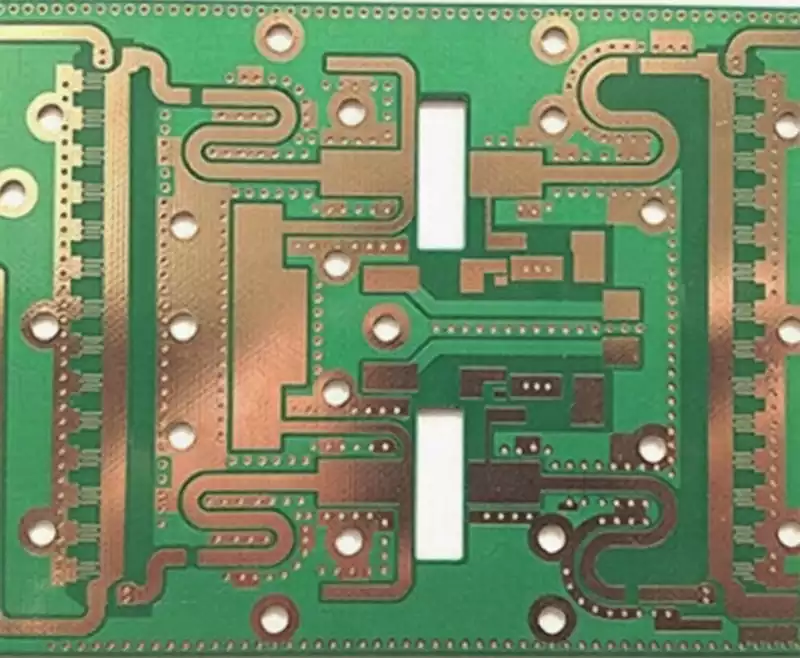
Comparison of Common high frequency PCB Materials
RO4000 Series (Typical Grade: RO4350B)
The RO4000 series is a glass-fibre-reinforced composite material developed by Rogers Corporation, designed to bridge the performance and cost gap between traditional FR-4 and high-end PTFE. It offers a balance of performance and cost-effectiveness and is currently one of the most widely used materials in mid-to-high-frequency applications.
Key Performance Characteristics: Dk approximately 3.48±0.05, with minimal variation within the 1–10 GHz range; Df approximately 0.0037 (at 10 GHz), significantly lower than standard FR-4 (Df approximately 0.02); Tg approximately 280°C, with a long-term operating temperature of 140°C; mechanical properties are similar to FR-4, offering good processing compatibility.
Suitable Applications: Mid-to-high frequency applications (1–10 GHz), such as short-to-medium range wireless communications, 5G base station antennas, GPS modules and microwave modules. It is particularly suitable for projects with specific performance requirements but limited budgets, where ease of processing is a priority.
Advantages and disadvantages: Relatively low cost (unit price approx. 800–1,200 RMB/m², which is 8–10 times that of FR-4 but lower than PTFE), easy to process, stable dielectric properties, and outstanding value for money; however, in ultra-high-frequency (above 10 GHz) scenarios, loss remains slightly high, making it difficult to meet the extremely demanding requirements of 6G terahertz and high-end millimetre-wave radar. Furthermore, the RO4835 variant in the same series features a Df as low as 0.0031, which is 15% lower than that of the RO4350B, making it suitable for medium-to-high-frequency applications where loss sensitivity is critical.
PTFE Materials (Polytetrafluoroethylene, typically known as Teflon)
PTFE is a recognised high-end, high frequency PCB material. Thanks to its extremely low loss factor and excellent dielectric stability, it is widely used in ultra-high-frequency applications such as microwave, millimetre-wave and radar systems, serving as the core substrate for high-end specialised electronic equipment.
Core performance: Dk is approximately 2.1 ± 0.02, with virtually no fluctuation across a wide frequency band; Df typically ranges from 0.001 to 0.002 (at 10 GHz), with high-end models such as Rogers RT/Duroid 5880 as low as 0.0009, and loss increases slowly with rising frequency (remaining stable within 0.0015 at 500 GHz); Operating temperature range: -55°C to +260°C, with excellent chemical resistance; pure PTFE is soft in texture and requires reinforcement with glass fibre or boron nitride nanosheets; once reinforced, flexural strength can be increased by over 140%.
Applications: Ultra-high-frequency applications above 10 GHz, such as satellite communications, millimetre-wave radar, 6G terahertz equipment and high-end microwave circuits; particularly suitable for high-end projects with extremely stringent signal quality requirements and harsh operating environments.
Advantages and disadvantages: Extremely low signal loss, excellent dielectric stability, and resistance to high and low temperatures and corrosion, capable of meeting the stringent demands of ultra-high-frequency applications; however, the material is expensive and difficult to process, requiring specialised techniques such as laser drilling and plasma etching. Processing yields are relatively low, resulting in high overall costs, making it suitable only for high-end specialised fields and unsuitable for cost-sensitive projects.
There is no absolute superiority or inferiority in the selection of high frequency PCB materials; the key lies in matching actual requirements. For medium-to-high-frequency applications, the cost-effective and easy-to-process RO4000 series is the preferred choice; for ultra-high-frequency or extreme environments, one must accept the high cost and complex processing involved with PTFE materials.