Flexible PCB technology has become increasingly important as modern electronic devices continue to evolve toward higher frequencies, faster data transmission, and more compact designs. Compared with conventional rigid PCBs, flexible printed circuits offer superior signal integrity, mechanical flexibility, and reliability, making them an ideal choice for high-frequency applications. This article explores the key material characteristics that enable Flexible PCBs to deliver outstanding high-frequency performance.
Flexible Polymer Substrates Ensure Structural Consistency for High-Frequency Signal Transmission
High-frequency circuits demand exceptional uniformity in PCB thickness and surface flatness. Compared with low-frequency signals, high-frequency signals are much more sensitive to variations in substrate thickness, structural deformation, and surface irregularities, all of which can lead to signal attenuation, phase deviation, and transmission distortion.
To meet these stringent requirements, flexible PCBs utilize high-performance polymer films as their base material rather than the rigid glass fiber laminates commonly used in conventional PCBs.
These advanced polymer films provide excellent thickness control, superior flatness, and highly uniform flexibility, enabling the fabrication of ultra-thin and dimensionally stable circuit substrates. This minimizes signal degradation caused by thickness variations or localized surface irregularities.
In addition, flexible polymer substrates exhibit outstanding mechanical stability. Even during repeated bending, folding, or compact assembly processes, the circuit layers maintain their structural integrity without cracking or deformation. This consistent mechanical performance provides a reliable foundation for stable high-frequency signal transmission and is one of the key reasons why FPCs excel in demanding high-frequency applications.
Rolled Copper Foil Minimizes High-Frequency Conduction Loss
The conductor material is another critical factor that differentiates flexible PCBs from traditional rigid boards in high-frequency environments.
The copper foil used in FPC manufacturing differs substantially from that used in standard rigid PCBs. To satisfy the requirements of low-loss signal transmission, flexible PCBs typically employ rolled annealed (RA) copper foil, which is produced by repeatedly rolling, elongating, and annealing large copper ingots. This manufacturing process refines the internal grain structure and produces larger, more uniform copper grains.
During high-frequency signal transmission, the smoother grain structure and lower conductor resistance of RA copper foil help reduce losses associated with the skin effect, resulting in lower insertion loss and improved signal transmission efficiency.
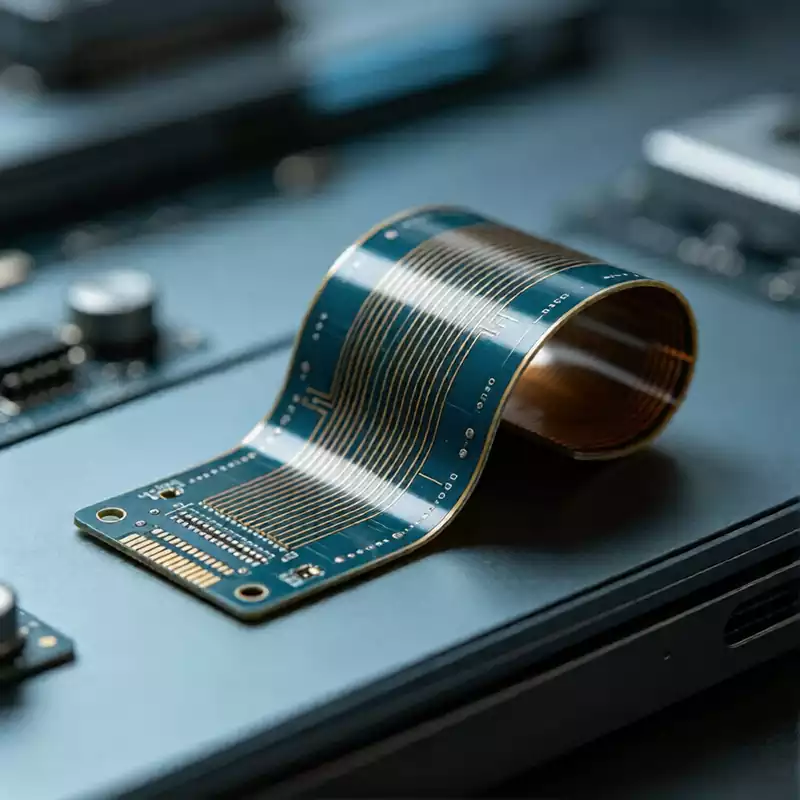
The bonding method also differs significantly from that of conventional rigid PCBs. Rigid PCBs generally rely on laminated copper bonded to fiberglass substrates, which provides excellent rigidity but offers limited flexibility under repeated mechanical stress. In contrast, flexible PCBs bond the copper foil to the polymer substrate using specially formulated adhesive systems or adhesive-less lamination technologies, creating a highly flexible conductor structure.
This construction allows the circuit to withstand continuous bending and dynamic mechanical movement without conductor cracking or delamination, ensuring long-term electrical reliability in high-frequency electronic equipment.
High-Performance Dielectric Materials Improve Electrical Insulation and Signal Integrity
The dielectric layer plays a vital role in providing electrical insulation and maintaining stable signal transmission. Its dielectric constant (Dk), dielectric loss (Df), and insulation properties directly influence the performance of high-frequency circuits.
Flexible PCBs utilize composite dielectric materials consisting of high-performance insulating resins combined with ceramic fillers. This material system delivers excellent electrical insulation, strong bonding strength, and outstanding high-frequency performance.
The ceramic fillers improve adhesion between the dielectric layer and the copper conductors while minimizing the risk of layer separation or void formation, thereby enhancing the overall structural integrity of the circuit.
Modern flexible PCBs primarily employ epoxy-based or acrylic adhesive-based dielectric systems. Both material systems can maintain stable electrical characteristics at frequencies above 1 GHz, providing consistent dielectric properties and uniform dielectric thickness.
Stable dielectric performance helps suppress signal crosstalk, reduce electromagnetic interference (EMI), and minimize dielectric losses and phase distortion during high-frequency signal transmission. At the same time, uniform dielectric thickness ensures consistent signal propagation velocity across the circuit, significantly improving overall signal integrity. This is one of the key technological advantages that enables flexible PCBs to outperform conventional rigid PCBs in high-frequency applications.
Flexible PCB combine highly uniform polymer substrates, low-loss rolled annealed copper foil, and advanced dielectric materials to overcome many of the challenges that conventional rigid PCBs face in high-frequency environments, including excessive signal loss, electromagnetic interference, and reduced transmission stability.
As high-speed communications, RF electronics, and miniaturized electronic devices continue to evolve, the unique material characteristics and electrical performance of flexible PCBs make them an indispensable substrate technology for high-frequency circuit design. Their ability to deliver excellent signal integrity, mechanical flexibility, and long-term reliability makes FPCs a critical foundation for next-generation high-frequency electronic systems.