With the widespread adoption of 5G communications and IoT technologies, electronic devices are rapidly evolving toward higher frequency operation, placing greater demands on the dielectric properties of FPC materials. In high-frequency signal transmission, dielectric loss has become a critical bottleneck affecting signal integrity—excessive loss can lead to signal attenuation, increased heating, and even device instability.
Dielectric Loss in High-Frequency Signals and Influencing Factors
The dielectric loss of FPC materials is mainly influenced by three core factors, which also serve as the key criteria for selecting and optimizing FPC materials. The first factor is the material’s dielectric constant (εr) and dissipation factor (tanδ), which are the primary indicators of dielectric performance. A lower dielectric constant enables faster signal propagation, while a smaller dissipation factor reduces dielectric loss, making the material more suitable for high-frequency signal transmission. For high-frequency FPC materials, the ideal dielectric constant should be below 3.0, and the dissipation factor should be less than 0.005 to effectively minimize signal attenuation.
The second factor is the purity and uniformity of the FPC material. Impurities such as metallic contaminants, moisture, or residual solvents increase the number of polar molecules, intensifying polarization vibrations and increasing dielectric loss. Inhomogeneous internal structures can also cause signal refraction and reflection during transmission, further increasing loss. Therefore, high-frequency FPC materials require extremely high purity and uniformity, achieved through precise manufacturing processes that remove impurities and ensure a stable internal structure.
The third factor involves environmental and process influences. In high-frequency applications, variations in temperature and humidity can affect the dielectric properties of FPC materials—higher temperatures accelerate molecular vibrations, increasing dielectric loss, while higher humidity introduces polar water molecules, further increasing loss. Additionally, PCB manufacturing processes such as etching, soldering, and lamination, if improperly executed, can damage the internal structure of FPC materials, degrading dielectric performance and indirectly increasing dielectric loss.
Main High-Frequency FPC Materials
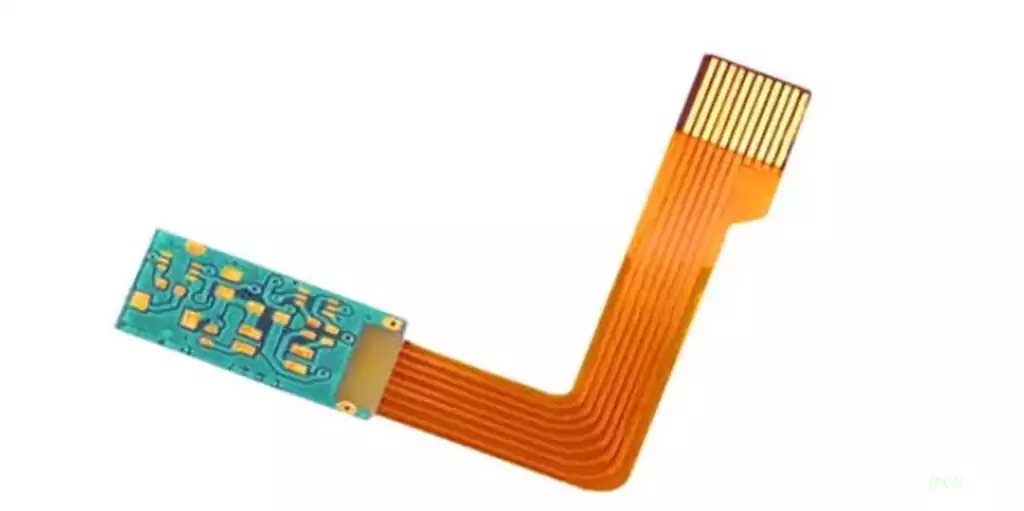
FPC materials are mainly divided into three categories: Liquid Crystal Polymer (LCP), Modified Polyimide (MPI), and Polytetrafluoroethylene (PTFE). These materials complement each other in dielectric performance and application scenarios, covering the needs of most high-frequency PCB devices.
Liquid Crystal Polymer (LCP) is currently the most widely used material in high-frequency FPC applications and is considered the “core choice” for addressing high-frequency dielectric loss. Its key advantages include excellent dielectric properties, with a dielectric constant as low as 2.9–3.1 and a dissipation factor of only 0.002–0.005. Its dielectric performance remains stable across high-frequency bands (10 GHz–100 GHz), showing minimal influence from frequency or temperature. LCP also offers excellent flexibility, high-temperature resistance, and chemical stability, allowing bending and folding for complex installation scenarios. Its extremely low moisture absorption (≤0.02%) effectively prevents increased dielectric loss caused by water, making it ideal for high-frequency applications such as 5G millimeter-wave, automotive V2X, and smart terminals.
From a PCB manufacturing perspective, LCP materials have moderate processing difficulty and can be fabricated into FPC antennas and other components using conventional etching and soldering processes. However, process precision is critical—etching must control dimensional deviations to avoid damaging the internal structure, and soldering temperatures must be carefully regulated to prevent deformation. LCP is widely used in smartphones, automotive radar, and IoT terminals, making it the preferred high-frequency FPC material that balances performance and practicality.
Modified Polyimide (MPI) serves as a cost-effective alternative to LCP. It is produced by modifying conventional polyimide (PI) to reduce the dielectric constant and dissipation factor while retaining PI’s flexibility and high-temperature resistance. MPI materials have a dielectric constant of approximately 3.2–3.5 and a dissipation factor of 0.004–0.008. Although slightly inferior to LCP in dielectric performance, MPI costs 30%–50% less and is suitable for moderate-frequency applications with budget constraints, such as mid-to-low-end 5G phones and wearable devices.
It should be noted that MPI has slightly higher moisture absorption than LCP (≤0.1%), which can increase dielectric loss in humid environments. Therefore, PCB manufacturing requires enhanced lamination and moisture-proof measures to maintain stable dielectric performance. Additionally, MPI’s high-frequency stability declines above 50 GHz, making it unsuitable for ultra-high-frequency applications.
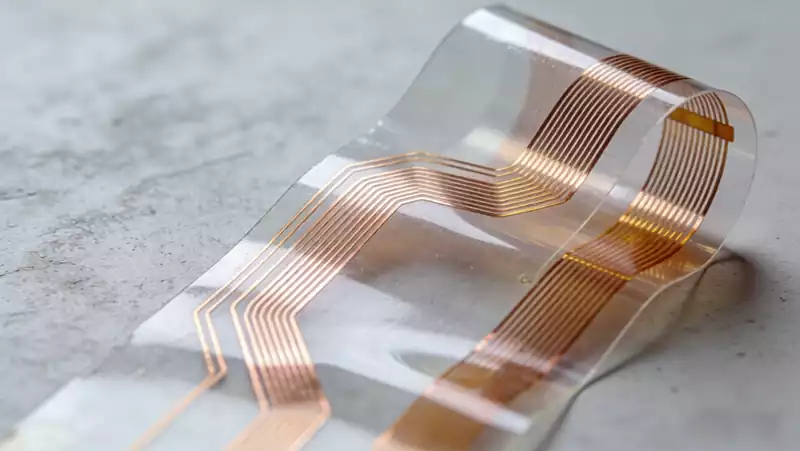
Polytetrafluoroethylene (PTFE) is the highest-performing high-frequency FPC material, with a dielectric constant as low as 2.1–2.3 and a dissipation factor of 0.001–0.003. Its dielectric properties remain stable even at ultra-high frequencies (above 100 GHz), making it the “exclusive choice” for ultra-high-frequency applications. PTFE also exhibits exceptional corrosion resistance, high-temperature tolerance, and very low moisture absorption, suitable for extreme environments, such as aerospace, high-end automotive radar, and medical high-frequency equipment.
However, PTFE has notable limitations: it is less flexible, difficult to bend or fold, challenging to process, requires advanced PCB manufacturing techniques, and is 2–3 times more expensive than LCP. Consequently, PTFE is rarely used in standard high-frequency applications and is reserved for high-end, ultra-high-frequency scenarios.
Optimization Strategies for Reducing High-Frequency Dielectric Loss in FPC Materials
Material Level: Precise selection and modification improve dielectric performance. Depending on device frequency requirements and budget, select the appropriate high-frequency FPC material—PTFE for ultra-high-frequency applications, LCP for high-frequency applications, and MPI for cost-sensitive high-frequency applications. Material modification techniques, such as adding nano-ceramic particles to LCP or hydrophobic treatments for MPI, can further reduce dielectric constant, dissipation factor, and moisture absorption, minimizing dielectric loss in humid environments.
Maintain strict control over material purity and uniformity during production by removing impurities and residual solvents. When sourcing PCBs, choose reputable manufacturers and perform material inspections to prevent low-purity or inhomogeneous materials from increasing dielectric loss.
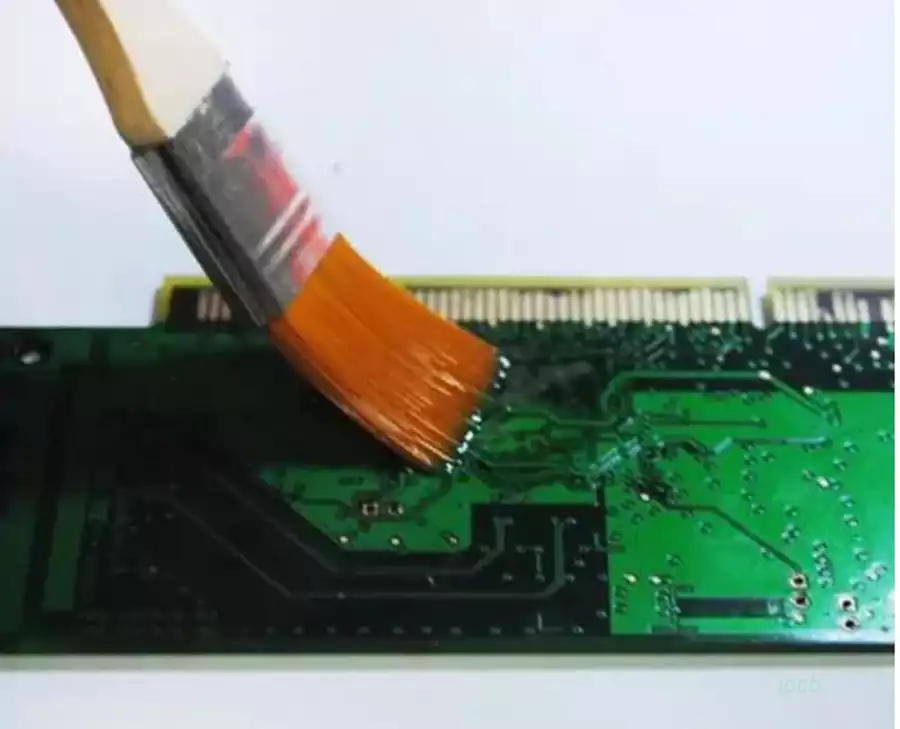
Process Level: Optimize PCB manufacturing to reduce cumulative losses. High-precision etching, controlled soldering temperatures, and low-loss protective films (e.g., polyimide) help maintain dielectric performance. Ensure proper lamination, moisture-proofing, and environmental control during storage and processing to prevent water absorption and maintain consistent dielectric properties.
Structural Design Level: Optimize FPC structure to minimize transmission loss. Designing antenna radiation units and ground planes to shorten signal paths, enlarging ground planes for better shielding, and optimizing feed point placement to reduce reflections can effectively reduce dielectric loss. Multi-layer designs that separate signal and ground layers and the use of low-loss adhesives further enhance signal quality.
With the rapid development of 5G and IoT, selecting high-frequency FPC materials, optimizing manufacturing processes, and designing efficient structures are key to ensuring signal integrity and device stability. Through careful material selection, precise manufacturing, and thoughtful design, FPC antennas and high-frequency circuits can achieve low-loss, high-performance, and reliable transmission in complex environments, providing a solid foundation for future high-frequency electronic applications.