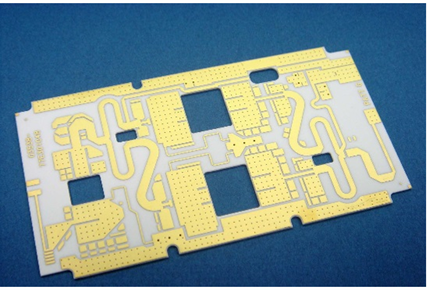
As a benchmark product in the field of specialised high-frequency substrates, the thermal stability and reliability of Rogers PCBs directly determine the performance and service life of equipment in high-end sectors such as 5G communications, automotive millimetre-wave radar and medical devices. Unlike standard FR-4 PCBs, Rogers PCBs rely on a unique material system and process design to maintain excellent electrical and mechanical properties even under extreme temperature fluctuations and complex operating conditions, making them a key consideration in the selection of high-end electronic equipment.
The thermal stability of Rogers PCBs is essentially manifested in the substrate’s ability to maintain structural integrity and stable electrical performance during temperature fluctuations, a capability rooted in specialised material systems and precise process control. Compared to standard FR-4 substrates, Rogers substrates utilise advanced composite materials such as ceramic-filled PTFE and hydrocarbon-based ceramics, thereby suppressing performance variations caused by temperature fluctuations at the source. Among these, the coefficient of thermal expansion (CTE) is a key indicator of thermal stability.
Through precise material formulation, Rogers PCBs control the X-Y axis CTE within 10–20 ppm/°C; in some high-end models, such as RO3003, this figure is as low as 8 ppm/°C. This ensures a high degree of compatibility with the thermal expansion coefficient of copper foil, significantly reducing the risk of delamination, warping, and even fracture caused by thermal stress during alternating high and low temperature cycles.
The impact of temperature on PCB electrical performance is often overlooked, yet it directly affects the operational precision of equipment. The thermal stability of Rogers PCBs is also evident in the high stability of the dielectric constant (Dk) and dielectric loss (Df) under varying temperatures. In standard FR-4 substrates, the dielectric constant exhibits significant drift as temperature rises, leading to fluctuations in signal transmission rates and increased insertion loss.
In contrast, Rogers PCBs such as RT/Duroid 5880 maintain a dielectric constant of approximately 2.2, with a low dielectric loss (Df) of 0.0009. Within the extreme temperature range of -55°C to +150°C, the deviation in dielectric constant can be controlled within ±0.05, ensuring the integrity and accuracy of high-frequency signal transmission. This advantage is particularly pronounced in 77 GHz automotive millimetre-wave radar systems, where it enables phase errors to be stabilised within 1°, detection accuracy of ±0.1 metres, and compliance with ISO 26262 functional safety certification.
In addition to the inherent advantages of the material, the thermal stability of Rogers PCBs is further supported by precision manufacturing processes. Parameter control in each process—including drilling, etching and solder mask application—directly influences the final thermal stability performance.
Due to the high hardness of the ceramic fillers in Rogers substrates, burrs are prone to form during drilling; if not properly addressed, this can lead to uneven heat dissipation and exacerbate thermal stress concentration. By using specialised diamond-coated drill bits, controlling the drilling speed to 80,000 ± 5,000 rpm, and adjusting the feed rate to 2.5 ± 0.5 mm/s, burrs can be limited to ≤0.03 mm, meeting the IPC-A-600H standard.
During the etching process, the etching rate of Rogers substrate is approximately 15% slower than that of standard FR-4. By employing a staged etching process combined with real-time online AOI inspection, line width deviation can be controlled within ±5 μm, thereby preventing localised overheating issues caused by insufficient circuit precision.
Insufficient adhesion of the solder mask can easily lead to peeling or blistering in high-temperature environments. By incorporating a plasma cleaning step, using the specialised solder mask ink recommended by Rogers, and curing at a constant temperature of 150°C for 60 minutes, the solder mask adhesion can reach 1.8 N/mm. This withstands 100 thermal cycling tests without peeling, further enhancing thermal stability.
If thermal stability is the ‘foundational quality’ of Rogers PCBs, reliability is the core guarantee of their ‘long-term performance’ in practical applications. The reliability of Rogers PCBs is demonstrated by their resistance to interference, ageing and wear in complex environments, spanning the entire lifecycle of equipment from production and installation through to use. This advantage stems from the synergy between material properties and comprehensive quality control throughout the entire process.
Low moisture absorption is a key indicator of Rogers PCB reliability. Most Rogers base materials have a water absorption rate of less than 0.02%, far lower than the 0.15% typical of standard FR-4. Even in high-humidity environments, this prevents the deterioration of dielectric properties and reduction in insulation resistance caused by moisture absorption, making them suitable for humid environments such as medical equipment and marine exploration. For example, a PCB for a medical radiofrequency ablation device using RO4360G2 substrate exhibited an impedance deviation of only 1.5% after undergoing 1,000 alcohol disinfection cycles, meeting the IEC 61249 halogen-free standard and medical safety requirements.
In terms of reliability testing, Rogers PCBs consistently outperform industry standards, which is key to their widespread use in high-end applications. In thermal shock testing, in accordance with the IPC 6012 standard, after 500 cycles between -55°C (30 min) and 125°C (30 min), Rogers PCBs exhibited no warping (≤0.5%) and no copper plating delamination, far exceeding the standard of 200 cycles for ordinary PCBs.
In salt spray testing, conducted in accordance with the IEC 60068-2-11 standard, the PCB was immersed in a 5% NaCl solution at 35°C for 96 hours. It showed no corrosion or delamination, with an impedance variation of ≤3%, meeting the long-term operational requirements for outdoor 5G base stations. Vibration testing complies with the ISO 16750-3 automotive standard.
Under conditions of 10–2000 Hz and 20 g acceleration, components did not detach and impedance variation was ≤2%, making it suitable for the harsh environments of automotive electronics. A certain operator utilised AAU RF PCBs made from Rogers 5880 substrate; after two years of outdoor deployment, the failure rate was only 0.3%, far below the industry average of 2%, fully demonstrating its exceptional reliability.
The reliability of Rogers PCBs is also reflected in the long-term stability of their electrical performance. In high-frequency, high-power applications, the insertion loss and return loss of a PCB directly impact equipment operational efficiency and signal quality. Thanks to its extremely low dielectric loss, Rogers PCBs achieve insertion loss ≤ 0.3 dB/cm and return loss ≤ -20 dB at the 26 GHz frequency band, with signal reflection ≤ 1%, and no significant increase in loss values during long-term use. A certain automotive manufacturer utilised millimetre-wave radar PCBs based on Rogers 5800 substrate, achieving a detection range of 250 metres.
Under extreme temperatures ranging from -30°C to 120°C, transmission loss over a 5 cm distance was merely 0.5 dB, with performance degradation remaining below 5% even after prolonged use, ensuring the long-term stable operation of the radar system. Furthermore, Rogers PCBs offer extremely high impedance control precision, maintaining accuracy within ±3% for 5G and automotive applications and within ±2% for medical applications. This effectively prevents signal reflection and distortion caused by impedance deviations, thereby further enhancing equipment reliability.
As the PCB manufacturing industry advances towards high-end and precision applications, the thermal stability and reliability of Rogers PCBs represent not only a core competitive advantage distinguishing them from standard PCBs, but also form a vital foundation for the upgrading of high-end electronic equipment. From 5G signal coverage to automotive safety systems, and the precise operation of medical devices, Rogers PCBs are playing an irreplaceable role across multiple high-end sectors.
For PCB manufacturers, gaining a thorough understanding of the thermal stability and reliability characteristics of Rogers PCBs, optimising manufacturing processes, and precisely matching them to specific application scenarios will help better meet market demands and enhance core competitiveness. For end-device manufacturers, fully understanding the performance advantages of Rogers PCBs and selecting them scientifically will enable the creation of more stable and durable high-end products, thereby enhancing product value.
In the future, with the continued development of 5G, automotive intelligence and medical electronics, the demands on PCB thermal stability and reliability will continue to rise. Rogers PCB will continue to advance the iteration of material formulations and manufacturing processes, further optimising key metrics such as the coefficient of thermal expansion and dielectric properties.
At the same time, the PCB manufacturing industry will overcome the processing challenges associated with Rogers PCB through technological innovation, thereby improving product yield and quality. This will enable the advantages of Rogers PCB in terms of thermal stability and reliability to be fully realised, laying a solid foundation for the sustained development of the high-end electronics industry.