The extended service life of RO4835 at high temperatures stems from the systematic synergy between its material formulation, structural design and process optimisation. In harsh high-temperature environments such as outdoor base stations, automotive engine compartments and industrial equipment, standard high-frequency substrates are highly susceptible to oxidation, embrittlement and performance drift. As a core product of the Rogers RO4000 series, RO4835, with its multi-dimensional advantages, has become the ideal choice for high-end PCB manufacturers.
As a specialised ceramic-filled hydrocarbon substrate, ‘high-temperature stability’ has been a core objective for RO4835 since its inception. In particular, the enhancement of its oxidation resistance forms the key foundation for its extended service life. It eschews conventional epoxy resin and glass fibre systems, which are prone to oxidation and ageing, opting instead for a specialised hydrocarbon resin matrix combined with high-purity ceramic fillers. This creates a stable molecular structure that suppresses performance degradation caused by high temperature oxidation at its source.
The specialised hydrocarbon resin is the cornerstone of RO4835’s high-temperature resistance. This resin possesses a robust, oxidation-resistant cross-linked structure, with inter-molecular bonding strength far exceeding that of traditional resins. Within a wide temperature range of -50°C to 250°C, its molecular chains remain stable and are resistant to breakage or oxidative degradation. According to official data from Rogers, the oxidation resistance of RO4835 is more than ten times that of typical thermosetting microwave materials, which is a key reason why its service life in high-temperature environments far exceeds that of ordinary substrates.
The incorporation of high-purity ceramic fillers further enhances the material’s stability. Production experience demonstrates that the purity and particle size uniformity of the fillers directly influence the substrate’s coefficient of thermal expansion (CTE). The ceramic fillers selected for RO4835 undergo rigorous screening, ensuring that the in-plane CTE is controlled at approximately 10 ppm/°C, whilst the Z-axis CTE is approximately 31 ppm/°C.
These values are highly compatible with the thermal expansion characteristics of copper foil, effectively preventing issues such as interface delamination and solder joint cracking caused by differences in thermal expansion and contraction between the substrate and the copper foil at high temperatures—these are precisely the primary causes of high-temperature failure in conventional substrates, and represent the key details behind RO4835’s extended service life.
Furthermore, the moisture absorption rate of RO4835 is only 0.05%, significantly lower than that of standard high-frequency substrates. High-temperature environments are often accompanied by high humidity; once the substrate absorbs moisture, it tends to accelerate oxidation reactions, thereby reducing electrical performance and mechanical strength. Its extremely low moisture absorption rate enables it to effectively block moisture ingress, maintaining stability even in harsh high-temperature and high-humidity environments.
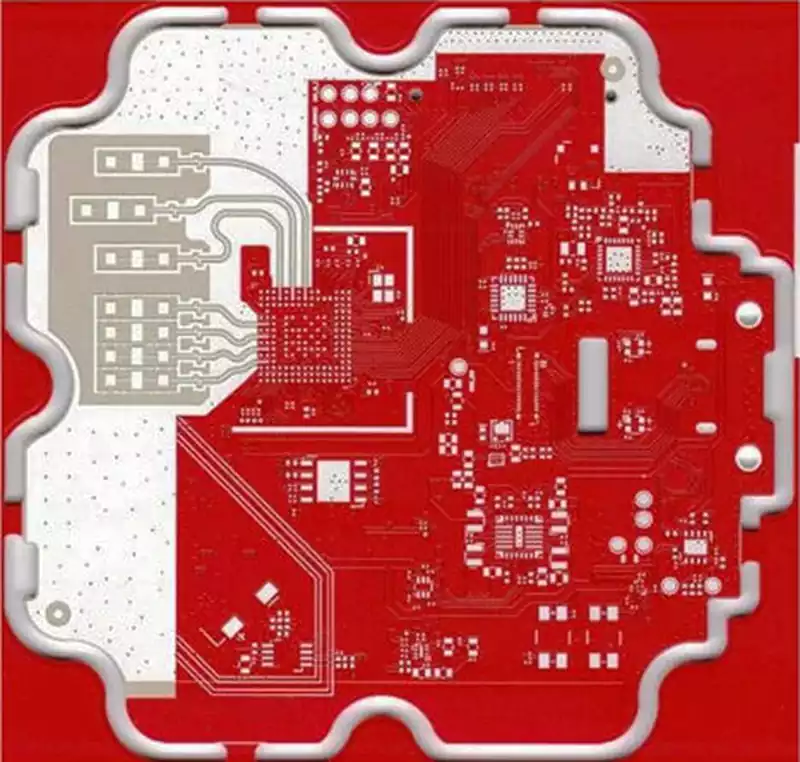
The surface of the RO4835 substrate undergoes a special passivation treatment, forming a dense anti-oxidation protective layer that acts as a ‘barrier’. This effectively isolates the substrate from oxygen, moisture, salt spray and corrosive gases in the air, preventing oxidation reactions from occurring on the surface and within the substrate. We have conducted accelerated ageing tests: under the harsh ‘double 85’ conditions of 85°C and 85% humidity, RO4835 operated continuously for 1,000 hours, with a dielectric constant fluctuation of only ±0.02 and a dielectric loss tangent remaining stable within 0.0037, showing virtually no performance drift. This performance is particularly critical in actual outdoor base station applications.
In terms of manufacturing processes, RO4835 is equally well-suited to the practical production requirements of the PCB industry. It utilises RoHS-compliant flame-retardant technology, achieving a UL 94 V-0 flame-retardant rating, which not only enhances safety but also indirectly improves high-temperature resistance. More importantly, it is compatible with standard FR-4 circuit board processing techniques; no special via pre-treatment is required, allowing it to be processed directly using automated systems and in conjunction with copper foil surface grinding.
This offers significant advantages in mass production, helping to reduce dust generation, improve via wall quality, and prevent high-temperature failures caused by processing defects. In actual production, processing defects are often the ‘silent killers’ leading to premature ageing of the substrate. The process compatibility of RO4835 not only reduces processing costs and improves yield rates but also indirectly extends its own service life.
In terms of electrical performance, RO4835 offers the advantages of a low dielectric constant (typically 3.48±0.05 at 10 GHz) and a low dielectric loss tangent (0.0037 at 10 GHz), whilst its temperature coefficient of dielectric constant is only +50 ppm/°C, ensuring stability across a wide temperature range and frequency band. In high-temperature environments, the dielectric properties of standard substrates often drift significantly, leading to increased signal transmission loss and phase shift, which in turn affects the normal operation of PCBs.
The stable electrical performance of RO4835 ensures the reliable transmission of high-frequency signals at high temperatures, reducing equipment failures and indirectly extending service life. Furthermore, it possesses excellent CAF resistance (resistance to ion migration), preventing circuit short-circuits caused by ion migration in high-temperature and high-humidity environments—which is a key reason why we prioritise RO4835 for applications such as outdoor base stations and automotive electronics.
In terms of mechanical properties, the RO4835 has a tensile modulus of 7780 MPa, a flexural strength of 186 MPa, and a peel strength that remains above 0.88 N/mm even after tin plating. High temperatures can easily lead to a decline in the substrate’s mechanical strength, embrittlement, or even fracture; however, thanks to its superior mechanical properties, the RO4835 retains excellent toughness and strength even at high temperatures.
In production practice, we have found that RO4835 exhibits excellent dimensional stability; after etching, dimensional changes at 150°C are less than 0.5 mm/m. This effectively prevents dimensional deformation at high temperatures, ensuring the precision of PCB circuit patterns and reducing faults caused by circuit misalignment.
In terms of environmental resistance, RO4835 not only withstands high-temperature oxidation but also resists erosion from harsh environments such as salt spray and ultraviolet (UV) radiation. Following salt spray corrosion and UV ageing tests, the substrate surface showed no signs of oxidation or dimensional deformation, with mechanical property retention exceeding 95%, fully meeting the long-term usage requirements of outdoor and automotive electronics applications.
In the automotive electronics sector, automotive radar and electronic modules within the engine compartment are constantly exposed to high-temperature environments exceeding 80°C. Conventional substrates often experience performance degradation or even failure due to ageing within 1–2 years. In contrast, PCBs utilising the RO4835 substrate can achieve a service life of over 10 years, significantly reducing the operational and maintenance costs of automotive electronics.
In the field of 5G millimetre-wave base stations, these are frequently deployed in outdoor locations such as building rooftops and masts, where they are continuously exposed to harsh conditions including high temperatures, UV radiation and salt spray. RO4835’s exceptional oxidation resistance and high-temperature tolerance ensure the stable operation of base station RF units, meeting the requirement for an ultra-long service life of over 10 years.
In the industrial equipment sector, devices such as high-frequency power amplifiers and industrial control modules operate continuously for extended periods, generating high internal temperatures, which places extremely high demands on the high-temperature resistance of PCB substrates. Thanks to its stable performance and long service life,RO4835 effectively reduces equipment failure rates and enhances the stability of industrial production.
Overall, the long service life of RO4835 under high-temperature conditions is the result of the combined effects of material formulation, structural design, process optimisation and performance synergy. It not only addresses the industry-wide challenge of short substrate lifespan in high-frequency, high-temperature environments, but also provides a reliable direction for the research, development and production of high-end PCB substrates.