In the AI computing hardware ecosystem, PCB boards serve as the cornerstone connecting chips to clusters. Whether it’s training large models with hundreds of billions of parameters or performing millisecond-level edge inference, these precision circuit boards are indispensable. The following is an overview of the main types of AI PCB boards in this field:
Core Substrates for AI Training Clusters
AI training clusters are the absolute core of large-model pre-training and scientific computing, placing extreme demands on PCB layer count, materials, signal transmission, and thermal management capabilities. This represents the pinnacle of high-end PCB board technology applications.
GPU Accelerator Card Motherboards (20–40-Layer High-End High-Speed PCB boards)
Serving as the hardware foundation for independent GPU computing power, this motherboard is vertically mounted onto the CPU control board, providing a stable platform for high-performance GPUs, HBM memory, and power supply modules. It integrates ultra-high-speed interfaces such as PCIe 5.0 and NVLink to achieve single-channel signal transmission speeds exceeding 112 Gbps. Through precise impedance control and signal optimization, it ensures long-term stability under trillions of floating-point operations, eliminating fluctuations in computing power.
UBB GPU Backplane (30–78-layer ultra-high-layer PCB board)
This serves as the interconnect hub for GPU clusters and the “backbone” of high-density training servers. It can simultaneously support and interconnect 8 to 16 GPU accelerator cards, achieving ultra-low-latency data exchange at 600 GB/s via protocols such as NVLink and CXL. The ultra-high-layer design meets high-density wiring requirements, completely breaking through single-card computing power bottlenecks, and serves as the core for achieving multi-GPU computing power aggregation and collaborative scheduling.
High-Speed Switching Backplane (40–70-layer ultra-high-layer PCB board)
Serving as the server’s internal “high-speed data highway,” this backplane spans the entire system, integrating all high-speed signal paths for GPUs, CPUs, network cards, and storage. Equipped with high-end switching chips, it establishes data routing channels that span across boards and nodes. The use of ultra-high-layer counts and high-frequency, high-speed substrates effectively mitigates signal crosstalk and loss, significantly enhancing the system’s overall data throughput and ensuring the real-time flow of massive amounts of data.
Rack Backplane/Interconnect Backplane
Designed for ultra-node architectures such as GB200 and Rubin, this backplane is deployed at the base of AI racks and serves as the cornerstone for achieving rack-level multi-device coordination. It centrally manages the interconnection of multiple servers, switches, and power supplies within the rack, supporting seamless coordination and load balancing for 72-card NVLink clusters with massive computing power. This effectively reduces network latency and improves computing power utilization.
Power Distribution Backplane (2–3 oz Thick Copper PCB board)
Utilizing a 2–3 oz thick copper foil process, this backplane is specifically designed for continuous operation under high loads. It reliably handles ultra-high operating currents of 500–1000 A, precisely distributing 12V/48V power to core computing components. Integrated thermal vias and a metal heat sink backplane resolve heat dissipation and voltage drop issues under high current conditions, ensuring 24/7 uninterrupted and stable server operation.
General-Purpose AI Servers
Compared to dedicated training supercomputers, general-purpose servers support small-to-medium model training, business inference, and data storage, serving as the primary hardware for large-scale data center deployments and enterprise-level AI services.
CPU Motherboard (16–24-Layer Mid-to-High-Density PCB board)
As the server’s “brain board,” it houses the main CPU, memory, and control modules, centrally managing the system’s hardware resources. Through high-speed interfaces such as PCIe and CXL, it coordinates all peripherals—including GPUs, network cards, and hard drives—handling task distribution and I/O management to ensure efficient and stable operation during multi-tasking.
Hard Drive Backplane (8–12-layer multi-layer PCB board)
This is the core channel for AI data storage. It fully supports high-speed storage devices such as NVMe and SAS, providing high-speed read/write capabilities and stable power supply for massive datasets and model weights. With support for hot-swap technology, it significantly enhances data center operational efficiency and prevents storage bandwidth from becoming a bottleneck for computing power.
Fan Control Board
As the core hardware for intelligent temperature control, it is equipped with high-precision sensors that monitor the temperatures of critical components in real time and dynamically adjust fan speeds. It automatically boosts cooling during high loads to prevent throttling and reduces fan speed during low loads to minimize power consumption, balancing thermal management, stability, and cost.
AI Acceleration Module
Through a miniaturized, high-density, modular design, the AI acceleration module breaks free from the constraints of traditional PCIe card form factors, making it suitable for high-density servers and elastic computing deployments.
OAM Open Acceleration Module Board (Advanced HDI Substrate)
Utilizing advanced HDI technology, it highly integrates GPUs/NPUs and HBM memory into a compact form factor. It supports hot-swapping and horizontal scaling, allowing for flexible adjustment of computing power based on demand, significantly enhancing server scalability and hardware adaptation efficiency.
SXM GPU Carrier Board (HDI+ High-Speed Specialty Substrate)
Custom-designed for NVIDIA SXM architecture GPUs, this carrier board is the ideal companion for high-performance computing servers. Compared to traditional PCIe interfaces, it offers more than three times the data transfer bandwidth and features the NVLink full-interconnect architecture, unleashing the ultimate performance of high-end GPUs.
AI Inference Acceleration Card (Advanced HDI Substrate)
Designed specifically for lightweight cloud and edge inference. It integrates NPU and ASIC chips optimized for INT8 low-precision algorithms, delivering high-throughput, low-power inference performance. Compared to training cards, it offers lower costs and is precisely tailored for scenarios such as image recognition and speech synthesis.
High-Speed Interconnects and Optical Modules
High-speed interconnect hardware serves as the “neural network” connecting massive computing nodes, enabling ultra-low-latency, non-blocking cross-node data synchronization.
High-Speed Network Card PCB (High-Frequency, High-Speed PCB board)
Plug-in to server PCIe slots, compatible with 100G/200G/400G network card chips, and supports cluster communication protocols such as RoCEv2 and InfiniBand. Through high-frequency substrate materials and impedance matching, it ensures efficient parameter synchronization during large-scale parallel training, eliminating idle computing power caused by network latency.
CPO Optical Module Backplane (High-Frequency HDI Substrate)
This is the core carrier of CPO co-packaged optical technology, integrating silicon photonics chips and DSPs. It enables efficient electro-optical signal conversion with a single-channel data rate of up to 1.6 Tbps, significantly reducing latency and power consumption, and serves as the foundation for next-generation ultra-high-speed interconnects in data centers.
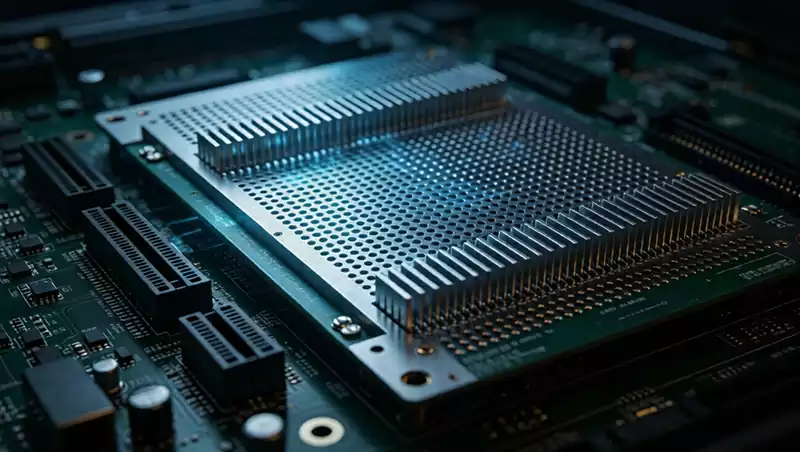
Switch Line Card PCB (Ultra-High-Layer High-Speed PCB board)
Deployed in data center core switches, this serves as the hub of the cluster network. It houses high-end switching chips and multi-channel optical modules, with a total switching capacity of up to 12.8 Tbps. It builds a non-blocking, low-latency dedicated AI network, ensuring efficient coordination across the entire network.
Edge AI
Edge AI emphasizes low power consumption, miniaturization, and real-time response, bringing computing power to the edge. It is widely used in industrial, automotive, and IoT scenarios.
Edge AI Core Board (Advanced HDI Substrate)
As the embedded core of edge computing boxes, it integrates an NPU, MCU, memory, and other components while maintaining ultra-low power consumption of 5–20W. It can independently perform local inference, reducing reliance on the cloud and minimizing latency, making it suitable for applications such as industrial vision and intelligent security.
Automotive AI Domain Control Board (Automotive-Grade HDI Substrate)
Strictly compliant with the AEC-Q100 automotive-grade standard, it features high-temperature resistance and vibration resistance. Equipped with an autonomous driving main chip, it performs real-time fusion processing of multi-source data from cameras, LiDAR, and other sensors to handle perception, decision-making, and control, serving as the core computing foundation for smart vehicles.
Smart Camera AI Board (Thin HDI Substrate)
Utilizing ultra-thin HDI technology, it is designed for compact spaces. It integrates an ISP and NPU to perform tasks such as facial recognition and anomaly detection on-device, eliminating the need to upload raw video data, thereby reducing bandwidth consumption and enhancing data security.
Advanced Packaging Substrate
The advanced packaging substrate connects the die to the PCB board, serving as the key to overcoming single-chip computing power limitations.
GPU Packaging Carrier Board (FCBGA Packaging Substrate)
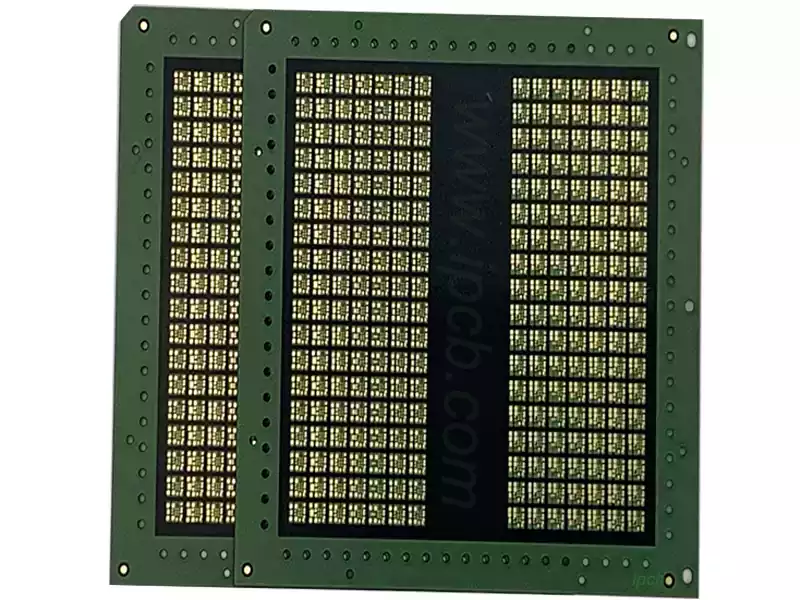
Positioned between the GPU die and the PCB board, it handles I/O fan-out, power distribution, and signal interconnects. Compatible with 2.5D/3D packaging, it meets the ultra-high pin density requirements of high-end GPUs and serves as the foundation for unleashing the performance of computing chips.
HBM Memory Substrate (Ultra-Thin High-End HDI Substrate)
Connects HBM stacked memory to the GPU carrier board, delivering an extreme bandwidth of 2TB/s. Ultra-thin, precision HDI routing meets the demanding requirements of AI training for high-speed read/write operations of massive parameters, resolving memory bandwidth bottlenecks.
Chiplet Interconnect Substrate (SLP-like Carrier Board)
Utilizing SLP-like carrier board technology, it serves as the foundation for heterogeneous integration of CPU, GPU, I/O, and other chiplets. By integrating multiple chiplets, it overcomes the design challenges and cost limitations of traditional large-scale chips, serving as the core foundational support for the next generation of AI chip iterations and upgrades.
From advanced packaging to cluster interconnects, these PCB boards collectively form the physical foundation of AI computing power, supporting every computation in large-model training, supercomputing collaboration, and edge intelligence. They are the most fundamental and core hardware carriers of the digital age.