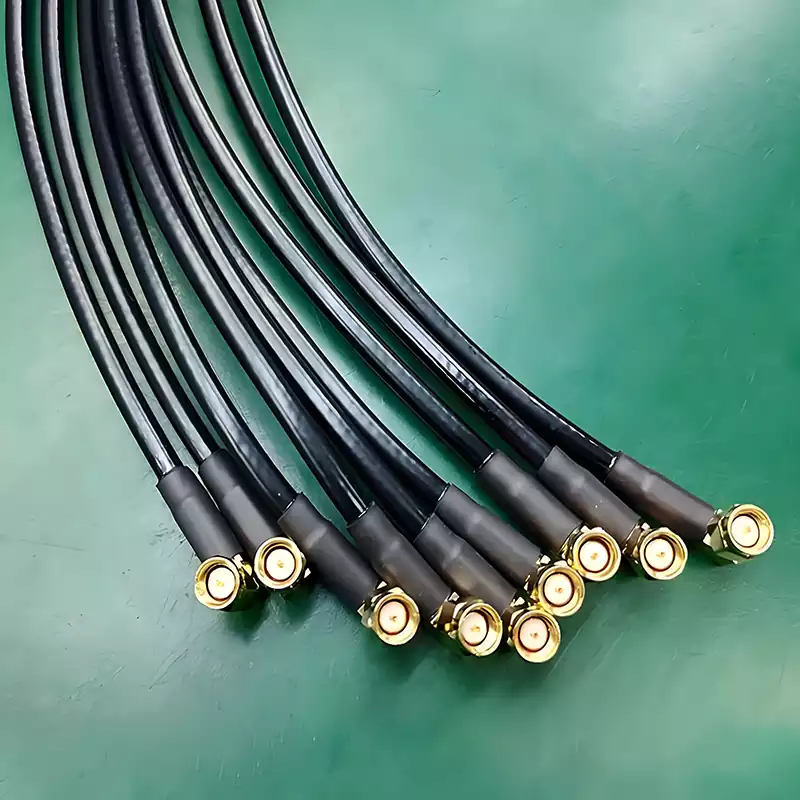
RF coaxial cable is a specialized transmission medium designed for high-frequency electromagnetic signals. Thanks to its unique coaxial layered structure, it offers key advantages such as stable impedance, excellent shielding effectiveness, low signal loss, and strong immunity to electromagnetic interference. As a result, it has become an indispensable transmission component in RF, microwave, and high-frequency communication systems.
RF Coaxial Cable Structure
1.Inner Conductor (Signal Transmission Core)
The inner conductor is the central and most critical component of a RF coaxial cable. Located at the geometric center of the cable, it serves as the primary path for high-frequency RF signal transmission.
The most commonly used material is high-purity oxygen-free copper. In applications requiring reduced weight or lower cost, copper-clad aluminum and pure aluminum conductors may also be used. Based on construction, inner conductors can be categorized as either solid conductors or stranded conductors. Solid conductors provide superior impedance stability and are ideal for fixed installations, while stranded conductors offer greater flexibility and are better suited for applications involving frequent bending and movement.
The purity of the conductor material and the uniformity of its diameter directly affect signal transmission quality. Therefore, the inner conductor must exhibit extremely low electrical resistance, excellent conductivity, and sufficient mechanical tensile strength to prevent breakage or deformation during installation and handling, ensuring continuous and reliable signal transmission.
2.Dielectric Insulation Layer (Isolation and Impedance-Control Layer)
The dielectric layer tightly surrounds the inner conductor and serves several critical functions, including electrical isolation between the inner and outer conductors, maintenance of the coaxial geometry, and control of the cable’s characteristic impedance. It is also one of the primary factors affecting signal attenuation and transmission performance.
This layer is typically manufactured from low-dielectric-constant, low-loss insulating materials such as polyethylene (PE), polytetrafluoroethylene (PTFE), and polyvinyl chloride (PVC).
Different materials are selected according to application requirements:
Polyethylene (PE): Cost-effective and low-loss, making it the preferred choice for commercial communication cables.
Polytetrafluoroethylene (PTFE): Offers excellent high-temperature resistance, extremely low high-frequency loss, and superior stability, making it suitable for military, microwave, precision testing, and other high-performance applications.
Polyvinyl Chloride (PVC): Provides good insulation and environmental protection, commonly used in lower-frequency and general-purpose applications.
The uniformity of dielectric thickness and material consistency directly determine the stability of the cable’s characteristic impedance, helping to prevent impedance discontinuities and signal reflections during high-frequency transmission.
3.Outer Conductor Shield (Electromagnetic Shielding Layer)
The outer conductor surrounds the dielectric layer and is typically constructed from a densely woven copper braid. High-performance cables may incorporate an additional metallic foil layer to form a dual-shield structure. Common materials include bare copper and tinned copper.
The outer conductor performs two essential functions:
Electromagnetic shielding: Prevents external electromagnetic interference from entering the transmission path while simultaneously minimizing RF signal radiation from the cable itself.
Signal return path: Forms the complete transmission circuit together with the inner conductor.
In practical applications, the shield should be properly grounded to maximize shielding effectiveness and minimize the impact of external noise on RF signals.
Additionally, the braided metallic structure enhances the cable’s mechanical flexibility and durability, helping it withstand compression, bending, and other mechanical stresses.
4.Outer Jacket (Environmental Protection Layer)
The outer jacket is the cable’s outermost protective layer and serves as the primary barrier against environmental damage. Common jacket materials include PVC, PE, and low-smoke halogen-free flame-retardant compounds.
Its primary functions include:
Mechanical protection against abrasion, crushing, and tensile stress
Resistance to moisture, chemicals, oils, and corrosive environments
Adaptation to indoor, outdoor, and industrial installation conditions
High-quality jackets also provide insulation, waterproofing, flame resistance, and long-term aging resistance. Low-smoke halogen-free materials are particularly suitable for data centers, rail transit systems, and enclosed environments with stringent fire safety and environmental requirements.
These protective properties help prevent RF coaxial cable deterioration, short circuits, leakage currents, and signal interruptions, ensuring long-term operational reliability.
Applications of RF Coaxial Cables
1.Wireless Communication Systems
RF coaxial cables are widely used as the primary connection medium between antennas, RF circuit boards, and communication equipment. They are responsible for transmitting and receiving RF signals in applications such as:
5G and 4G cellular base stations
Satellite communication systems
Microwave relay networks
Internet of Things (IoT) wireless devices
Their low-loss transmission characteristics help maintain signal quality over long distances while supporting high-frequency communication requirements.
2.Broadband and RF coaxial Cable Communication Networks
RF coaxial cables are extensively used in high-frequency wired transmission systems, including:
RF coaxial cable television (CATV) networks
Residential broadband access systems
Local area communication networks
Compared with conventional twisted-pair cables, RF coaxial cables provide superior high-frequency performance and greater resistance to signal attenuation and crosstalk, ensuring reliable delivery of high-definition video and high-speed data services.
3.Precision Test and Measurement Applications
RF coaxial cables play a vital role in laboratories and industrial testing environments, where they connect test instruments to devices under test.
Common applications include:
Spectrum analyzers
Vector network analyzers (VNAs)
High-speed oscilloscopes
Signal generators
These applications demand exceptional impedance consistency, low insertion loss, and stable phase performance. High-quality RF coaxial cables ensure accurate transmission of weak RF signals and contribute directly to measurement accuracy and repeatability.
4.Broadcasting and Television Transmission Systems
RF coaxial cables are widely used throughout broadcasting and television infrastructure, connecting modulators, power amplifiers, transmitters, and antennas.
Their low distortion and strong interference immunity help maintain signal clarity and transmission stability, preventing picture degradation, signal noise, and audio distortion.
Key Performance Characteristics of RF Coaxial Cables
1.Characteristic Impedance
Characteristic impedance is one of the most fundamental parameters of RF coaxial cables, connectors, and cable assemblies. Unlike DC resistance, it represents the inherent impedance presented by a transmission line to high-frequency signals.
The two most common impedance standards are:
50 Ω: Primarily used in RF communication, industrial, and wireless systems.
75 Ω: Primarily used in broadcasting and video transmission applications.
Maximum power transfer and minimum signal reflection can only be achieved when all components in the RF system share the same characteristic impedance.
When cable, connector, and equipment impedances are perfectly matched, signals propagate with minimal reflection and only experience the cable’s inherent transmission loss. Impedance mismatches result in signal reflections, power loss, waveform distortion, and potentially degraded system performance.
2.VSWR and Return Loss
Voltage Standing Wave Ratio (VSWR) and return loss are key indicators of signal reflection within a transmission system.
Manufacturing imperfections, structural inconsistencies, and impedance variations can cause signal reflections that reduce transmitted power.
VSWR is calculated from the ratio of incident voltage to reflected voltage and serves as a direct indicator of impedance uniformity and manufacturing precision.
A VSWR value approaching 1:1 indicates:
Minimal signal reflection
Excellent impedance consistency
Superior transmission performance
Conversely, higher VSWR values indicate greater reflection losses and poorer signal transmission quality.
In precision RF testing and cellular base station applications, strict VSWR requirements are often used as an important measure of RF coaxial cables quality.
3.Transmission Attenuation (Insertion Loss)
Attenuation, commonly referred to as insertion loss, measures the reduction in signal power as an RF signal travels through a cable.
Total cable loss consists of three primary components:
Conductor loss
Dielectric loss
Radiation loss
Loss characteristics are influenced by several factors:
Larger conductor diameters reduce conductor losses.
Dielectric losses increase significantly with frequency and become the dominant loss mechanism at higher frequencies.
Conductor losses increase approximately in proportion to the square root of frequency.
Elevated temperatures increase both conductor resistance and dielectric loss, resulting in greater attenuation.
The total loss of a cable assembly also includes connector losses and impedance mismatch losses. Improper installation, excessive bending, or poor connector interfaces can further increase attenuation.
When selecting a cable, engineers should evaluate the maximum operating frequency and allowable system loss while balancing performance, cable size, and installation requirements.
4.Average Power Handling Capacity
Average power handling capacity refers to the maximum RF power a cable can continuously carry under normal operating conditions.
This capability is determined primarily by the cable’s ability to dissipate heat generated by conductor and dielectric losses. It directly affects both load capacity and service life.
Actual power handling capability is influenced by several environmental factors, including:
VSWR
Ambient temperature
Installation altitude
High VSWR, elevated temperatures, and low-pressure environments at high altitudes reduce the cable’s effective power capacity and may accelerate aging, overheating, or dielectric breakdown.
For high-power RF systems, sufficient power margin should always be incorporated during cable selection.
5.Signal Propagation Velocity
The propagation velocity of RF signals inside a coaxial cable is lower than the speed of light in a vacuum and is determined by the dielectric constant of the insulating material.
Signal velocity is inversely proportional to the square root of the dielectric constant:
Lower dielectric constants result in faster signal propagation.
Lower dielectric constants generally also reduce dielectric losses.
Foamed dielectric cables typically exhibit lower dielectric constants than solid dielectric cables, resulting in higher velocity factors, lower insertion loss, and improved high-frequency performance.
These cables are commonly used in high-speed and high-frequency applications.
6.Flexure Phase Stability
Phase stability is a critical parameter in applications where cables are frequently bent or moved.
When a cable is flexed, small changes occur in the internal coaxial geometry, causing phase variations in the transmitted signal. Smaller bend radii, larger bend angles, and repeated flexing generally produce greater phase shifts.
RF coaxial cables construction significantly influences phase stability:
Low-density foamed dielectric cables typically exhibit superior phase stability compared with solid dielectric designs.
Flexible cables with stranded conductors generally offer better phase stability than solid-conductor cables.
Larger ratios of cable diameter to bend diameter result in smaller phase deviations.
Phase stability is particularly important in radar systems, precision measurement equipment, and other phase-sensitive RF applications.
With their precisely engineered layered structure and outstanding electrical performance, RF coaxial cables play an indispensable role across a wide range of applications, from wireless communications to precision measurement systems.
As high-frequency communication technologies continue to evolve, RF coaxial cables will remain a critical bridge between the physical and digital worlds, providing the reliable, high-performance signal transmission required for next-generation communication and electronic systems.