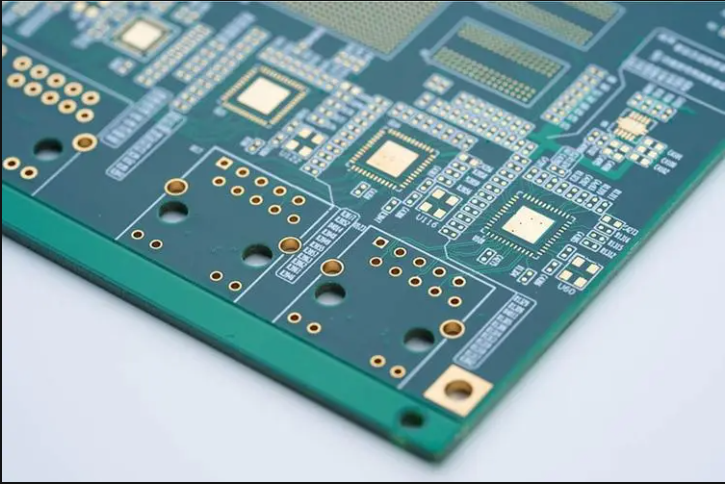
PTFE PCBs are high-frequency printed circuit boards that use polytetrafluoroethylene (PTFE, commonly known as ‘Teflon’) as the dielectric substrate. Unlike traditional FR-4 epoxy resin materials, PTFE is a fluorinated polymer with extremely low polarity in its carbon-fluorine bonds, resulting in molecular chains with virtually no dipole moment. This unique chemical structure enables its high-frequency electrical performance to significantly surpass that of traditional substrates.
The Four Key Characteristics of PTFE PCBs
1.Ultra-low dielectric loss, ensuring signal integrity
The primary challenge in high-frequency signal transmission lies in energy attenuation. The dielectric loss factor of PTFE PCBs is as low as 0.0005–0.002, which is merely 1/10 to 1/40 that of FR-4 materials. Taking a 100 mm long 50 Ω microstrip transmission line at 10 GHz as an example, the dielectric loss of FR-4 exceeds 4.0 dB, whereas that of PTFE PCBs is only approximately 0.35 dB—a difference of more than tenfold.
This performance advantage stems from the fact that PTFE molecules generate virtually no dipole relaxation loss, meaning that the proportion of signal energy converted into heat is extremely low. In long-distance, high-frequency transmission scenarios such as base station feed networks and radar signal links, PTFE PCBs can significantly reduce signal attenuation, ensuring transmission quality and system stability.
2.Stable Dielectric Constant, Enabling Precise Impedance Control
The dielectric constant of PTFE PCBs remains stable within the range of 2.0–2.6, with fluctuations of less than ±0.02 across the broad frequency band of 1–100 GHz, and temperature drift is also kept to a minimum. Compared to the Dk values of approximately 4.2–4.8 for FR-4 and their characteristic fluctuations with frequency and temperature, PTFE demonstrates a clear advantage.
A stable dielectric constant directly ensures the precision of impedance control. The realisation of characteristic impedances such as 50Ω and 75Ω in high-frequency circuits relies heavily on the precise matching of Dk with trace width and dielectric thickness. The Dk stability of PTFE PCBs enables engineers to perform impedance simulation design with greater accuracy, effectively reducing signal reflection and crosstalk. Taking 5G millimetre-wave antennas as an example, the use of PTFE substrates can control phase consistency errors to within ±2°.
3.Excellent environmental adaptability, suitable for demanding environments
PTFE PCBs possess wide-temperature adaptability, with an operating temperature range of -200°C to +260°C, far exceeding the conventional tolerance range of FR-4. With a water absorption rate of less than 0.01%, their hydrophobic properties ensure that the dielectric constant remains stable in high-humidity environments; simultaneously, they exhibit exceptional chemical inertness, withstanding corrosion from strong acids, strong alkalis and organic solvents.
These characteristics enable PTFE PCBs to maintain stable operation even in extreme environments such as satellite communications, military electronics and automotive electronics, making them the material of choice for sectors with stringent reliability requirements.
4.Wide-band compatibility, covering all high-frequency applications
PTFE PCBs maintain stable electrical performance across the 1 GHz to 100 GHz frequency band, supporting applications spanning the entire spectrum from L-band to Ka-band. Whether for 28/39 GHz millimetre-wave modules in 5G base stations, low-Earth orbit (LEO) satellite phased array antennas, or 77/79 GHz automotive radar, PTFE substrates deliver consistent low loss and high stability, meeting the design requirements of multi-band integrated systems. Traditional substrates suffer a significant decline in performance at high frequencies, making it difficult to achieve the same level of wide-band compatibility.
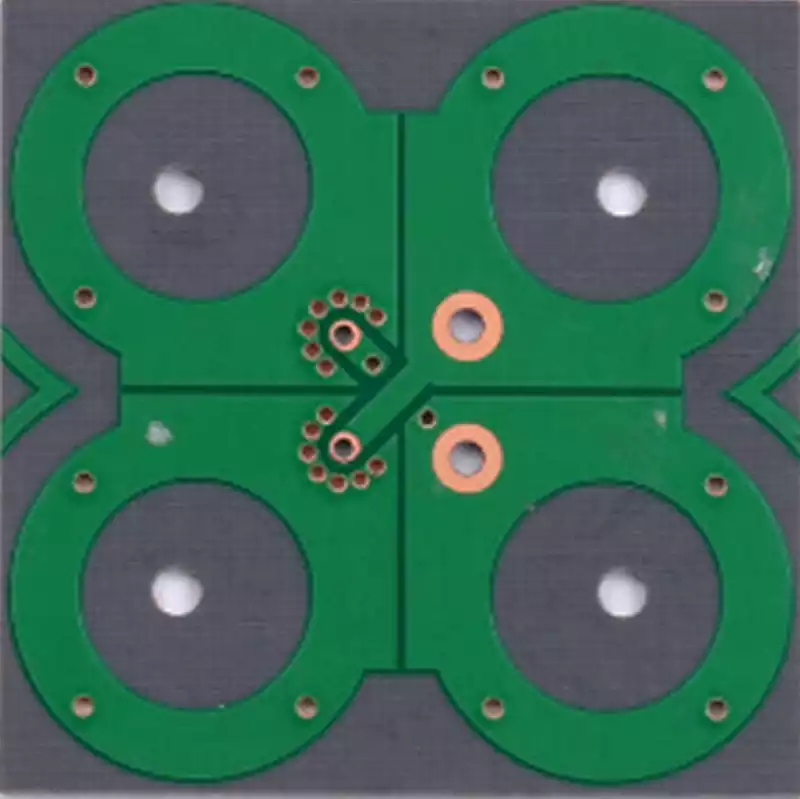
Key Differences Between PTFE PCBs and Traditional Substrates
| Key specifications | PTFE PCB | FR-4 PCB | Impact of differences |
| Dielectric constant (Dk, 10 GHz) | 2.0-2.6 | 4.2-4.8 | PTFE offers faster signal transmission and more precise impedance control |
| Dielectric loss factor (Df, 10 GHz) | 0.0005-0.002 | 0.015-0.020 | PTFE reduces signal loss by over 80%, resulting in higher link efficiency |
| Temperature range | –200°C to +260°C | –40°C to +130°C | PTFE is suitable for more extreme temperature conditions |
| Water absorption | <0.01% | 0.1-0.3% | PTFE offers more stable performance in high-humidity conditions |
| Difficulty of processing | Relatively high (requires specialised processes) | Lower (standard processes are sufficient) | PTFE requires specialised production lines to ensure processing quality, and is slightly more expensive |
Key Applications of PTFE PCBs
1.5G Millimetre-Wave Communications
In 5G millimetre-wave bands such as 28GHz and 39GHz, PTFE PCBs serve as the core material for base station antennas and RF modules. Their ultra-low loss characteristics significantly reduce system power consumption and enhance signal coverage; their stable dielectric constant ensures the gain accuracy and beam steering precision of antenna arrays, providing critical support for the large-scale commercial deployment of 5G millimetre-wave technology.
2.Satellite Communications and Aerospace Electronics
The communication and radar systems of low-Earth orbit (LEO) satellites, geostationary satellites and deep-space probes are constantly subjected to high radiation, extreme temperature fluctuations and vacuum environments. Thanks to their excellent radiation resistance, wide-temperature stability and extremely low loss, PTFE PCBs are the preferred solution for on-board antennas, phased arrays and electronic equipment, ensuring reliable signal transmission throughout the 10-year or longer service life of aerospace systems.
3.Automotive Electronics and Intelligent Driving
In core sensors for intelligent driving, such as 77GHz/79GHz millimetre-wave radars, PTFE PCBs can effectively reduce high-frequency signal transmission losses, thereby enhancing target detection accuracy and recognition rates. At the same time, their outstanding resistance to high temperatures, humidity and vibration fully meets automotive-grade reliability standards, providing hardware assurance for the stable operation of ADAS (Advanced Driver Assistance Systems) and autonomous driving functions.
4.Military Electronics and Phased Array Radar
Military phased array radar, electronic warfare and communication systems often require operation across multiple frequency bands, imposing stringent demands on signal integrity and adaptability to extreme environments. The wide-band, low-loss characteristics of PTFE PCBs help to enhance radar detection range and anti-jamming capabilities; meanwhile, their superior material stability and reliability enable them to withstand complex battlefield electromagnetic environments and harsh operating conditions, meeting the high standards required for military electronic equipment.
Thanks to its unrivalled performance, PTFE PCB has become an indispensable base material in the field of high-frequency electronic design. From the large-scale deployment of 5G millimetre-wave technology to deep-space exploration via satellite communications, and from safety perception in autonomous driving to battlefield awareness in military electronics, PTFE PCB is supporting the continuous advancement of modern electronic technology towards higher frequencies, harsher environments and more complex systems through its ever-evolving material properties.