PTFE substrates have become a key material in high-frequency, high-speed PCB applications such as 5G communications and millimetre-wave radar, owing to their extremely low dielectric constant and dielectric loss. Micro-drilling is a core step in the manufacturing process, directly affecting signal transmission performance and product reliability.
Compared to traditional FR-4 substrates, PTFE material is soft and has poor thermal conductivity; moreover, the extremely high bond energy of the C-F bonds in its molecular structure renders its surface highly chemically inert. During micro-drilling, these characteristics can easily lead to issues such as rough hole walls, drill residue, diameter deviations and broken drill bits, and may even adversely affect subsequent hole metallisation, ultimately resulting in PCB failure.
Prior to process implementation, substrate selection and pre-treatment are of paramount importance. PTFE substrates must be rigorously selected to ensure compliance with design specifications, with particular attention paid to thickness uniformity, surface flatness, and the absence of internal defects such as delamination or bubbles, to prevent substrate quality from compromising machining accuracy. For composite PTFE materials containing SiO₂ or Al₂O₃ ceramic fillers, the uniformity of filler distribution must also be verified.
Although such fillers can reduce the coefficient of thermal expansion, they simultaneously increase processing difficulty; therefore, process optimisation must be carried out in advance. During the pre-treatment stage, professional cleaning should be used to remove oil, particles and oxides, supplemented by low-temperature drying to eliminate moisture and prevent the formation of bubbles or delamination during processing. At the same time, the use of highly corrosive chemicals should be avoided to prevent damage to the substrate’s surface structure and to ensure subsequent metal adhesion.
The appropriate selection of equipment and cutting tools is directly related to machining quality. CNC drilling equipment with low spindle runout and high positioning accuracy should be selected, with positioning accuracy controlled within ±15 μm and repeatability of positioning no less than ±10 μm. For micro-holes with diameters ≤0.15 mm, UV laser drilling is recommended; its short wavelength enables high-precision machining and limits the heat-affected zone to within 20 μm, thereby reducing carbonisation of the hole walls and burr formation.
In terms of cutting tools, diamond-coated drill bits should be prioritised, as their high hardness and wear resistance effectively reduce wear and tool adhesion; if carbide drill bits are used, high-wear-resistant materials must be selected and the rake angle design optimised to accommodate the softness and springiness of PTFE. The drill bit specifications must precisely match the hole diameter, and the rake angle error should be controlled within ±0.5°.
During the machining process, the optimisation of process parameters and standardised operation are key to ensuring consistent quality. Spindle speed must be strictly controlled, generally maintained within the range of 110,000–120,000 rpm; excessively high speeds may cause material melting, whilst excessively low speeds will increase hole wall roughness.
The recommended cutting linear speed is 180–240 SFM. The feed rate should be maintained between 0.25 and 0.35 μm/rev, and must not exceed 0.4 μm/rev to prevent drill bit overload and fracture. For micro-holes of ≤0.15 mm, a step-drilling (peck drilling) method should be adopted, with the depth of cut per step controlled between 0.15 and 0.20 mm, and a retraction speed of 2,000–3,000 mm/min to ensure effective chip removal and heat dissipation.
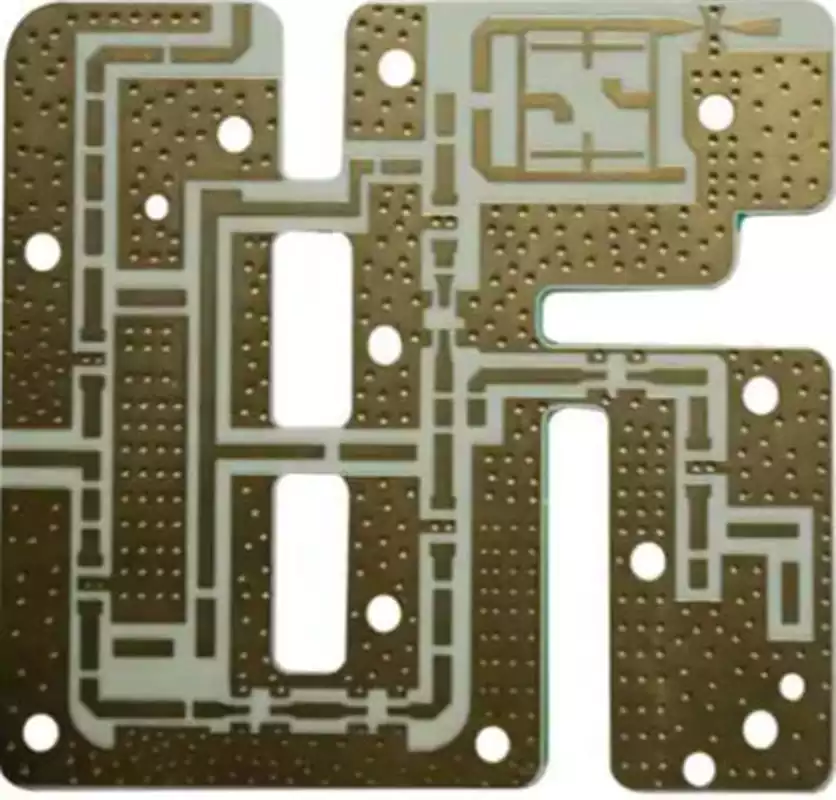
Regarding operational procedures, equipment calibration must be completed prior to machining, including checks on spindle perpendicularity, concentricity and clamping force, whilst ensuring the drill bit shows no wear or excessive runout. For PTFE substrate machining, single-piece processing is recommended to avoid heat dissipation issues and vibration caused by stacked boards. Equipment status must be monitored in real-time during machining; should drill bit wear, breakage or abnormal hole conditions (such as whitening or melting) occur, the machine must be stopped immediately for rectification. Furthermore, environmental conditions should be maintained within a range of 23±2°C and 45%–65% humidity to minimise interference from external factors.
Quality control of the bore walls must be maintained throughout the entire process. Bore wall roughness should be controlled to Ra < 1 μm, with a typical bore diameter tolerance of ±0.02 mm, whilst ensuring the absence of burrs, stringing, and molten residue. Sampling inspections can be conducted, utilising a 3D microscope to assess the condition of the hole walls and dimensional accuracy in real time. For laser processing, energy fluctuations must also be controlled within ±5% to avoid over-burning or under-processing.
Once processing is complete, the post-processing stage is equally critical. The removal of drilling residues is the primary step; as PTFE is prone to producing molten residues during processing, these insulating materials can hinder the subsequent copper plating process. Plasma treatment using O₂/CF₄ is recommended; micro-etching enhances the roughness of the hole walls and introduces polar groups, thereby improving wettability. For severe drilling residues, low-temperature sodium naphthalene treatment may be used as a supplementary measure, but reaction conditions must be strictly controlled and by-products properly managed.
This is followed by pore wall activation to enhance metal adhesion. A common method is N₂/O₂/CF₄ plasma activation, which forms a 50–100 nm modified layer and offers good controllability and environmental friendliness. Following activation, the chemical copper plating process should commence as soon as possible to prevent surface re-oxidation.
The micro-hole machining of PTFE substrates is a highly precise and systematic process. With the development of 5G and future 6G technologies, this machining will continue to evolve towards smaller hole diameters, higher precision and greater efficiency.