The stability of the dielectric constant (Dk) is central to the electromagnetic compatibility (EMC) of Rogers PCBs and represents the most significant distinction between them and standard FR-4 PCBs. Many PCB professionals encounter failed EMC tests in their projects; the root cause often lies in impedance shifts caused by fluctuations in the dielectric constant, which in turn lead to signal reflection and radiation.
The dielectric constant of standard FR-4 PCBs typically ranges between 4.2 and 4.5, with fluctuations of up to 10%–15% due to variations in frequency and temperature. In high-frequency scenarios at the GHz level, such fluctuations can cause transmission line impedance deviations to exceed permissible limits, exacerbating signal reflection and generating significant electromagnetic radiation, which interferes with the normal operation of surrounding equipment.
Rogers PCBs effectively address this issue. Their mainstream high-frequency laminates, such as RO4350B, have a Dk value of 3.48 ± 0.05, whilst RT/Duroid 5880 has a Dk as low as 2.20 ± 0.02. Across a wide frequency range from DC to 77 GHz, the Dk value remains virtually unaffected by temperature and frequency variations. This stability ensures that transmission line impedance remains consistent, reducing signal reflection losses and suppressing electromagnetic interference at source.
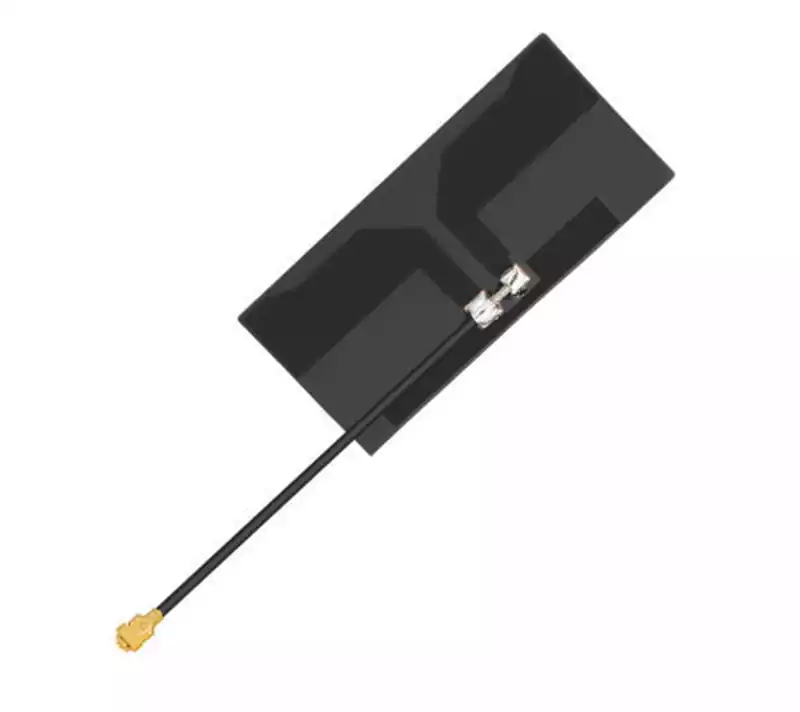
Simulation tests indicate that at a frequency of 2.45 GHz, the S11 of a microstrip antenna based on the RO4350B substrate is approximately -16 dB. Although this is slightly higher than the -30 dB achieved with FR-4 material, its gain coverage is more uniform, with a three-dimensional gain pattern exhibiting wide coverage characteristics, making it more suitable for high-end applications with stringent signal stability requirements. This is also a key demonstration of the electromagnetic compatibility of Rogers PCBs in high-frequency applications.
Ultra-low dielectric loss reduces electromagnetic radiation at source
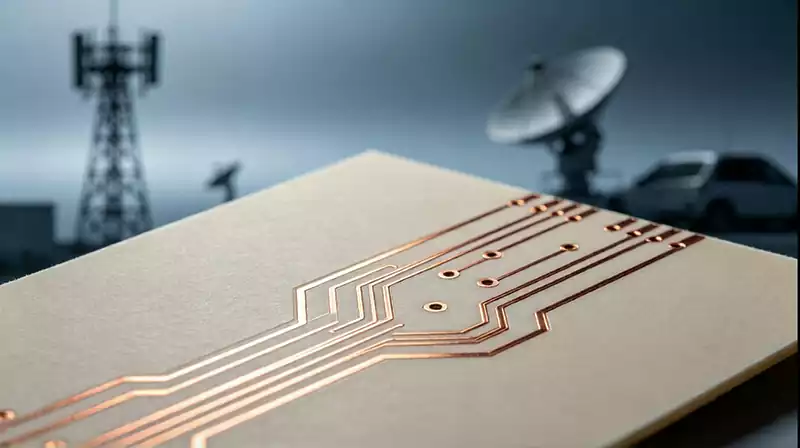
Dielectric loss (Df) directly determines the intensity of a PCB’s electromagnetic radiation; the lower the loss, the weaker the electromagnetic interference, and the better the electromagnetic compatibility of Rogers PCBs. This characteristic is particularly evident in high-frequency, high-speed signal transmission scenarios, and is a key reason why Rogers PCBs are suitable for applications such as millimetre-wave and satellite communications.
Conventional FR-4 PCBs have a Df value of approximately 0.02 at 10 GHz. During signal transmission, a significant amount of energy is converted into electromagnetic radiation, which not only causes signal attenuation but also generates strong electromagnetic interference, affecting the overall stability of the equipment. In contrast, Rogers laminates have a Df value far lower than that of FR-4, enabling them to minimise energy loss and radiation to the greatest extent possible.
Specifically, the Df value of RT/Duroid 5880 is as low as 0.0009 at 10 GHz, while that of RO4003C is 0.0027 at 10 GHz and RO4350B is 0.0037 at 10 GHz; all are significantly superior to standard FR-4 laminates. Measurement data shows that in the 77 GHz millimetre-wave band, signal attenuation in Rogers PCBs is more than 50% lower than in FR-4 PCBs, whilst electromagnetic radiation intensity is reduced by more than 30%. This ensures signal purity whilst preventing interference with surrounding equipment.
For PCB manufacturers, this ultra-low loss advantage can be achieved without the need for additional shielding layers, thereby reducing production costs and enhancing product competitiveness. This is a key manifestation of the core EMC advantages of Rogers PCBs in practical applications.
Material uniformity and environmental adaptability enhance EMC stability
Insufficient material uniformity can lead to variations in local dielectric properties within a PCB, thereby causing localised electromagnetic interference—a common shortcoming of standard FR-4 PCBs. Rogers PCBs, however, fundamentally resolve this issue through precise material formulations and manufacturing processes, whilst also offering excellent environmental adaptability, which further enhances electromagnetic compatibility.
Conventional FR-4 PCBs utilise a glass fibre woven structure, which can easily lead to localised Dk value inconsistencies—known as the ‘glass fibre effect’. In differential pair design, this can introduce asymmetry, generating common-mode noise and consequently causing electromagnetic interference. Particularly in high-frequency applications, this localised interference is amplified, leading to failure in equipment EMC testing.
Rogers laminates effectively circumvent this flaw. In particular, PTFE-based materials such as RT/Duroid 5880, which do not require glass fibre braiding, possess a uniform internal structure. This provides a consistent electrical environment for differential pairs, suppressing common-mode noise at its source. Even the RO4000 series of hydrocarbon ceramic laminates, through optimised formulations, maximises material uniformity and minimises local variations in dielectric properties.
At the same time, the low moisture absorption and high thermal stability of Rogers PCBs ensure that they maintain stable electromagnetic compatibility even in extreme environments. RT/Duroid 5880 has a moisture absorption rate of just 0.02%, enabling it to maintain stable dielectric properties in high-humidity environments; with an operating temperature range of -55°C to +280°C. During thermal cycling, fluctuations in dielectric constant and dielectric loss are minimal, preventing structural defects and degradation of EMC performance caused by temperature changes.
Comparison of Electromagnetic Compatibility Between Rogers and FR-4 PCBs
In terms of dielectric properties, the Dk value of Rogers PCBs ranges from 2.20 to 3.55, with fluctuations of only ±0.02 to ±0.05, demonstrating excellent broadband stability; the Dk value of FR-4 PCBs ranges from 4.2 to 4.5, with fluctuations of 10% to 15%, resulting in poorer stability at high frequencies. In terms of dielectric loss, the Df value of Rogers PCBs at 10 GHz is only 0.0009–0.0037, whereas that of FR-4 is approximately 0.02, representing a significant difference between the two.
Regarding material uniformity, Rogers PCBs exhibit no glass fibre effect, ensuring consistent local dielectric properties, with local impedance deviations controllable within ±3 Ω; FR-4 PCBs, due to the glass fibre weave, exhibit localised non-uniformity, with local impedance deviations often exceeding ±8Ω, making them prone to common-mode noise. In terms of high-frequency performance, Rogers PCBs have low radiated emissions and strong immunity to interference, making them suitable for frequencies of 77GHz and above; FR-4 PCBs have high radiated emissions and are susceptible to interference, and are only suitable for applications below 1GHz.
It is worth noting that in microstrip antenna tests at 2.45 GHz, the FR-4 material exhibits higher gain in the main radiation direction, whilst the Rogers RO4350B material provides more uniform coverage. This distinction makes Rogers PCBs more suitable for high-end equipment requiring high signal coverage precision, such as automotive millimetre-wave radar and satellite communication equipment.
The advantages of Rogers PCBs in terms of electromagnetic compatibility (EMC) are a comprehensive reflection of substrate properties, process compatibility and suitability for specific applications. They not only resolve the EMC challenges faced by standard PCBs in high-end applications but also offer significant practical value. For companies deeply involved in the PCB manufacturing sector, mastering the core advantages of Rogers PCBs in EMC and precisely matching the requirements of high-end applications is essential to gaining a competitive edge in the fiercely competitive market, thereby achieving product upgrades and market expansion.