A circuit board cleaner must remove contamination without attacking the PCB, component packages, connectors or protective materials. The strongest solvent is not automatically the best choice because cleaning performance depends on the type of residue, assembly structure and downstream reliability requirements.
Selecting a circuit board cleaner therefore begins with identifying what must be removed. Flux residue, fingerprints, oil, dust and ionic contamination behave differently and may require different chemistry, application methods and validation tests.
Cleaning Must Remove Contamination From the Assembly
A cleaner does not make a PCBA reliable simply because the visible surface looks clean. It must dissolve or displace the contamination and transport it away from the assembly.
If dissolved flux remains on the board after the solvent evaporates, the contamination has only been redistributed. The resulting film may be less visible than the original residue but can still interfere with test probes, conformal coating or high-impedance circuits.
A suitable circuit board cleaner must therefore perform three connected operations: dissolve the target residue, allow that residue to be flushed from the board and support complete drying. Techspray similarly describes defluxing as dissolving the residue, flushing away the dissolved material and drying the PCBA.
Identify the Contamination Before Selecting Chemistry
Flux residue is one of the most common reasons for cleaning an assembled PCB, but “flux” does not describe one universal material. Rosin, resin, organic-acid and no-clean formulations contain different activators, binders and solvents.
A circuit board cleaner that removes traditional rosin residue may perform poorly against a cured synthetic no-clean material. Increasing brush pressure or repeating the same ineffective cleaning step may spread the residue instead of removing it.
The age and thermal history of the contamination also matter. Recently formed flux is generally easier to dissolve than residue that has experienced extended heating or has remained on the assembly for several days. Reflow temperature, soldering time and manual rework can all change how the material responds to a cleaning agent.
Oil and fingerprints require a different evaluation. They may come from handling, mechanical assembly, machining or production equipment. Dust may be removed with controlled air or vacuum methods, but sticky particles attached to oil or flux require chemical cleaning.
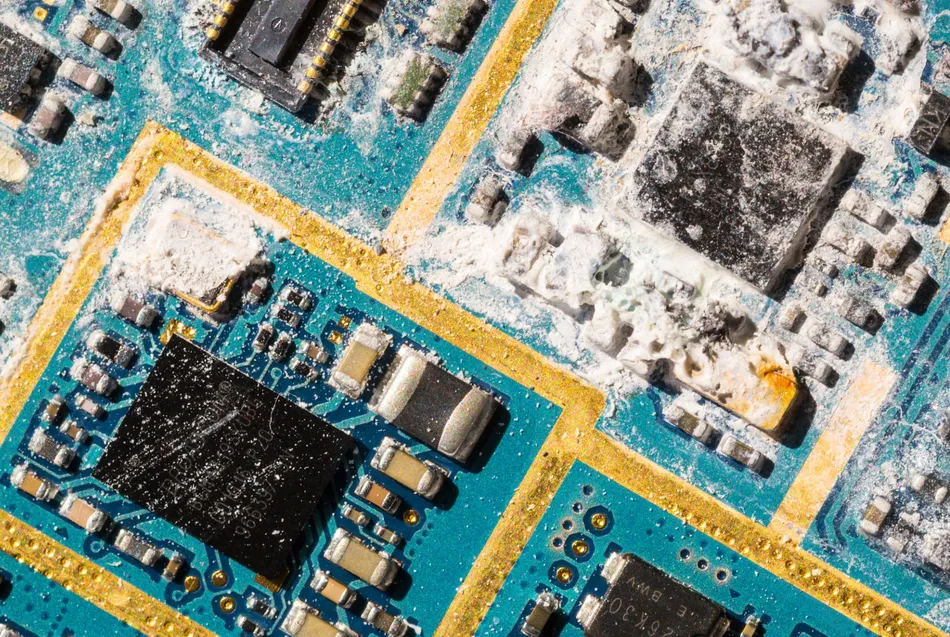
White residue should not automatically be assumed to come from the cleaner. It can result from partially dissolved flux, insufficient rinsing, incompatible chemistry or a reaction involving board materials and the cleaning process. Chemtronics notes that patchy residue can indicate incomplete cleaning, while a uniform film may indicate that the cleaner does not match the contamination.
Solvency Must Match the Flux System
The first technical question is whether the cleaner can dissolve the residue within a practical exposure time. This should be verified on the actual soldering material rather than inferred only from a generic label such as flux remover.
An effective circuit board cleaner should soften and release the residue without requiring excessive mechanical force. If the dissolved material immediately redeposits when the solvent moves, additional rinsing volume or a different delivery method may be needed.
Isopropyl alcohol is widely used for PCB cleaning, but it is not effective against every no-clean flux. It can dissolve part of a residue while leaving binders or activators behind, producing smears or white deposits after drying.
Adding more alcohol does not necessarily solve this problem. The correct response may be a purpose-formulated solvent, aqueous cleaning chemistry or a change to the assembly process. Cleaner selection should match the approved solder paste, liquid flux and rework flux used on the board.
Material Compatibility Is as Important as Cleaning Strength
A PCBA contains more than copper and solder mask. Plastics, elastomers, labels, adhesives, display materials, relay housings, switches, cables and conformal coatings may all react differently to cleaning chemistry.
Before approving a circuit board cleaner, the manufacturer should evaluate swelling, cracking, discoloration, softening, label removal and loss of adhesion. A solvent that appears safe during brief wiping may damage a component after longer exposure or repeated cleaning cycles.
Connectors and switches require particular attention because liquid may enter enclosed spaces and remain after the board surface looks dry. Microphones, speakers, cameras, sensors and unsealed electromechanical components may also require masking or exclusion from the cleaning process.
IPC-9505 provides a methodology for evaluating the compatibility of electronic components and cleaning materials using both static and dynamic exposure. This reflects the need to test not only the chemical itself but also the mechanical energy used to deliver it.
Compatibility should be assessed at the intended concentration and temperature. An aqueous cleaner that is safe when properly diluted may attack metals or finishes when used at an excessive concentration.
Low Standoff Components Create a Cleaning Problem
Modern assemblies often contain QFN, LGA, BGA and other packages with very little space between the component body and PCB. Flux can enter these gaps during soldering or rework, but a brush cannot reach the residue directly.
A circuit board cleaner may dissolve exposed contamination while leaving partially processed material underneath the package. If the board dries before the dissolved residue is flushed out, contamination can remain concentrated at the package edge.
Cleaning underneath low-standoff components depends on fluid access, residence time, flow direction and rinsing. Spray pressure alone is not sufficient if the cleaner cannot enter the gap or carry the dissolved material back out.
Board layout affects this process. Component spacing and orientation can create channels or barriers for cleaning fluid. The IPC cleaning checklist notes that component placement should allow the cleaning agent to reach the required surfaces.
Brushing Can Spread Residue
A swab or brush helps loosen localized contamination, but it does not automatically remove it. If the same contaminated brush is moved repeatedly across the PCB, dissolved flux can be transferred to previously clean areas.
When using a circuit board cleaner for manual rework, fresh solvent should carry residue away from the cleaned region. Holding the board at an appropriate angle can help the contaminated liquid drain away rather than collect beneath components.
Brush material must also be compatible with the solvent and suitable for ESD-controlled work. Excessive force can damage fine component leads, displace small passives or scratch protective surfaces.
The objective is controlled agitation followed by complete rinsing. Mechanical action supports the chemistry but cannot compensate for poor solvent compatibility.
Drying Must Include Hidden Spaces
A board surface may appear dry while liquid remains beneath components, inside connectors or around shields. Residual moisture can alter electrical measurements, promote corrosion or become trapped beneath conformal coating.
The drying process should account for cleaner volatility, board geometry, component sensitivity and production volume. Controlled airflow, time and temperature may be used, provided they remain within component and material limits.
Applying power before the circuit board cleaner has fully evaporated can cause leakage or damage. Assemblies must be electrically isolated, discharged where necessary and handled according to the product’s safety requirements before cleaning begins.
High-voltage equipment and assemblies containing large capacitors require procedures beyond ordinary PCB cleaning. The absence of external power does not guarantee that all stored energy has been removed.
Visual Cleanliness Does Not Measure Ionic Contamination
Ionic residues can absorb moisture and increase electrical leakage between conductors. Under suitable voltage and humidity conditions, they can contribute to electrochemical migration even when the board appears visually clean.
A circuit board cleaner and cleaning process should therefore be validated against the product’s actual cleanliness requirements. Visual inspection can identify residue, water spots and incomplete drying, but it cannot quantify invisible ionic material.
Available evaluation methods may include ionic extraction, ion chromatography and surface insulation resistance testing. The appropriate method depends on the product, process and reliability risk. A single cleanliness number should not be interpreted without understanding how the sample was extracted and what contamination the method can detect.
IPC-CH-65B collects guidance on cleaning printed boards and assemblies and emphasizes that cleaning decisions also involve equipment, environmental controls and worker safety.
Cleaning Must Support Conformal Coating
“No-clean” describes a flux system whose properly processed residue may be acceptable under validated conditions. It does not guarantee that every conformal coating will adhere reliably over that residue.
A circuit board cleaner may be required before coating even when the soldering process uses no-clean flux. Residue can reduce wetting, create coating separation or trap contamination beneath the protective layer.
The cleaner itself must not leave a film that interferes with coating adhesion. Cleaning, drying and coating should therefore be qualified as one connected process rather than approved independently.
Test coupons can help evaluate adhesion, coverage and environmental performance, but the actual assembly geometry must also be considered. Residue underneath low-clearance components may behave differently from residue on an open test surface.
Validate the Complete Cleaning Process
Cleaner selection should be confirmed on assemblies made with the intended PCB finish, soldering materials, components and production equipment. Testing only a bare laminate coupon does not represent the material interactions present on an assembled board.
Validation should examine cleaning effectiveness, material compatibility, hidden moisture, visible residue and the required electrical-cleanliness indicators. If the process includes conformal coating, testing should also confirm adhesion and coverage.
At iPCB, the circuit board cleaner can be evaluated together with the approved flux, rework method, drying process and cleanliness requirement. Treating these elements as one manufacturing process reduces the risk of solving a visible residue problem while creating an electrical or material-compatibility problem.
Any change in flux, cleaner, concentration, wash equipment or drying conditions should receive controlled review. A substitution with a similar product description may behave differently on the actual assembly.
Choose the Process Rather Than Only the Product
The best circuit board cleaner is the one that removes the identified contamination, reaches the necessary areas and remains compatible with every exposed material. Its performance depends on application quantity, contact time, agitation, rinsing and drying rather than the product name alone.
A reliable cleaning result requires the circuit board cleaner and the cleaning method to be validated together. When residue is physically removed, hidden spaces are dried and cleanliness is verified against the product’s operating environment, PCB cleaning becomes a controlled reliability process instead of a cosmetic step.