In FPC manufacturing, Roll-to-Roll (RTR) processing and fixture-mounted assembly represent two fundamentally different production approaches. RTR technology excels in full automation and the manufacture of ultra-thin flexible circuits, while fixture-mounted processing remains the industry’s dominant solution due to its versatility, flexibility, and cost-effectiveness.
Roll-to-Roll (RTR) Continuous Production Process
Roll-to-Roll (RTR) processing is an integrated continuous manufacturing technology specifically developed for reel-based flexible printed circuits. The concept was first introduced in the 1980s and initially adopted by leading international FPC manufacturers. However, limitations in equipment accuracy and process maturity at the time often resulted in alignment errors, material deformation, and soldering defects, preventing the technology from achieving large-scale adoption.
By the late 1990s, driven by the rapid growth of advanced applications such as TAB (Tape Automated Bonding) and COF (Chip-on-Film) packaging, RTR technology underwent multiple generations of improvement. Its advantages in continuous, highly automated production became increasingly evident, establishing it as a key manufacturing process for high-precision FPC products.
Entering the 21st century, RTR technology reached full industrial maturity. Improvements in equipment stability, process precision, and production yield enabled its widespread use in the mass production of ultra-thin and miniaturized flexible circuits.
Advantages of RTR Processing
Highly Automated and Streamlined Production
RTR manufacturing utilizes continuous reel-to-reel material transport throughout the entire process. Manual operations such as fixture mounting, alignment, loading, and unloading are eliminated, significantly reducing labor costs while improving process consistency.
Superior Surface Quality
Since the FPC remains under controlled reel tension throughout production, direct human handling is minimized. This effectively prevents cosmetic defects such as scratches, creases, warpage, and mechanical deformation.
Ideal for High-Cleanliness Manufacturing Environments
Advanced processes such as FOG bonding and NCP dispensing require extremely clean production conditions. RTR’s enclosed continuous manufacturing environment minimizes contamination from personnel and airborne particles, meeting the stringent cleanliness standards of high-end electronics manufacturing.
Excellent Supply Chain Compatibility
RTR products can be directly integrated with upstream and downstream reel-based manufacturing systems. This simplifies packaging, storage, and transportation while reducing the risk of secondary handling damage.
Suitable for Ultra-Thin High-End FPCs
RTR technology supports advanced manufacturing processes such as COF packaging and fine-pitch assembly on ultra-thin flexible circuits, addressing limitations that conventional methods struggle to overcome.
Limitations of RTR Processing
Limited Product Flexibility
RTR production lines are highly specialized and optimized exclusively for reel-based flexible circuits. They are unsuitable for single-panel, irregular-shaped, or small-format FPC products, resulting in limited application flexibility.
High Capital Investment
An RTR production line typically incorporates dedicated systems for reel handling, precision alignment, continuous assembly, and controlled thermal processing. Equipment acquisition, installation, and maintenance costs are substantially higher than those of conventional SMT lines.
Best Suited for High-Volume Manufacturing
RTR lines require lengthy setup procedures and involve relatively high product changeover costs. As a result, they are most economical for standardized products produced in very large volumes and are generally unsuitable for high-mix, low-volume manufacturing environments.
Fixture-Mounted Production Process
Fixture-mounted assembly is currently the most widely adopted FPC SMT manufacturing method. The core principle involves securing flexible circuits onto specially designed carrier fixtures and positioning tools, allowing the FPC to achieve dimensional stability, flatness, and transportability comparable to rigid PCBs.
Compared with RTR processing, fixture-mounted production offers lower investment costs, faster product changeovers, and greater flexibility, making it particularly suitable for diverse product portfolios and small-to-medium production volumes.
Critical Fixture Design Considerations
The positioning accuracy, flatness, and structural compatibility of carrier fixtures directly determine assembly quality. Fixture design is typically based on original PCB CAD data.
Key parameters such as tooling-hole coordinates, hole diameters, board thickness, and structural features are analyzed to develop high-precision fixtures and carrier plates. Accurate matching between locating pins, fixture holes, and FPC registration holes ensures micron-level alignment accuracy.
Because FPC products often feature uneven thicknesses, cutouts, stiffeners, and mixed rigid-flex structures, direct mounting onto a carrier plate can create surface irregularities that negatively affect printing and placement accuracy. To address this, carrier plates are often customized with machined pockets, relief areas, and localized surface modifications to ensure a perfectly flat mounting surface.
Common Carrier Plate Materials
Synthetic Stone Carriers
Synthetic stone carriers are easy to machine and offer short lead times, making them ideal for prototypes and low-volume production.
They exhibit low thermal conductivity, remain safe to handle during operation, and provide excellent dimensional stability under thermal cycling. Typical service life ranges from 3,000 to 7,000 production cycles. Their primary disadvantage is relatively high procurement cost, often exceeding five times that of aluminum carriers.
Aluminum Carriers
Aluminum carriers provide excellent heat transfer and temperature uniformity across the entire assembly surface, reducing soldering defects caused by thermal variations.
They offer high mechanical strength, long service life, and can often be reconditioned after minor deformation. Their major drawback is the high surface temperature reached during reflow, requiring operators to use heat-resistant gloves.
Silicone Carriers
Silicone carriers possess natural self-adhesive properties that allow FPCs to be mounted without additional tape. They offer excellent thermal resistance and leave no adhesive residue during removal.
However, silicone materials gradually lose adhesion due to thermal aging and contamination. Their service life typically ranges from 1,000 to 2,000 cycles, and their relatively high manufacturing cost limits their use to precision applications.
High-Temperature Magnetic Fixtures
Manufactured from specially treated magnetic steel capable of withstanding temperatures up to 350°C, these fixtures maintain permanent magnetic force without demagnetization or distortion.
Magnetic fixtures securely hold FPCs flat during reflow soldering, preventing board lifting and movement caused by hot-air turbulence. This significantly reduces defects such as insufficient solder joints and component misalignment. They also provide thermal shielding and can remain in service indefinitely under normal operating conditions.
Due to their complex design and high customization costs, magnetic fixtures are generally justified only in high-volume production environments.
Key Process Controls in FPC SMT Manufacturing
Incoming Material Pre-Baking
Most FPC substrates are manufactured from polyimide and other moisture-sensitive materials. During storage and transportation, they readily absorb moisture from the surrounding environment.
If moisture-laden FPCs are exposed directly to reflow soldering temperatures, rapid vapor expansion can cause blistering, delamination, and substrate separation, resulting in catastrophic product failure.
Although suppliers typically provide vacuum-sealed moisture-barrier packaging, pre-baking remains an essential quality-control measure before SMT processing.
Optimal baking parameters depend on substrate type, board thickness, stacking configuration, oven performance, and tray design. Following baking, boards must be cooled to room temperature before stencil printing to prevent solder paste slumping and printing defects caused by elevated substrate temperatures.
Solder Paste Printing
FPC assemblies generally do not require special solder paste formulations. Paste particle size and alloy composition can be selected according to component pitch and assembly requirements.
However, compared with rigid PCBs, FPCs place greater demands on printing performance. Solder pastes should exhibit excellent thixotropic behavior, release characteristics, and adhesion properties to prevent stencil clogging, paste collapse, uneven deposits, and insufficient transfer.
Because mounted FPCs cannot achieve the absolute flatness of rigid PCBs, polyurethane squeegees with a hardness of approximately 80–90 Shore are preferred over metal blades. Their flexibility accommodates minor surface variations and improves print consistency.
High-precision optical alignment systems are also essential for compensating for small positional deviations between the FPC and carrier fixture.
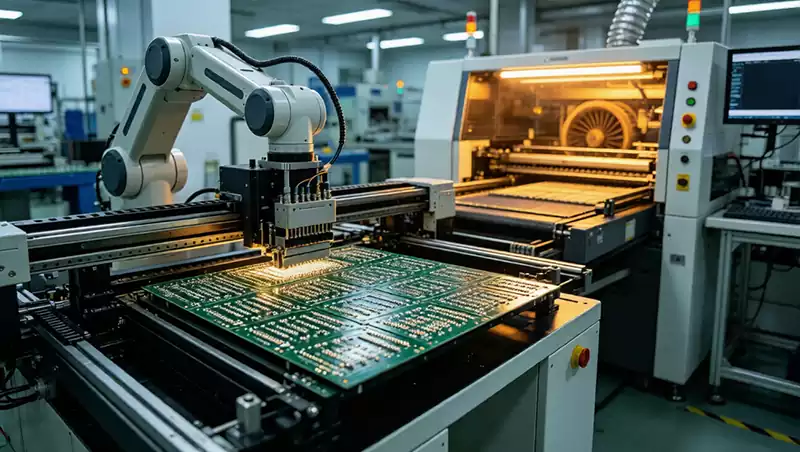
Component Placement
Once properly secured and leveled, FPC assemblies exhibit sufficient rigidity for standard SMT placement operations.
Most FPC products are compact and contain relatively few components, primarily chip devices. Large ICs and connectors typically account for a small percentage of total placements. Consequently, production efficiency and panelization optimization are often more important than placement accuracy alone.
For panelized FPCs supplied by the manufacturer, process optimization focuses primarily on maintaining throughput despite varying defect rates.
For single-piece FPCs, dedicated fixtures are used to create temporary panels. To maximize machine utilization, panel configurations are commonly designed as multiples of the placement machine’s feeder and head configuration. For example, a machine equipped with twelve placement positions may use 12-up or 24-up panel formats.
Because each individual FPC may exhibit slight positional variation, independent fiducial recognition is required for every board, which can reduce production efficiency. This is typically compensated for through software optimization and machine speed improvements.
Reflow Soldering Process Control
FPC assemblies should be soldered using forced-convection infrared reflow ovens to ensure uniform heating of both substrates and components.
When standard tape is used to secure the FPC, only the board edges are restrained. The central area may warp under high-temperature airflow, causing soldering defects due to pad movement and molten solder migration.
Reflow Profile Verification
Differences in carrier materials, board thicknesses, and component thermal masses result in varying heating rates across the assembly. Accurate thermal profiling is therefore essential.
Temperature probes are typically attached to critical solder joints using high-temperature solder wire. Test assemblies should be arranged in production-equivalent configurations with adjacent loaded carriers to simulate actual manufacturing conditions.
Temperature Profile Design
Due to the lower thermal robustness and poorer temperature uniformity of FPCs compared with rigid PCBs, a three-stage profile consisting of preheat, soak, and reflow is generally preferred.
In production, oven temperatures are usually set at the lower limit of the solder paste supplier’s recommended process window. Conveyor stability and reduced airflow settings help minimize mechanical disturbance and thermal stress on the flexible substrate.
Inspection, Testing, and Depanelization
Following reflow soldering, high-thermal-mass carriers such as aluminum fixtures may remain extremely hot. Forced-air cooling systems are therefore commonly installed at the oven exit to accelerate cooling and prevent prolonged thermal exposure.
Operators should always wear heat-resistant gloves and handle assemblies carefully to avoid tearing, creasing, or deforming the flexible circuit.
After cooling, visual inspection is performed using magnification of 5× or higher. Inspection focuses on adhesive residue, substrate discoloration, solder balls, solder contamination on gold fingers, insufficient solder joints, and bridging defects.
Because FPCs naturally exhibit slight dimensional variation and surface distortion, Automated Optical Inspection (AOI) systems often generate excessive false calls and may fail to achieve reliable inspection performance. Consequently, manual visual inspection remains the preferred method in many FPC manufacturing environments.
Following visual inspection, assemblies typically undergo ICT (In-Circuit Testing) and FCT (Functional Circuit Testing) using dedicated test fixtures to verify electrical continuity and functional performance.
Both RTR continuous reel-to-reel processing and fixture-mounted assembly have clearly defined application boundaries. Throughout the entire FPC SMT manufacturing flow—from pre-baking and solder paste printing to component placement, reflow soldering, and final inspection—process parameters must be carefully optimized around the unique characteristics of flexible substrates. Only through rigorous process control can manufacturers achieve high yields, consistent quality, and reliable product performance.