With the rapid evolution of the consumer electronics, advanced semiconductor packaging, 5G communications and intelligent driving industries, electronic products are continuously evolving towards lighter, thinner, higher-density and higher-precision designs. Consequently, the manufacturing technology for printed circuit boards (PCBs)—as the core medium—is also undergoing constant innovation and evolution. From traditional, crude forming processes to refined, optimised techniques, PCB production technology has undergone four key iterations. Among these, the modified semi-additive process (mSAP) has become the core supporting technology for high-end electronics manufacturing today, thanks to its exceptional circuit precision and mass production stability.
Three Generations of Circuit Board Manufacturing Processes
First-Generation Process: Subtractive Process
The subtractive process is the foundational technology of the PCB industry. It has been in use since the industrialisation of circuit board production and remains the mainstream process with the highest market share today. The core logic of this process is subtractive forming, and the overall operational workflow is straightforward:
First, a full copper plating is applied to the entire substrate; subsequently, a resist ink is applied to the surface of the copper layer; then, using a photolithography machine, the circuit pattern is exposed and defined, precisely outlining the required circuit pattern, and the ink in the areas not to be retained is removed; finally, the exposed excess copper is etched away using a chemical etching solution, and the remaining copper layer forms the finished circuit.
This manufacturing method is akin to engraving a solid copper plate to form the desired circuit by removing the excess copper material. Thanks to years of industrial application, the subtractive method offers distinct advantages, including a mature process system, low mass production costs, and strong compatibility with various production equipment, making it suitable for the manufacture of the vast majority of standard PCB products.
However, this process has insurmountable physical limitations, with its core shortcomings centring on precision: the photolithographic accuracy of the circuit is directly constrained by the thickness of the copper layer, and side etching occurs during the etching process, leading to loss at the edges of the lines. Under conventional processes, line widths and line spacings are difficult to reduce below 40 micrometres. Particularly in the production of high-density, ultra-fine circuits, the etching solution readily erodes the edges of precision circuits, causing deformation and uneven thickness, rendering it completely unsuitable for the production requirements of high-end, precision circuit boards.
Second-Generation Process: Fully Additive Process (FAP)
To overcome the precision bottleneck of the subtractive method, the industry has developed the Fully Additive Process (FAP), which adopts a reverse-moulding approach. Based on the core principle of additive manufacturing, it completely overturns traditional production logic. This process does not require the entire board to be pre-plated with copper; instead, copper circuits are selectively formed only in the areas of the substrate where circuits are required.
The specific production process is as follows: first, the surface of the insulating substrate is activated to impart metal-binding properties; the treated substrate is then fully immersed in an electroplating solution. Relying on the catalytic activity of the substrate surface, copper is deposited and grown only in designated areas, building up layer by layer to form a complete circuit. From a theoretical perspective, the all-additive method can achieve ultra-fine line widths of less than 10 micrometres, offering a precision advantage far surpassing that of traditional subtractive methods, and is well-suited to the production of ultra-high-density circuits.
However, this process suffers from engineering flaws that make it difficult to implement, and it has consistently failed to achieve large-scale mass production. On the one hand, it is difficult to control the uniformity of the catalytic effect between the electroplated copper layer and the substrate, resulting in an extremely low yield rate during mass production; on the other hand, the directionally grown copper circuits have weak adhesion to the substrate, making them highly prone to circuit detachment and peeling during subsequent use. Despite over thirty years of laboratory research and optimisation, this process remains unsuitable for industrial batch production and has remained confined to the experimental research stage.
Third-generation process: Semi-Additive Process (SAP)
The Semi-Additive Process (SAP) is an optimised compromise that combines the advantages of subtractive and fully additive processes, striking a balance between process precision and mass production feasibility. It represents a key transitional technology in the evolution of PCB manufacturing processes. Its core logic can be summarised as: first depositing the substrate, then forming the circuit patterns, and finally removing the substrate.
The specific process is as follows: first, an ultra-thin copper layer of 1–3 micrometres is deposited onto the surface of an insulating substrate to serve as a seed layer, replacing the thick copper substrate used in the subtractive process; subsequently, photolithographic patterning is performed on the surface of the seed layer to outline the circuit pattern; then, through an electroplating process, thickened copper is deposited only in the patterned areas to form the circuit; finally, the ultra-thin seed layer is etched away from the non-circuit areas, resulting in a precise, fine-line circuit.
To distinguish the three generations of processes in concrete terms: the subtractive method is akin to carving away excess material from a solid copper block; the fully additive method involves growing circuits directly on a blank substrate; whereas the semi-additive method first lays down an extremely thin substrate layer, then stacks the formed circuits on top of it, and finally removes the excess substrate material.
Compared to traditional subtractive methods, the core advantage of the SAP process lies in the ultra-thin seed layer, which significantly mitigates the side-etching effect, enabling the stable production of ultra-fine line widths and line spacings of 15 micrometres or even below 10 micrometres, resulting in a quantum leap in precision. However, the process still has its shortcomings: the ultra-thin seed layer increases the difficulty of initiating electroplating, copper layer filling efficiency is relatively low, and it is difficult to control the uniformity of the plating layer; early mass production yield rates were also less than ideal.
Modified Semi-Additive Process (mSAP)
mSAP (Modified Semi-Additive Process) is an advanced process that has undergone comprehensive optimisation based on the traditional SAP. Through three key improvements, it has overcome the mass production limitations of traditional processes, becoming the core mass production technology for high-end PCBs and semiconductor packaging substrates.
Firstly, optimisation of the seed layer preparation process. Abandoning the chemical copper plating seed layer approach of traditional SAP, advanced processes such as sputtering and chemical vapour deposition (CVD) are employed to prepare the seed layer. This also allows for precision thinning of ultra-thin copper foil, enabling the seed layer thickness to be controlled within 0.5–1 micrometres. Not only is the layer thinner, but overall uniformity, flatness and adhesion are significantly improved, reducing the risk of side etching at the source.
Secondly, the electroplating solution formulation has been iteratively optimised. Low-concentration, high-extensibility sulphate and aminosulphate electroplating solutions are employed, combined with a three-dimensional additive system (SPP system) comprising inhibitors, accelerators and levellers, to achieve a super-filling effect during electroplating. During the plating process, the copper selectively fills critical areas such as circuit micro-pores and deep trenches, preventing premature accumulation of the surface copper layer and the formation of internal voids, thereby completely resolving the issue of uneven filling associated with traditional methods.
Thirdly, the process tolerance window has been expanded. Traditional SAP processes impose extremely stringent requirements on photoresist thickness, exposure accuracy and plating parameters, with a very low margin for error, making mass production difficult. Through equipment upgrades and formulation optimisation, mSAP leverages the synergistic effects of horizontal plating production lines and new additives to significantly relax process control standards, making it fully suitable for stable industrial mass production.
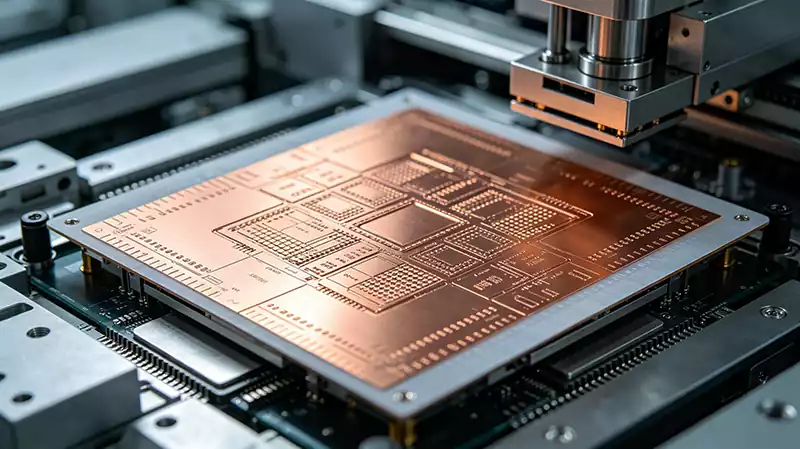
Standardised mSAP Manufacturing Process
Step 1: Substrate Selection and Preparation
The mSAP process is not suitable for the FR-4 substrates commonly used in standard PCBs; instead, high-precision insulating resin substrates are required. In the semiconductor packaging sector, the mainstream substrate is ABF insulating film, developed by Hitachi Chemical. This film uses modified epoxy resin as its core raw material, doped with silica particles, and has a thickness range of 20–100 micrometres. This material features high surface flatness, a controllable coefficient of thermal expansion and excellent insulating properties.
It also supports multi-layer lamination processes, serving as the core foundation for the fabrication of multi-layer ultra-fine circuits. In the field of high-end PCB substrate (SLP) applications, mSAP is compatible with high-end substrates such as high-Tg halogen-free copper-clad laminates and BT resin substrates.
Step 2: Preparation of the Ultra-Thin Seed Layer
The preparation of the seed layer on the substrate surface is the core of the mSAP process, directly determining circuit precision and stability. The conventional industry process involves sputtering a 0.5–1-micrometre-thick layer of nickel or copper onto the ABF substrate surface to serve as the seed base; Advanced processes first subject the substrate to plasma activation to enhance surface reactivity, followed by copper sputtering or electroless copper plating, ensuring uniform seed layer thickness and strong adhesion. Seed layer thickness must be precisely controlled; excessive thickness exacerbates side etching issues during subsequent etching, compromising circuit precision; conversely, excessive thinness leads to excessively high resistance and circuit breakage during electroplating, affecting production yield.
Step 3: Photolithographic Patterning
A negative photoresist is uniformly applied to the surface of the prepared seed layer, followed by circuit patterning via a stepper or laser direct imaging (LDI) equipment. High-end FC-BGA flip-chip packaging substrates demand extremely high circuit precision, with line widths and line spacings needing to be controlled within 8–15 micrometres. This approaches the limits of conventional PCB photolithography equipment; therefore, high-precision stepper lithography systems utilising 365 nm i-line and 248 nm KrF light sources are required to ensure the accuracy of the pattern formation.
Step 4: Selective Electrolytic Copper Plating
Electrolytic copper plating is the core process of mSAP formation. Following photolithography, directional plating is performed exclusively on the exposed circuit grooves. This is achieved using a high-acid, low-copper sulphate plating bath combined with organic additives, with the process carried out on specialised horizontal and vertical plating production lines.
Three types of additives each fulfil specific roles and work synergistically: inhibitors adsorb onto the seed layer surface in non-circuit areas, preventing unwanted copper deposition; accelerators concentrate at the bottoms of micropores and fine lines, promoting the prioritised filling of deep regions; and levellers smooth out protrusions in the plated layer, ensuring uniform overall thickness.
This system enables the copper layer to be gradually filled from the bottom of the circuit upwards, avoiding defects such as surface sealing and bottom voids. Upon completion of electroplating, the copper layer on the circuit will protrude slightly above the photoresist plane. It must therefore be levelled using a CMP (Chemical Mechanical Polishing) process to meet precision standards.
Step 5: Photoresist Stripping and Seed Layer Etching
Strong alkaline solutions, such as sodium hydroxide, are used to dissolve and remove the surface organic photoresist, exposing the excess seed layer metal on the substrate surface; subsequently, acidic etching solutions based on ammonia or ammonium persulphate are employed to precisely remove the seed copper layer from the non-circuit areas.
This step demands extremely high precision in etching control; over-etching can cause the lines to become too thin or result in open circuits, whilst under-etching can lead to short circuits between adjacent lines. It is a critical process for ensuring the yield rate of the finished circuit. Once etching is complete, the high-precision copper lines are securely bonded to the surface of the insulating substrate.
Step 6: Multi-layer Stacking and Forming
For multi-layer carrier boards with 2, 4, 6 or more layers, production can be carried out by repeatedly stacking layers on top of a single-layer circuit. The process involves sequentially completing ABF film lamination, laser drilling and metallisation, followed by a full cycle of photolithography, electroplating and etching, thereby building up the circuit structure layer by layer.
With each additional layer, the circuit density of the board increases significantly. High-end FC-BGA carrier boards can achieve 6–10-layer structures, with circuit precision consistently maintained at around 10 micrometres per layer, placing extremely high demands on process stability and mass production yield.
Core applications of the mSAP process: A critical, essential technology for the electronics industry
Smartphones: The cornerstone of slim, lightweight, high-density motherboards
Smartphones represent the most critical existing application market for the mSAP process, primarily implemented in System-in-Package (SLP) products. Starting with the iPhone X series, flagship smartphones were the first to adopt SLP-process motherboards. Building upon traditional HDI boards, this technology reduces trace widths to below 30–40 micrometres, enabling the integration of more circuits and components within the phone’s confined internal space, thereby achieving upgrades in terms of slimness and peak performance.
Currently, this process is gradually extending from flagship models to mid-range devices. The production of motherboards for all slim, high-performance smartphones relies on mSAP’s precision circuit formation technology. Put simply, the core process of SLP substrate-like boards integrates mSAP’s ultra-thin seed layer and precise electroplating filling technology with traditional HDI processes.
Advanced Packaging: The Core Infrastructure of the Chiplet Era
If smartphone motherboards represent the foundational market for mSAP, then advanced semiconductor packaging constitutes the core growth sector for this process. Chiplet technology has been a key innovation in the semiconductor industry in recent years, breaking away from the traditional single-chip integration design philosophy. It involves modularising chips with different functions, assembling them like building blocks, interconnecting them via high-speed interfaces, and then completing system integration using high-end packaging substrates.
The mass production of such high-end packaging substrates relies entirely on the mSAP process, and leading industry products have already been widely adopted. For example, NVIDIA’s H100 and H200 series AI GPUs utilise the CoWoS advanced packaging solution for their core computing chips, with the corresponding packaging substrates manufactured by foundries such as TSMC and ASE, employing the mSAP process throughout; AMD’s 3D V-Cache stacked cache technology also utilises the same packaging process and mSAP substrate.
Due to export controls on EUV lithography systems from overseas, the development of advanced process chips in China has been constrained. Consequently, chiplet modular packaging combined with advanced substrate technology has become the core pathway for the domestic semiconductor industry to break through these limitations, making companies with mSAP process capabilities a key focus for industrial investment.
5G High-Frequency PCBs: Ensuring Precision for Millimetre-Wave Communications
RF circuits operating in the 5G millimetre-wave band (24 GHz and above) impose stringent requirements on PCB substrate loss and circuit formation precision. The traditional combination of Rogers high-frequency laminates and subtractive processes cannot meet the low-loss requirements of ultra-high-frequency bands above 60 GHz.
The industry’s optimal solution currently involves high-frequency specialty laminates (PTFE, hydrocarbon resins, modified epoxy resins) combined with mSAP fine-line technology, which effectively reduces high-frequency signal loss and ensures stable signal transmission. Core components of 5G millimetre-wave base stations—such as RF switches, power amplifier modules and antenna arrays—all utilise mSAP-processed high-frequency PCBs, making this a core supporting technology for high-end 5G communication equipment.
In-vehicle millimetre-wave radar: the hardware foundation of autonomous driving
Autonomous driving systems utilise 77GHz and 79GHz millimetre-wave radar, which operate at extremely high frequencies and impose near-extreme demands on PCB dielectric loss and circuit consistency. Global leading automotive radar suppliers such as Bosch, Continental and Denso are comprehensively advancing their production process upgrades, gradually phasing out traditional PCB processes and switching to refined mSAP process solutions. This is to meet the high-precision, low-loss and high-stability operational requirements of high-end autonomous driving radars, serving as a key technological underpinning for the iteration of intelligent driving hardware.
The iterative upgrading of PCB manufacturing processes is an inevitable outcome of the industry’s move towards greater precision. Compared to traditional processes, mSAP effectively balances circuit precision with mass-production feasibility, meeting the core requirements of high-end sectors such as consumer electronics, semiconductor packaging, high-frequency communications and intelligent driving. In the future, as the integration of electronic devices continues to increase, the mSAP process will undergo continuous optimisation and iteration, becoming a key foundational process underpinning innovation and development in the high-end electronics manufacturing sector.