Following surface-mount soldering (reflow soldering), BGA devices typically undergo several post-process steps to enhance their environmental adaptability, mechanical strength and reliability. In accordance with industry practice, these primarily comprise three types of processes: conformal coating, underfill and adhesive reinforcement, and PCB depanelling. The technical requirements and key implementation points for these processes are outlined below.
Conformal Coating
Conformal coating is an insulating protective layer that conforms to the contours of the PCB board and components. Its primary purpose is to prevent damage to components caused by environmental factors such as moisture, corrosion and arcing. This process must comply with the IPC-CC-830 standard and be explicitly specified in the master assembly drawing. Where UL mandates it, the coating used must be UL-approved for use by PCB manufacturers. Designers must also consider compatibility between materials.
Conformal coating is typically applied only to surfaces or areas containing electrical conductors (see IPC-2221, Section 4.5.2). Depending on chemical type and thickness, commonly used coatings are classified into five categories:
AR (Acrylic Resin): 0.03–0.13 mm
ER (Epoxy Resin): 0.03–0.13 mm
UR (Polyurethane Resin): 0.03–0.13 mm
SR (Silicone Resin): 0.05–0.21 mm
XY (Polyphenylene Terephthalate): 0.01–0.05 mm
In actual production, silicone elastomers, polyphenylene terephthalate and other organic materials constitute the three main chemical systems. They all provide varying degrees of protection against threats such as solvents, moisture, corrosive gases and arc discharge.
Thicker coating layers can also serve as shock-absorbing damping layers to resist impact and vibration. However, in environments with low-temperature fluctuations, thick coatings may introduce mechanical stress to glass or ceramic sealing components; therefore, their use typically requires the incorporation of cushioning materials. It is particularly important to note that conformal coating materials should not be allowed to leave the underside of the BGA ‘unfilled’. Tests have shown that if standard conformal coating materials (with the exception of p-xylene) are used to completely fill the underside of a BGA, Z-axis expansion during thermal cycling can lead to solder joint fatigue failure. Therefore, conformal coating materials cannot be used as a substitute for underfill compounds.
Furthermore, conformal coating is not the same concept as sealing materials (such as encapsulants or chip-level encapsulants). Sealants are used to protect bare chips, whilst encapsulants provide external protection for BGAs. However, compatibility issues between sealing materials and thermal interface materials share similarities with those of conformal coating.
Underfill and Adhesive Reinforcement
BGA packages often require the use of adhesives to enhance the strength of the interconnection between the package and the PCB. In recent years, the widespread adoption of lead-free solder and the reduction in ball pitch have made package structures more fragile, particularly in areas subject to impact or bending. At the same time, the increasing miniaturisation of electronic products, coupled with more frequent handling and a higher risk of drops, has led the industry to demand higher levels of impact and drop resistance. These factors have collectively driven the widespread application of underfill and structural bonding technologies in electronic packaging.
Polymer reinforcement technology for BGAs has expanded from its initial applications in mobile phones, MP3 players, PDAs, cameras, medical electronics, avionics and military equipment to emerging fields such as laptop motherboards and ultra-portable mobile PCs. There remains some resistance in the desktop and server motherboard markets; however, as the strength of BGA packages continues to decline, these markets may also adopt reinforcement solutions.
There are currently three common methods of polymer reinforcement: full capillary underfill, partial capillary underfill, and corner adhesive application. Non-flowing underfill is still under development and has not yet been adopted on a large scale. Research indicates that the impact and bending resistance of reinforced BGAs can be improved by approximately 100% to 200%, with results superior to other approaches such as enlarging pads or restricting pad shapes.
The key factor in determining whether to adopt underfill is not the size of the BGA itself or the ball pitch, but rather the product’s market segment and its reliability requirements. Designers must assess whether the product requires additional mechanical protection to meet specifications for shock, bending, vibration, drops, and temperature cycling.
High-Performance Underfill Group: Used in avionics, defence, medical, and automotive electronics, with an expected lifespan of 10–20 years or more, and extremely high requirements for thermal cycling and impact resistance. The underfill material used is a low-molecular-weight resin capable of filling fine particles to suppress voids and filler separation; it typically has a long curing time and is non-reworkable. Performance is the primary driver, with cost being a secondary consideration.
Process-Oriented Underfill Group: Used in consumer electronics such as mobile phones, smartphones, MP3 players and tablets. High impact resistance is required, but temperature cycling requirements are relatively lenient (due to low power consumption and cooler operating environments). As cost is a key consideration, resins with extremely high flow rates and low-temperature rapid curing are employed; some products even permit rework to maintain high production rates and reduce scrap costs.
Corner Adhesive Group: Used in laptops, tablets, netbooks, some desktop computers and a very small number of servers. These devices are carried less frequently, so impact requirements are not as stringent as for the previous group. The improvement in impact resistance from corner bonding is less than that of full underfill, but rework is easier, and capital, material and labour costs are lower. Some corner adhesives can cure rapidly under UV light, eliminating the need for expensive curing ovens.
It is important to emphasise that the actual effectiveness of polymer reinforcement depends on the correct selection of materials and experimental validation specific to the application. When selecting underfill chemicals, it is essential to ensure that their cured mechanical properties are compatible with the operating environment. Underfilling typically improves resistance to impact, bending, vibration and drops; however, if selected improperly, it may actually compromise thermal cycling performance. Therefore, a balance must be struck between the gains in impact reliability and the potential losses in thermal cycling reliability.

1.Full Underfill and Partial Underfill
The typical method for full underfill involves applying uncured liquid polymer to the edges of the BGA package and utilising capillary action to allow it to flow into the underside of the package. The dispensing process should be designed to avoid entrapping large air bubbles. Compared to ‘L’-shaped (along two sides) or ‘U’-shaped (along three sides) dispensing patterns, the ‘I’-shaped (along a single side) pattern presents a lower risk of air entrapment.
Underfill can be dispensed via automated jet or peristaltic pumps, or manually using a syringe with pneumatic dispensing. To accelerate flow rates and improve production throughput, the PCB is typically preheated to 50–110 °C.
Voids in underfill are commonly found at the interfaces between solder balls and the PCB, or between solder balls and the package substrate. The industry consensus is that small voids have little impact on shock, bending, or thermal cycling performance; however, voids between any adjacent solder balls are considered a risk (solder may creep along the void during thermal cycling, causing short circuits between adjacent solder balls). Medium-sized voids (greater than half a solder ball’s diameter) fall into a grey area; whilst some consider them to have no significant negative impact, many users still strive to avoid them. Figure 3 illustrates examples of small halo voids, medium-sized voids and large voids.
The appropriate fill height is critical to underfill performance. Typically, a fill rising along the package side to between 25% and 100% of the package centreline is considered acceptable. When performing BGA perimeter underfill, clearance zones must be maintained from other components and open-window vias: the clearance on the non-distribution side is 1.5 times the ‘height from the PCB surface to the top of the BGA substrate’; the clearance on the distribution side is 6.0 mm.
The curing process can be carried out in a standard reflow oven, with the temperature set below normal reflow temperatures, allowing the board to pass through once. Many underfill chemicals cure after heating for 5 to 20 minutes at 120–165 °C; offline reflow ovens may also be used. Suppliers have developed new formulations that cure at lower temperatures and in shorter times.
In early high-volume manufacturing (HVM) environments, underfill epoxy was virtually non-reworkable. Whilst this was acceptable for low-cost circuit boards (such as early mobile phones), as underfill has entered the high-end market, reworkable chemical formulations are currently under development.
Partial underfill (or corner-only underfill) involves dispensing a small amount of underfill material near the corners of a BGA package in a dot or ‘L’-shaped pattern. The advantages include reduced material usage and shorter flow times, which help improve production efficiency. Although the strength improvement is not as significant as with full underfill, it is sufficient to meet requirements in many scenarios (for example, one experiment showed that partial corner underfill increased impact resistance by a factor of 1.5). Some mobile computer motherboard manufacturers have already adopted this method to reinforce BGAs.
2.Corner Adhesive Application
Corner adhesive application (also known as corner dispensing or corner bonding) involves applying adhesive only to the corners or outer edges of the BGA package. The principle behind this is to reinforce the areas subject to the greatest stress (i.e. the solder balls furthest from the centre of the package), thereby improving overall performance. Although the improvement is not as significant as that achieved with full underfill, it is often sufficient to meet market requirements. This method is widely used for large-size BGAs (20×20 mm to 45×45 mm) with high requirements for shock, vibration and bending resistance, such as those found on laptop motherboards.
Corner dispensing can be performed either before or after BGA placement and reflow soldering.
Pre-reflow dispensing: This requires the BGA package to have sufficient board space on the outer side of the outermost row of solder balls, with a minimum usable width of approximately 0.7 mm. As package sizes shrink, the application of this method will decrease.
Post-reflow dispensing: The effectiveness depends on the type of adhesive and the contact area with the corners. The amount applied can range from a single adhesive dot to an ‘L’-shaped bracket extending downwards along both sides for up to six solder balls. Studies have shown that long ‘L’-shaped brackets can significantly improve mechanical reliability (e.g., increasing the damage initiation acceleration from 180 G to 300 G).
It is recommended that each leg of the “L”-shaped bracket at each corner extends to a depth of 3 to 6 solder balls. A common issue is insufficient adhesive volume, resulting in an excessively small coverage area. When single-point coverage does not exceed the width of a single solder ball, the performance improvement is negligible, as the bond strength between the solder mask and the FR-4 or BGA substrate is limited, and an excessively small dispensing area is prone to cracking.
Other guidelines: The adhesive application line should uniformly wet at least 50% of the vertical edge of the package substrate; even if the epoxy flow contacts only part of the solder ball, it should be forced to flow to a certain depth.
Typical equipment for post-reflow dispensing consists of pneumatic syringes/needles, which are low-cost and suitable for production environments with lower labour rates. Corner adhesives are predominantly epoxy resins, with a typical curing cycle of 5–60 minutes at 60–180 °C; UV-curing variants are also available.
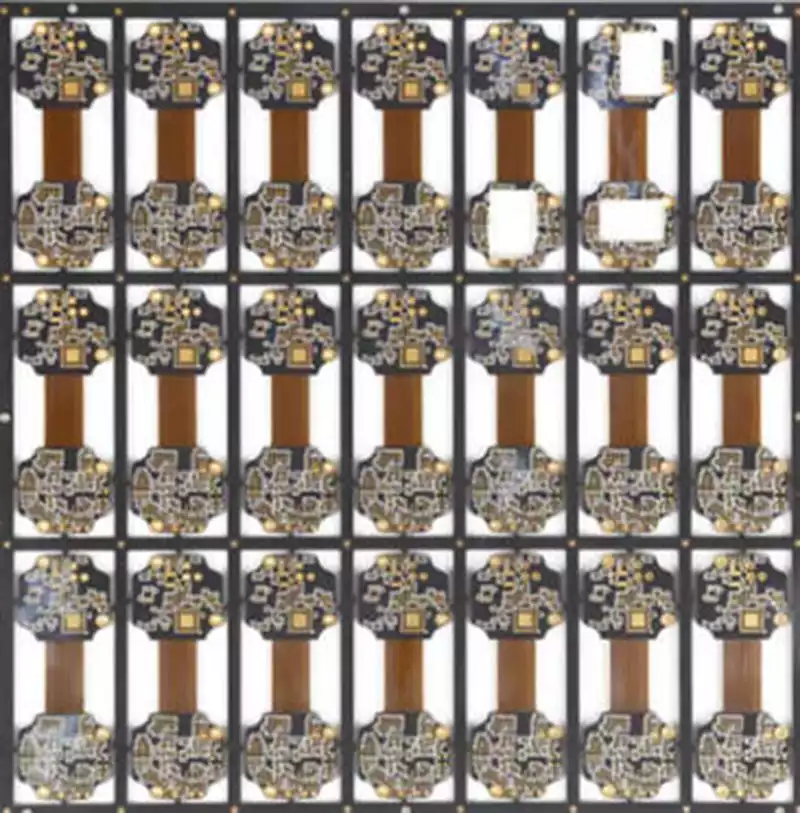
Panel Cutting for Printed Circuit Boards and Modules
Panel cutting (or separation) may employ processes such as slotting, a combination of slotting and milling, or milling combined with separation strips (see IPC-2222).
Scoring involves machining shallow, precise V-shaped grooves on both sides of the laminate; positional accuracy is critical to facilitate the separation of edge strips or individual components from the panel. Milling is used to define the final assembly boundaries; milling channels are machined using cutters of varying diameters, and the resulting separation strips serve as positioning aids during assembly.
Extreme care must be taken when removing the separation strips, particularly in the vicinity of BGAs, to avoid bending the PCB. Bending stress can cause BGA solder joints to crack, typically starting at the corner balls. Therefore, specialised jigs should be fabricated or machines specifically designed for strip removal should be purchased to eliminate or minimise stress near the BGAs.
Conformal coating, underfill and corner reinforcement, together with standardised panelisation, collectively form the reliability assurance system for BGAs and the entire PCBA following SMT soldering. They respectively address the three major challenges of environmental corrosion, mechanical stress and processing damage, complementing rather than replacing one another.