FR-4 and Rogers, as the two most prevalent substrate materials in the antenna PCB sector, possess no inherent superiority or inferiority; their suitability depends solely on the application context. Selecting the appropriate substrate not only enables the full realisation of antenna performance but also achieves an optimal balance between cost and reliability during mass production. Conversely, an incorrect substrate choice may result in substandard product performance at best, or trigger batch failures and project delays at worst.
Core Performance Parameters of Antenna PCB Substrates
Dielectric Constant (Dk) and Frequency Stability: Dk determines the dimensional accuracy and impedance calculations for antenna radiating elements. Fluctuations in Dk directly cause resonance frequency shifts, making it the most critical parameter for antenna PCBs.
Dielectric Loss Factor (Df): This determines signal energy dissipation within the substrate. A lower Df value minimises signal loss, enhancing antenna radiation efficiency and improving communication range and sensitivity.
Water Absorption Rate: Substrate water absorption elevates Dk values and deteriorates Df values, directly causing frequency drift and increased loss. This is a critical selection criterion for antenna PCBs in outdoor and high-humidity environments.
Thermal Stability: The substrate’s glass transition temperature (Tg) and coefficient of thermal expansion (CTE) determine dimensional stability and long-term reliability during soldering and thermal cycling. This is particularly critical for automotive and industrial-grade products.
Machinability: The substrate’s suitability for drilling, lamination, and surface treatment directly impacts PCB mass production yield and manufacturing costs.
Mass Production Cost: The substrate’s base price and processing expenses constitute the primary constraints for achieving scalable product deployment.
Key Differences in Core Properties Between FR-4 and Rogers Substrates
| Core Performance Parameters | Standard FR-4 substrate | Rogers high-frequency substrate |
| Dielectric constant Dk (10 GHz) | 4.2–4.7, batch variation ±0.2 | 2.2–10.7 optional, batch variation ±0.05 |
| Dielectric loss Df (10 GHz) | 0.02–0.03 | 0.0009–0.0037 |
| Water absorption rate (24h) | 0.1%-0.3% | 0.01%-0.05% |
| Glass transition temperature | 130°C–180°C | 280°C |
| Mass-production substrate cost Low | only 1/10 to 1/5 that of Rogers High | high-end models can exceed 20 times that of FR-4 |
| Processing Suitability | Mature manufacturing processes, enabling stable production across all industry production lines | High processing difficulty, requiring specialised equipment and process control, with stringent demands on production line capabilities |
The core advantage of conventional FR-4 lies in its exceptional cost control and mature mass production processes, whereas Rogers substrates derive their competitive edge from stable dielectric properties at high frequencies, extremely low dielectric loss, and outstanding environmental stability. Within the antenna PCB sector, these materials have established distinct application tiers, presenting no mutually exclusive substitution relationship.
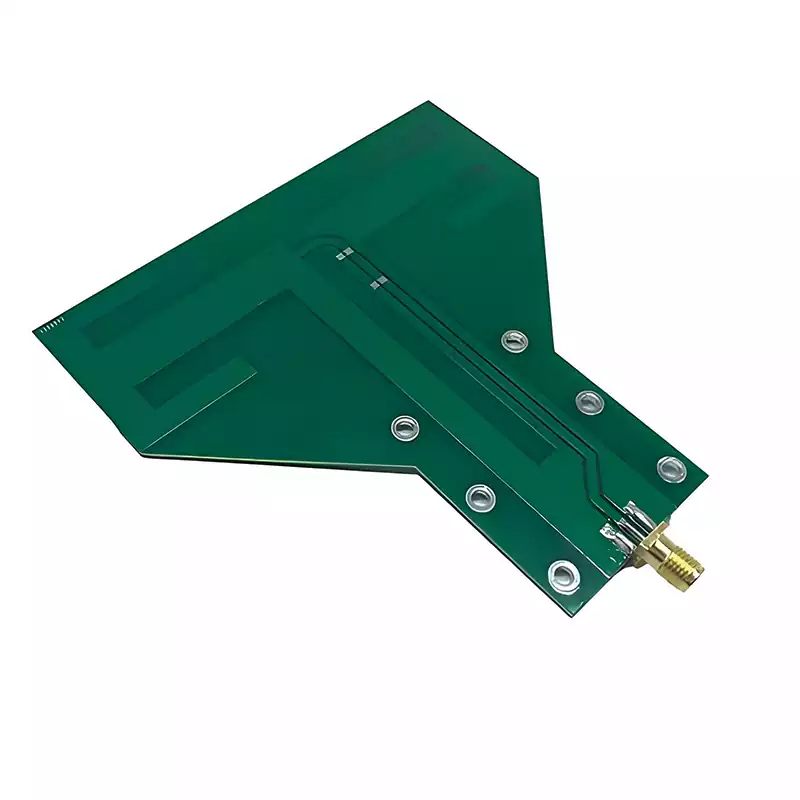
Principles for Selecting Antenna PCB Substrates
1.Scenarios where FR-4 substrates are the preferred choice
FR-4 substrate fully meets the performance requirements of the vast majority of low-to-mid-frequency antenna PCBs without incurring additional costs. Core suitable scenarios include:
Antenna PCBs operating below 3GHz, such as 2.4GHz Bluetooth, WiFi, Zigbee, RFID, remote controls, and other consumer electronics and general IoT antennas. Conventional FR-4 performance fully covers these applications, offering stable mass production yield and controllable costs.
Cost-sensitive mass-produced consumer goods, such as standalone smart home devices, standard wireless sensors, and toy-grade wireless products, where FR-4 delivers optimal cost-performance.
General-purpose wireless products operating in standard indoor ambient conditions without stringent high/low temperature, high humidity, or high corrosion requirements.
Note: Mid-to-high-end low-loss FR-4 materials extend the applicable frequency range to 6GHz, meeting requirements for WiFi 6, sub-1GHz, and similar scenarios. This represents a balanced compromise between cost and performance.
2.Scenarios Requiring Rogers Materials
When an antenna’s operating frequency band, performance requirements, or environmental conditions exceed the capabilities of FR-4, Rogers materials are the only reliable choice. Core applications include:
High-frequency antenna PCBs operating above 6GHz, particularly in 5G sub-6GHz, millimetre wave, 77GHz automotive radar, satellite communications, and high-precision positioning applications. FR-4’s high loss severely degrades antenna efficiency, necessitating low-loss Rogers materials.
Antenna PCBs demanding exceptional frequency stability and impedance precision, such as base station antennas, military communications, and test/measurement equipment. Rogers materials’ dielectric constant (Dk) variation within ±0.05 ensures consistent antenna resonance frequencies, preventing performance dispersion in batch production.
In demanding outdoor, automotive, and industrial environments characterised by high humidity, extreme temperature cycling, and severe corrosion, Rogers materials’ low moisture absorption, high glass transition temperature (Tg), and excellent thermal stability guarantee long-term antenna reliability, preventing performance degradation due to environmental fluctuations.
For broadband, high-gain, low-side-lobe array antenna PCBs, the uniformity and low-loss characteristics of Rogers substrates guarantee phase consistency across multi-element antennas, achieving optimal array performance.
Common Misconceptions in Selecting Antenna PCB Substrates
Bandwidth-centric approach: Blindly opting for Rogers substrates. Many designs unnecessarily employ Rogers substrates for antennas operating below 3GHz, significantly increasing costs while reducing yield due to heightened manufacturing complexity.
Forcibly employing FR-4 for high-frequency applications to reduce costs: For antennas operating above 6GHz, conventional FR-4 substrates result in excessive loss and severe frequency drift. This ultimately leads to substandard product performance, causing greater cost wastage.
Focusing solely on Dk while neglecting Df and parameter stability: Many designs prioritise dielectric constant while overlooking loss factor and parameter stability under varying frequencies and temperatures. This results in passable performance at room temperature but rapid failure in high-temperature, high-humidity environments.
Ignoring substrate manufacturability: Selecting materials based solely on performance metrics without considering production line processing capabilities leads to designs that cannot be mass-produced or suffer extremely low yield rates, causing cost spirals.
Selecting substrate materials for antenna PCBs is never about stacking high-end materials, but achieving a comprehensive balance between application context, performance, cost, and manufacturability.
FR-4, with its exceptional cost-performance ratio and mature manufacturing processes, underpins the antenna PCB requirements for the vast majority of general wireless applications. Rogers substrates, meanwhile, provide core support for antenna designs in high-frequency and high-reliability scenarios through their outstanding high-frequency performance and environmental stability.