In the field of RF and microwave electronics, the performance of substrate materials directly determines the potential for circuit miniaturisation, signal integrity and environmental adaptability. Thanks to its outstanding comprehensive properties, aluminium oxide ceramic substrate has become one of the most widely used core substrate materials in this field. Its high dielectric constant facilitates circuit miniaturisation, whilst its excellent thermal stability and low temperature coefficient of expansion enable it to withstand complex operating conditions.
Furthermore, it combines high mechanical strength with outstanding chemical stability, outperforming most other oxide materials. Consequently, aluminium oxide ceramic substrates are widely used in thick-film, thin-film and hybrid circuits, as well as in various microwave component modules, making them an indispensable foundational material for the development of microwave and RF technology.
Purity Classification and Performance Differences of Aluminium Oxide Ceramic Substrates
Aluminium oxide ceramic substrates are primarily classified by purity into types such as 90%, 96% and 99% purity. The fundamental difference lies in the content of impurities—the fewer the impurities, the higher the purity, and the superior the electrical and mechanical properties. Generally speaking, substrates with higher purity possess a higher dielectric constant, lower dielectric loss and a smoother surface, better meeting the design requirements of high-precision circuits.
Taking typical values at a frequency of 1 MHz as an example: an alumina ceramic substrate with a purity of 99.6% has a dielectric constant of 9.9, whereas a substrate with 96% purity has a dielectric constant of 9.6. Although the difference between the two is only 0.3, in microwave and RF design, this slight variation can cause significant changes in the electrical performance of the device, directly affecting the operational stability of the circuit. It should be noted that the manufacturing process for high-purity substrates is more stringent, and the price is correspondingly higher. Therefore, when selecting a substrate, a reasonable balance should be struck between performance requirements and cost considerations.
Applications of Aluminium Oxide Ceramic Substrates in Circuits
Thanks to the excellent properties described above, aluminium oxide ceramic substrates have given rise to a wide variety of device forms in microwave and RF circuits. The following are ten typical applications.
1.Thin-film microstrip circuits
Thin-film microstrip circuits designed on aluminium oxide ceramic substrates can have a gold layer thickness of up to 3.5 μm and can be reliably connected to external circuits via gold wire bonding. Common substrate thicknesses include 0.127 mm, 0.254 mm, 0.381 mm and 0.508 mm, with operating frequencies capable of exceeding 40 GHz, covering the frequency requirements of the vast majority of microwave components. Thanks to thin-film processes, line accuracy can reach ±5 μm, making this substrate widely used in the design and manufacture of microstrip transmission lines and high-precision circuits.
2.Thin-film Filters
Thin-film filters using aluminium oxide ceramic substrates as the carrier also have a maximum operating frequency of 40 GHz and serve as core frequency-selective components in various microwave devices. The manufacturing process involves thin-film techniques such as sputtering, photolithography, wet/dry etching, cleaning and dicing. They can be designed in various configurations, including finger-type, hairpin-type, comb-type, parallel-coupled-line-type and C-type, covering filter functions such as low-pass, high-pass, band-pass and band-stop. Owing to the high dielectric constant of aluminium oxide, these filters are smaller in size and offer superior electrical parameters compared to conventional microstrip filters; they are typically mounted using conductive adhesive or a gold-tin eutectic alloy.
3.Thin-film loads
Thin-film loads utilise an aluminium oxide ceramic substrate and are primarily used at the terminals of microwave circuit modules to achieve impedance matching and absorb excess reflected power. Their performance hinges on the precision of the resistance fabrication. Thin-film processes allow for precise control of the sheet resistance of the tantalum nitride film layer, enabling the manufacture of high-precision, compact thin-film loads. This contributes to the miniaturisation of component modules, with mounting typically achieved using conductive adhesive or gold-tin eutectic solder.
4.Thin-Film Equaliser
Thin-film equalisers are used to regulate broadband power flatness in microwave circuits and are designed on an aluminium oxide ceramic substrate. By altering the sheet resistance and patterning of the integrated tantalum nitride film layers, the resistance values can be flexibly adjusted to modify the output waveform, thereby achieving front-end power signal equalisation and optimising power flatness across the entire passband.
5.Thin-film power dividers
Thin-film power dividers are widely used in multi-channel communication network systems. Their core function is to distribute power according to a set ratio, enabling a single input to be split into multiple outputs. Their advantage lies in the ability to integrate isolating resistors into the thin-film circuit via a tantalum nitride layer, thereby avoiding the issue of resistance instability caused by the soldering of surface-mount resistors in traditional microstrip power dividers, and improving circuit performance. Furthermore, thin-film power dividers facilitate multi-stage ultra-wideband designs and are characterised by their compact size, high integration and stable performance.
6.Thin-Film Attenuators
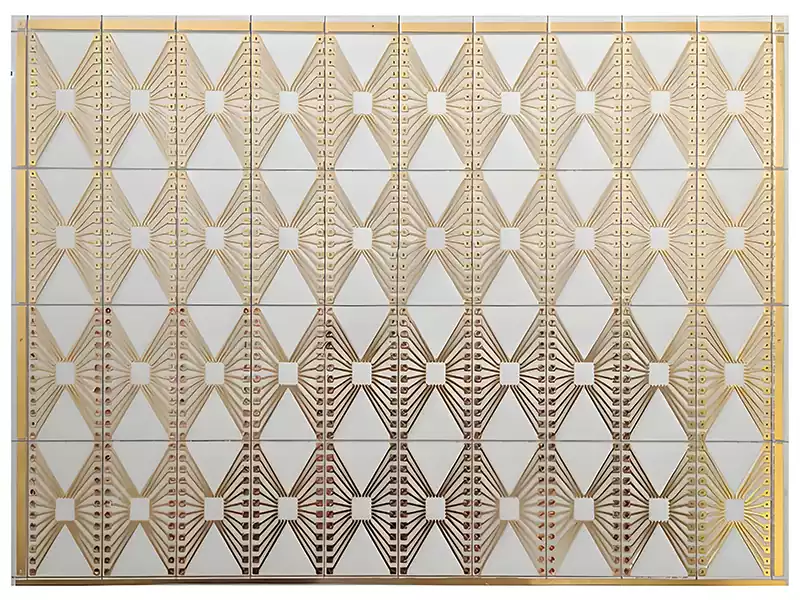
Thin-film attenuators utilise aluminium oxide ceramic substrates and thin-film processes, combined with precise control of the sheet resistance of the tantalum nitride film layer. They are primarily used for high-signal attenuation in microwave and RF components, or for multi-step attenuation value adjustment in programme-controlled attenuation circuits. These devices maintain high attenuation flatness across an ultra-wide frequency band, offer stable operational performance, and are suitable for complex high-frequency environments.
7.Thin-film couplers
Thin-film couplers are used for power detection or signal separation in microwave component systems. Utilising an aluminium oxide ceramic substrate as the carrier, they can be designed with any degree of weak coupling and can integrate isolation loads via tantalum nitride layers. The ports can be in surface-mount packaging for direct soldering onto the circuit; if a wider frequency band needs to be covered, a multi-stage structure can be designed.
8.Thin-Film Bridges
Thin-film bridges, also known as 3 dB bridges, primarily serve to separate signals and generate phase differences of 90° or 180°, with the Lange bridge being the most widely used type. These devices utilise an aluminium oxide ceramic substrate and employ gold wire bonding to connect signals between circuits, meeting the signal processing requirements of microwave systems.
9.Thin-Film Resistors
Thin-film resistors are designed using an aluminium oxide ceramic substrate and are suitable for circuit applications requiring high precision, low noise and high stability. They can be integrated with microstrip thin-film circuits during fabrication, or manufactured separately in various resistance values, or designed as resistor networks, with the required resistance selected via gold wire bonding, offering great flexibility in use.
10.Thin-film capacitors
Thin-film capacitors utilise an aluminium oxide ceramic substrate and are primarily used for high-frequency filtering. They can be designed with any capacitance value to meet circuit requirements. Compared to standard surface-mount capacitors, they offer more stable performance and can effectively meet the filtering requirements of high-frequency microwave circuits.
Owing to their high dielectric constant, low loss, excellent mechanical strength and chemical stability, aluminium oxide ceramic substrates demonstrate irreplaceable value in RF and microwave circuits. With the ongoing evolution of fields such as wireless communications, radar and satellite navigation, aluminium oxide ceramic substrates will continue to serve as a key foundational material, driving RF and microwave technology towards ever-higher frequencies, superior performance and smaller form factors.