Flexible pcbs (FPCs) have become indispensable in modern electronics thanks to their lightweight construction, ultra-thin profile, and excellent flexibility. They are widely used in smartphones, smartwatches, wearable devices, action cameras, medical electronics, and other compact electronic products. However, during product design and manufacturing, some engineers still apply the same surface finish selection principles used for rigid PCBs to flexible circuits.
To reduce manufacturing costs, they may choose Hot Air Solder Leveling (HASL), a mature and economical process commonly used for rigid PCBs. From both a material science and production reliability perspective, however, HASL is not an appropriate surface finish for flexible pcbs, and its use can introduce significant quality and reliability risks.
HASL is one of the most widely adopted surface finish technologies for rigid printed circuit boards. Its manufacturing process is well established and highly cost-effective for mass production. During fabrication, the PCB is first chemically cleaned and treated with flux before being immersed in a bath of molten solder at approximately 250°C to 265°C. The exposed copper circuitry is coated with solder, while high-pressure hot air knives remove excess solder to produce a uniform protective solder layer. This coating provides excellent oxidation resistance and solderability, making HASL an economical and reliable solution for conventional FR-4 rigid PCBs.
However, a manufacturing process optimized for rigid substrates cannot simply be transferred to flexible circuits because the two PCB types are fundamentally different in substrate composition and mechanical properties. This difference is the primary reason why HASL is unsuitable for FPC manufacturing. Rigid PCBs are reinforced with glass fiber, providing excellent thermal resistance, dimensional stability, and mechanical strength. As a result, they can easily withstand the high temperatures and strong airflow associated with the HASL process without suffering structural deformation.
Flexible PCBs, by contrast, are typically manufactured using polyimide (PI) or polyester (PET) substrates. These flexible materials are specifically designed to provide bending capability, but they sacrifice a certain degree of thermal stability and mechanical rigidity in the process. Compared with FR-4, PI and PET substrates have lower resistance to prolonged high temperatures and are considerably more sensitive to thermal shock and mechanical stress.
The high-temperature solder bath and high-pressure air leveling stages of the HASL process can therefore cause irreversible damage to flexible circuit boards. Exposure to temperatures exceeding 250°C can rapidly heat the flexible substrate, leading to board warpage, localized blistering, delamination between the copper foil and substrate, and other structural defects. Furthermore, the copper foil used in FPCs is typically only 18 μm thick or even thinner, while the adhesive layers bonding the copper to the substrate can soften or degrade under elevated temperatures. This weakens the laminate structure, reduces electrical reliability, compromises flexural durability, and significantly increases manufacturing scrap rates.
Beyond structural concerns, the characteristics of the HASL coating itself are also incompatible with the performance requirements of flexible circuits. HASL naturally produces a surface with uneven solder thickness, resulting in slight waviness or localized solder buildup. Such surface irregularities are unacceptable for most flexible PCB applications, which frequently incorporate high-density packages such as BGA (Ball Grid Array) and CSP (Chip Scale Package) devices. These advanced packages require exceptional pad coplanarity and placement accuracy. Uneven solder surfaces can easily cause SMT component misalignment, insufficient solder joints, open solder joints, or cold solder joints, ultimately reducing assembly yield and long-term product reliability.
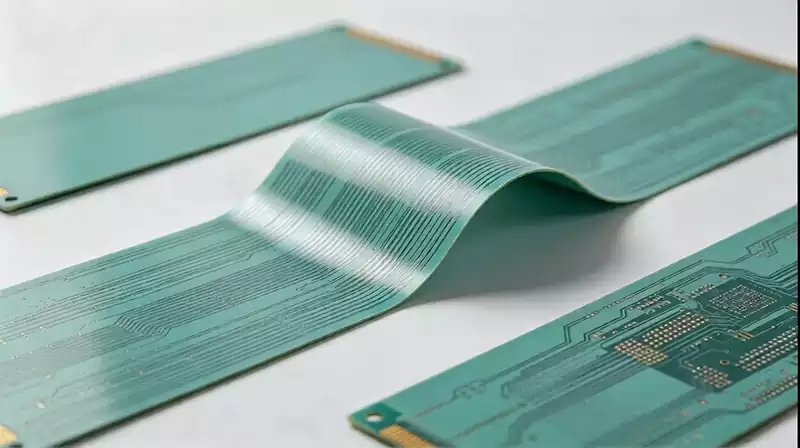
Although HASL can technically be applied to flexible PCBs under certain conditions, it involves high manufacturing risks, lower production yields, and greater reliability concerns. In most applications, the disadvantages far outweigh any cost savings, making HASL an impractical choice for flexible circuit manufacturing.
To address the unique material characteristics and application requirements of FPCs, the electronics industry has developed several mature surface finish technologies specifically suited to flexible circuits. These finishes provide superior flatness, reliability, and compatibility with modern assembly processes.
Electroless Nickel Immersion Gold (ENIG) has become the industry-standard surface finish for high-quality flexible PCBs. Through chemical deposition, a nickel layer is first formed on the copper circuitry, followed by a thin immersion gold layer. The nickel layer acts as a diffusion barrier, while the gold layer provides long-term oxidation protection and excellent electrical conductivity. ENIG produces an exceptionally flat surface, making it ideal for fine-pitch SMT assembly, BGA packages, and gold finger applications. Its outstanding solderability, durability, and corrosion resistance make it the preferred choice for most premium FPC products. Its primary drawback is its relatively higher manufacturing cost.
Organic Solderability Preservative (OSP) offers an environmentally friendly and cost-effective alternative. Rather than depositing a metal coating, OSP forms an ultra-thin organic protective film over the exposed copper surface to prevent oxidation. The process operates at relatively low temperatures and produces excellent surface flatness, making it well suited for flexible PCB manufacturing. OSP is particularly suitable for short production cycles and small-batch manufacturing. However, its protective coating has limited shelf life and is sensitive to humidity, contamination, and storage conditions, making it unsuitable for products requiring long-term inventory storage.
Immersion Tin and Immersion Silver are also widely used for flexible PCB applications. Both processes are performed at relatively low temperatures without exposing the flexible substrate to excessive heat or high-pressure airflow, thereby eliminating the risk of thermal damage. Each produces a smooth, uniform surface finish with excellent solderability. Immersion Tin is highly versatile and compatible with a wide range of conventional electronic assemblies, while Immersion Silver offers superior electrical conductivity, making it particularly suitable for high-frequency circuits and precision flexible electronics requiring optimal signal transmission.
Selecting the appropriate surface finish for a flexible PCB should never be based solely on minimizing manufacturing cost. Instead, the decision should be guided by the substrate material, assembly requirements, product performance, and long-term reliability objectives. Although HASL remains an economical and proven solution for rigid PCBs, its processing characteristics are fundamentally incompatible with the materials and performance requirements of flexible circuits.Surface finishes such as ENIG, OSP, Immersion Tin, and Immersion Silver provide far better compatibility with fpc manufacturing and are the preferred solutions for achieving consistent product quality, reliable assembly, and stable long-term performance in flexible electronic applications.