Printed circuit boards (PCBs) are the core components of modern electronic products, and their manufacture relies on a key base material: copper-clad laminate (CCL). Depending on product form and application, CCL is primarily divided into two categories: rigid copper-clad laminate (conventional CCL) and flexible copper-clad laminate (FCCL).
Among these, FCCL, owing to their unique bendable properties, have become an indispensable core material in fields such as flexible electronics and portable devices. They are produced by laminating a flexible insulating base film with a metal foil (primarily copper foil) through specific processes. Its core advantage lies in its high flexibility, which allows it to adapt to complex installation spaces and facilitates the miniaturisation and lightweight design of electronic products. Consequently, it is also known as flexible copper-clad laminate or soft copper-clad laminate; in Taiwan, it is commonly referred to as ‘soft copper foil laminate’ or ‘soft copper foil substrate’.
The core manufacturing principle of FCCL involves using various processes to firmly bond the metal foil to the surface of the flexible insulating base film, creating a composite substrate that combines both insulating and conductive properties. Current mainstream manufacturing processes include resin adhesive coating and direct deposition (the latter of which encompasses sub-processes such as electroplating, sputtering and electroless plating).
The choice of process directly determines the performance, cost and application scenarios of FCCL. From a product structure perspective, FCCL can be further classified into three-layer (3L-flexible copper-clad laminates) and two-layer (2L-flexible copper-clad laminates) types; the two differ significantly in structure, performance and application, and together constitute the current mainstream product system for FCCL.
Traditional FCCL products are predominantly three-layer flexible copper-clad laminates (3L-flexible copper-clad laminates), whose structure consists of three functional layers: copper foil, a flexible insulating base film, and an adhesive. The copper foil provides electrical conductivity, the base film offers insulation and flexibility, whilst the adhesive firmly bonds the copper foil to the base film. This three-layer composite structure features mature technology and a simple manufacturing process; it has long been the mainstream in the FCCL market and is widely used in the production of various conventional flexible PCBs.
Over the past decade, as electronic products have rapidly evolved towards miniaturisation, high density and high reliability, two-layer flexible copper-clad laminates (2L-flexible copper-clad laminates) have gradually emerged and achieved rapid adoption in high-end application fields. The key difference from 3L-FCCL lies in the elimination of the separate adhesive layer.
Instead, a special process bonds the copper foil directly to the flexible insulating base film, hence it is also known as adhesive-free flexible copper-clad laminate. This structure simplifies the production process whilst significantly enhancing performance, making it a core material in the high-end flexible electronics sector.
The development of 2L-FCCL owes much to the widespread adoption of COF (Chip on Flex) technology. Since the second half of 2003, driven by the rapid iteration of LCD electronic products and the growing demand for smaller, lighter and thinner portable devices, the COF application market has experienced explosive growth.
As a core component of COF packaging, the COF flexible substrate plays a key role in supporting IC chips, enabling circuit connectivity and providing insulating support; its performance directly determines the reliability and stability of the packaged product. COF flexible substrates possess three prominent characteristics: high-density fine-line circuits, high precision in lead placement, and the mandatory use of 2L-FCCL as the base material. This has directly driven the technological evolution and market expansion of 2L-FCCL.
Compared to traditional 3L-FCCL, 2L-FCCL offers clear advantages in several key performance areas: as it contains no epoxy or acrylic adhesives, its heat resistance, dimensional stability and chemical resistance are significantly enhanced, enabling it to withstand demanding applications such as high-temperature soldering and complex chemical environments; at the same time, the adhesive-free structure facilitates thinner product designs, aligning with the trend towards lighter electronic devices.
However, 2L-FCCL and 3L-FCCL are not substitutes for one another, but rather have distinct application focuses: 3L-FCCL, with its mature manufacturing processes and lower cost, is widely used in high-volume, standard flexible PCB products such as mobile phone flexible flat cables and general-purpose flexible sensors; 2L-FCCL, on the other hand, is primarily targeted at the manufacture of high-end flexible PCBs with stringent performance requirements, such as rigid-flex boards, COF packaging substrates and flexible automotive electronic components.
Looking at the current global FCCL market structure, 3L-FCCL remains dominant, accounting for approximately 80% to 85% of the market share, whilst 2L-FCCL accounts for around 15% to 20%. In terms of pricing, as the manufacturing process for 2L-FCCL is more complex and involves higher technical barriers, its market price is approximately 1.5 to 2 times that of 3L-FCCL. However, with technological maturation and the advancement of mass production, some leading manufacturers have already achieved prices for 2L-FCCL that are comparable to, or even lower than, those of 3L-FCCL, further enhancing its market competitiveness.
In terms of product characteristics, in addition to the advantages of heat resistance and dimensional stability offered by its adhesive-free structure, two-layer FCCL also boasts superior chemical resistance, flexibility and peel strength at high temperatures, enabling it to maintain stable performance under harsh conditions such as prolonged bending, high temperatures and corrosion.
Simultaneously, its adhesive-free design facilitates halogen-free and environmentally friendly production, aligning with the global electronics industry’s trend towards green development. Consequently, it is particularly well-suited for the manufacture of COF substrates characterised by high-density wiring, as well as other high-end flexible electronic components.
However, due to the complexity of the manufacturing process and the cost of core raw materials, the current manufacturing cost of 2L-FCCL remains relatively high, which is a key factor limiting its wider adoption. In the future, as technological breakthroughs are made and production capacity expands, a reduction in costs will inevitably follow.
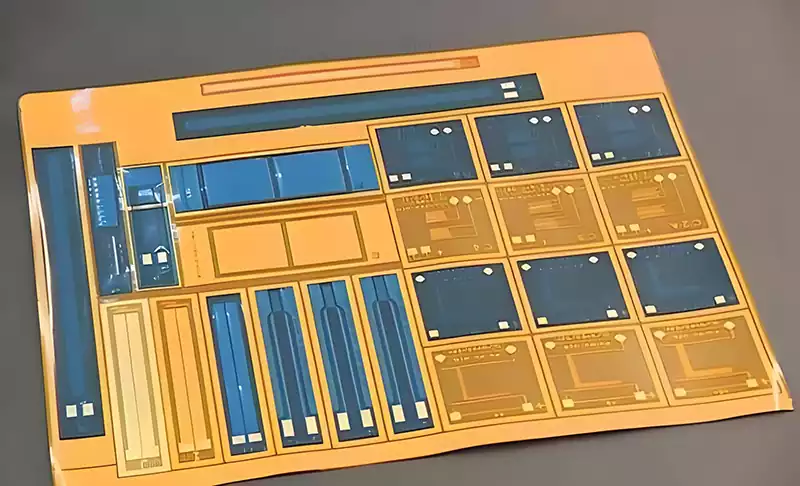
As the market mainstream, 3L-FCCL is primarily manufactured using either the sheet method or the roll method. The sheet method is a batch process: first, the pre-coated flexible insulating base film is cut to specification; then, the cut base film is laminated with copper foil and placed in a hot press, where it is thermally bonded under preset temperature, pressure and time conditions to produce sheet-type 3L-FCCL.
This process offers high flexibility and allows for rapid specification changes, making it suitable for small-batch, multi-variety production; however, its disadvantage is lower efficiency, making it difficult to meet the demands of large-scale mass production.
The roll-to-roll method is a continuous process better suited to mass production: adhesive is applied to the surface of a continuously conveyed flexible insulating base film; the film is then heated and dried to remove solvents and cure the adhesive to a specific state; subsequently, copper foil is continuously laminated onto the base film using roller press equipment; following winding and post-curing processes, roll-form 3L-FCCL is obtained.
Its advantages lie in high production efficiency and good product consistency, effectively reducing unit costs, making it suitable for high-volume, standardised products; the disadvantages are high capital expenditure on equipment, difficulty in adjusting production processes, and a lack of flexibility.
Compared to 3L-FCCL, the manufacturing process for 2L-FCCL is more complex and involves a higher technical barrier. Currently, the mainstream processes in the industry fall into three main categories: the coating method, the sputtering/electroplating method, and the lamination method (some view these as simplified into two categories: coating/lamination and sputtering/electroplating).
Products manufactured using different processes have distinct focuses in terms of performance, cost and application. The coating method involves applying liquid insulating resin directly onto the surface of copper foil; after curing, this forms a flexible insulating base film. This process is relatively simple and cost-effective, making it suitable for mid- to high-end conventional applications. The sputtering/electroplating method involves depositing a copper foil layer onto the surface of the insulating base film via physical sputtering or chemical electroplating.
It offers high circuit precision and strong adhesion, making it suitable for high-density, high-reliability, high-end applications such as COF substrates. The lamination method involves directly bonding a pre-prepared insulating base film with copper foil under high temperature and pressure without the use of adhesives. This requires good compatibility between the base film and the copper foil, resulting in stable product performance; however, the process is more complex and costly.
In the future, as technological breakthroughs are made and costs decrease, two-layer FCCL will unlock even greater potential in the field of flexible electronics.