RF Coaxial Connectors (commonly referred to as RF connectors) are precision electromechanical components that integrate both mechanical and electrical functions. They can be assembled onto RF cables, electronic instruments, and various terminal devices, serving primarily to establish and disconnect electrical connections within transmission lines. As indispensable interconnection components in RF signal transmission systems, RF coaxial connectors play a critical role in ensuring the stable transmission of high-frequency signals.
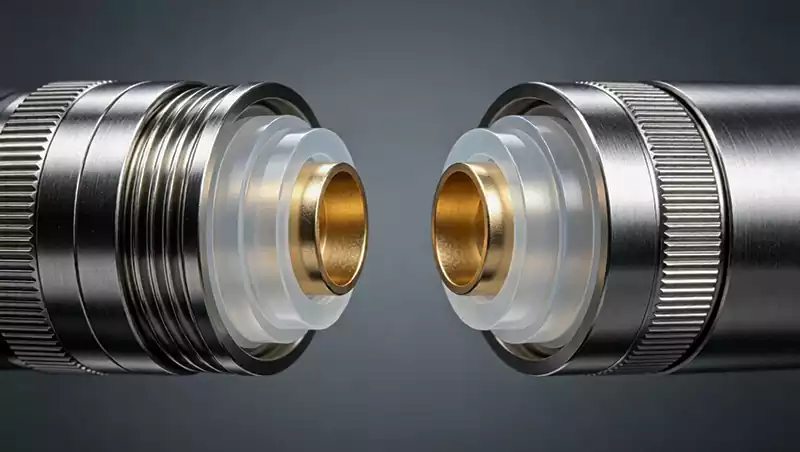
RF Coaxial Connectors feature highly precise structures, and the manufacturing accuracy and material properties of each component directly influence RF signal performance. Their fundamental architecture consists of three core elements that work together to ensure reliable operation:
Inner Conductor:
The inner conductor serves as the primary pathway for signal transmission and is available in two contact configurations: male pin contacts and female socket contacts. Its function is to efficiently conduct RF signals and electrical current. Common materials include brass and beryllium copper, both of which offer excellent conductivity, wear resistance, and fatigue resistance.
Insulating Dielectric:
Positioned between the inner and outer conductors, the dielectric insulator accurately centers and supports the inner conductor while maintaining coaxial alignment. It also provides electrical isolation, effectively preventing short circuits, leakage currents, and related failures. Common dielectric materials include polytetrafluoroethylene (PTFE) and polyetherimide (PEI), which offer excellent insulation, high-temperature resistance, and long-term stability.
Outer Conductor:
The outer conductor provides both electrical and mechanical protection. Electrically, it creates a 360-degree electromagnetic shielding structure and serves as the signal return path to ground, preventing external electromagnetic interference and signal leakage. Mechanically, it enhances the connector’s structural strength, ensuring precise mating and stable electrical contact. Common materials include brass and stainless steel, which provide excellent rigidity and corrosion resistance.
Key Electrical Performance Parameters of RF Coaxial Connectors
Characteristic Impedance
Characteristic impedance is the fundamental parameter for RF transmission matching. The industry-standard impedance values are 50Ω and 75Ω. Cables, connectors, and equipment must be matched to the same impedance specification; otherwise, signal reflections and increased transmission losses may occur.
Operating Frequency Range
The lower frequency limit of RF coaxial connectors can extend down to DC (0 Hz), while the upper operating frequency is typically specified at approximately 95% of the connector’s cutoff frequency. High-frequency performance is closely related to connector geometry and dielectric material properties. Smaller outer conductor dimensions and lower dielectric constants generally enable higher operating frequencies while reducing insertion loss. Commercial RF coaxial connectors are currently available with operating frequencies of up to 110 GHz, meeting the demands of ultra-high-frequency microwave transmission.
Voltage Standing Wave Ratio (VSWR)
VSWR is one of the most important indicators of signal transmission quality and impedance matching within RF systems. Values closer to 1 indicate superior performance. For example, an N-type connector designed for RG223 cable typically exhibits a VSWR of 1.15 + 0.01f/GHz in a straight configuration, while the right-angle version has a VSWR of 1.15 + 0.02f/GHz. This demonstrates that right-angle connectors generally provide poorer impedance matching. Many right-angle connectors produced by smaller manufacturers are prone to impedance discontinuities; therefore, minimizing the use of right-angle connectors and adapters is recommended whenever possible.
Contact Resistance
Contact resistance refers to the resistance generated at the contact interface when male and female connectors are mated. It includes both inner conductor contact resistance and outer conductor contact resistance. Lower resistance values correspond to higher signal transmission efficiency. Industry-standard values are typically measured in milliohms (mΩ). Because the outer conductor generally has a larger contact area and more stable contact characteristics, its contact resistance is usually lower than that of the inner conductor.
Insulation Resistance
Insulation resistance is determined primarily by the dielectric material used inside the connector and serves as a key indicator of electrical isolation performance. For a standard N-type connector, the typical insulation resistance is no less than 5 GΩ. Insufficient insulation resistance can result in leakage currents during operation. As operating power increases, leakage-related signal attenuation and equipment failures become increasingly significant.
Passive Intermodulation (PIM)
PIM is a critical performance metric in high-frequency communications and precision transmission applications. Standardized performance benchmarks have been established for major connector types. Under a 2 × 43 dBm test condition, the maximum PIM levels are typically -168 dBc for DIN (7-16) connectors, -166 dBc for Mini DIN (4.3-10) connectors, and -165 dBc for N-type connectors. Lower values indicate superior suppression of passive intermodulation.
RF Coaxial Connector Types and Interface Characteristics
Based on transmission-line structure and application requirements, RF coaxial connectors can generally be categorized into RF coaxial connectors, RF triaxial connectors, and twin-core balanced RF connectors, with RF coaxial connectors being the most widely used.
Mainstream connector interfaces available on the market include N-type, BNC, SMA, SMB, SMC, TNC, F-type, RCA, MCX, and MMCX connectors. These interfaces differ in locking mechanisms (threaded coupling, bayonet coupling, or push-on connection), characteristic impedance, and operating frequency range, enabling them to meet the requirements of consumer, industrial, and military applications.
All RF coaxial connectors follow the same fundamental coaxial design principle. The center conductor carries the signal, the intermediate dielectric provides insulation and mechanical support, and the outer conductor forms the shielding structure. Together, these three layers maintain stable characteristic impedance while preventing signal leakage and external electromagnetic interference.
From a connector polarity perspective, RF connectors are divided into male and female types. Male connectors feature a center pin contact and typically incorporate internal threads, while female connectors use a center receptacle contact and typically incorporate external threads. These complementary structures ensure reliable mating and electrical continuity.
In network systems or equipment configurations involving multiple interface types, RF adapters are used to connect different connector standards. During selection, it is essential to verify the connector type, impedance specification, and gender at both ends of the adapter to ensure mechanical compatibility and electrical matching, thereby avoiding signal degradation or connection failures.
Major Application Areas of RF Coaxial Connectors
Communications Networks
Communications infrastructure represents the largest application market for RF coaxial connectors. They are widely used in mobile communications and wired network transmission systems. In 5G and emerging 6G networks, RF connectors are extensively deployed in base station antennas, radio units, filters, microwave transmission equipment, optical transmission modules, routers, and terminal devices, ensuring reliable transmission of ultra-high-frequency and high-data-rate signals. They also provide critical interconnections throughout wired communication systems.
Test and Measurement
RF coaxial connectors are widely used in precision testing instruments, including network analyzers, spectrum analyzers, signal generators, oscilloscopes, and semiconductor testing equipment. These applications demand exceptional transmission accuracy, interference immunity, and signal integrity to support precise microwave signal measurement and data acquisition.
Aerospace and Defense
In aerospace applications, RF connectors are integrated into electronic control systems for aircraft, satellites, and unmanned aerial vehicles, as well as satellite navigation and satellite communication systems. They are also extensively used in ground-based, vehicle-mounted, airborne, and naval radar systems, as well as electronic warfare equipment. Connectors for these applications must withstand extreme temperatures, vibration, radiation exposure, and other harsh environmental conditions while maintaining exceptional reliability.
Automotive Electronics and Intelligent Transportation
As intelligent vehicle technologies continue to evolve, RF connectors are increasingly used in automotive applications, including millimeter-wave radar systems, V2X communication modules, high-frequency in-vehicle transmission systems, and high-voltage fast-charging equipment for electric vehicles. These applications require compact dimensions, high reliability, strong EMI resistance, and long service life.
Advanced Medical Equipment
RF coaxial connectors are widely employed in MRI systems, CT scanners, ultrasound diagnostic equipment, and robotic surgical systems. Their precise and low-noise signal transmission capabilities ensure clear medical imaging and reliable diagnostic data while meeting stringent medical EMC and safety standards.
Broadcasting and Television
In broadcasting and television systems, RF connectors are used in transmission equipment, receiving systems, and studio audio-video infrastructure. They support signal transmission across a wide frequency spectrum while providing excellent electromagnetic shielding to minimize signal distortion, video interruptions, and audio noise. Miniaturized connectors such as MMCX and SMB are also commonly used within consumer electronic devices, including smartphones and laptops, for internal high-frequency signal transmission.
Industrial and Emerging High-Precision Technologies
In industrial environments, RF coaxial connectors are utilized in automation control systems, power equipment, and oil exploration systems, where their environmental durability and EMI resistance support reliable long-term operation under demanding conditions. In advanced technology sectors, including quantum computing and semiconductor wafer testing, RF connectors provide the ultra-high transmission accuracy, low interference, and stability required for cutting-edge research and industrial applications.
Although RF coaxial connectors are relatively small components within larger electronic systems, they perform an irreplaceable function in high-frequency signal transmission chains. As communications, automotive electronics, medical technology, and emerging scientific fields continue to advance toward higher frequencies and greater reliability, RF coaxial connectors will continue to evolve accordingly, providing the essential foundation for the stable and efficient operation of modern electronic systems.