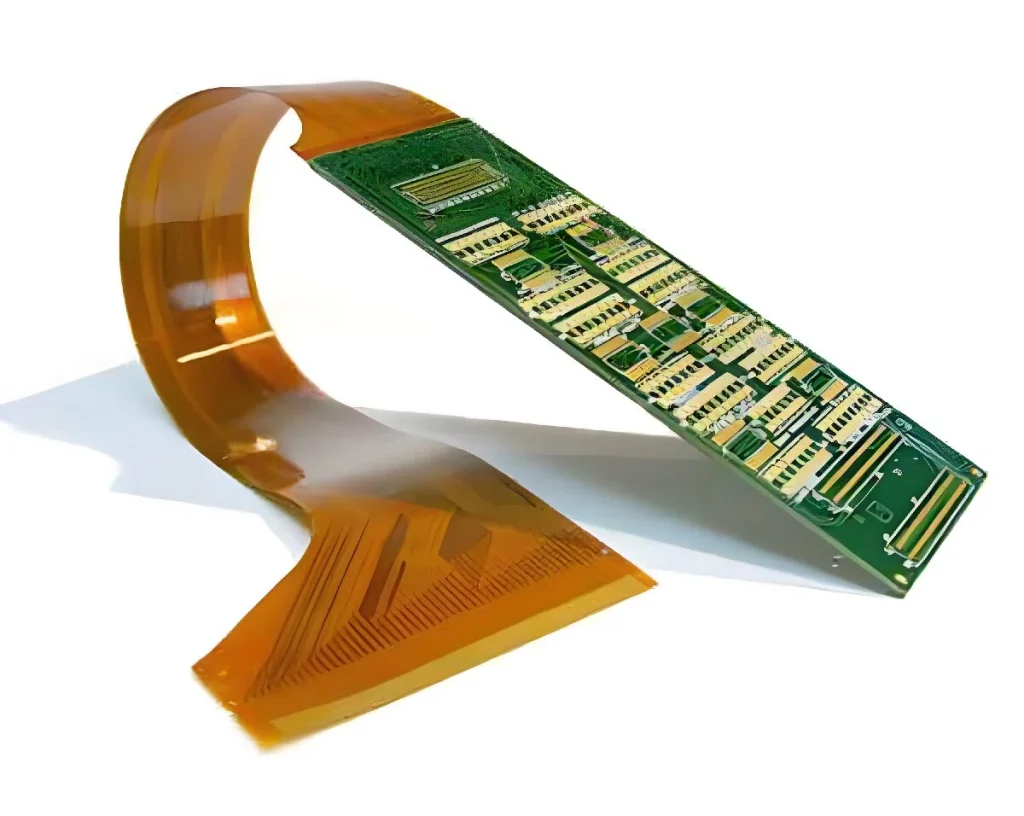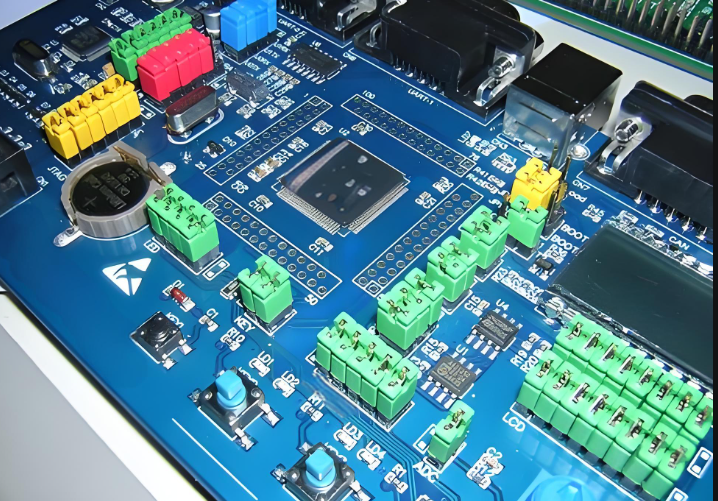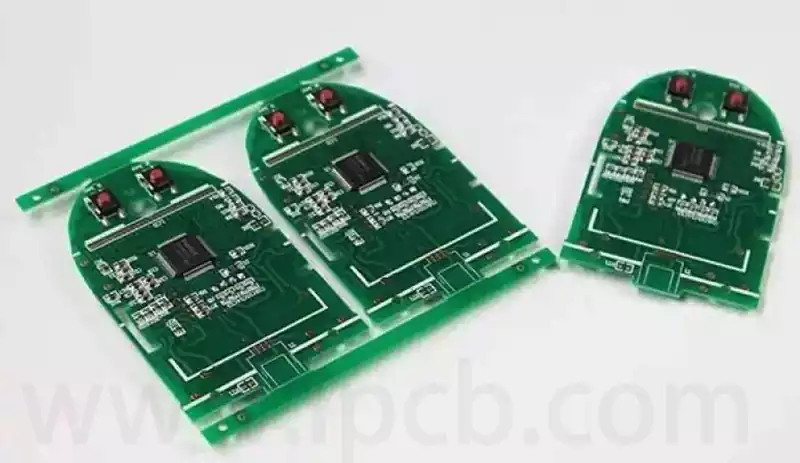
The defining characteristic of rigid PCBs (rigid printed circuit boards) is that they are ‘non-flexible’; relying on their rigid substrate, they provide stable support and electrical connection pathways for electronic components.
Unlike the flexible substrates used in flexible PCBs, the rigidity of a rigid PCB derives entirely from its core substrate. In actual production, the most commonly used substrate is FR-4 (glass fibre cloth impregnated with epoxy resin). Once cured, this material offers high strength and dimensional stability, enabling it to withstand a range of mechanical stresses such as soldering and assembly; it is also the most common substrate for rigid PCBs.
Common Materials for Rigid PCBs
FR-4 (Epoxy Glass Laminate)
Type: Currently the most widely used substrate, with a market share exceeding 90%
Composition: A composite of glass fibre cloth and flame-retardant epoxy resin
Features:
Relatively low cost, high mechanical strength, and good insulation properties
Temperature Resistance: Tg (glass transition temperature) is classified into different grades (standard grade Tg is approximately 130°C, medium-to-high grade Tg is not less than 150°C, and high grade Tg is not less than 170°C)
Applications: Suitable for consumer electronics, industrial control equipment, power supply boards and similar applications
Metal Substrates (Aluminium Substrates/Copper Substrates)
Structure: Composed of a metal (aluminium or copper) substrate, an insulating layer and copper foil
Features:
Possesses excellent thermal conductivity (the thermal conductivity of aluminium substrates ranges from 1 to 3 W/m·K)
Primarily used in high-power LED lighting equipment, power modules and automotive electronics, where efficient heat dissipation is required
High-frequency laminates (low dielectric loss type)
Common materials:
Polytetrafluoroethylene (PTFE): e.g. Rogers RO4000 series, Teflon, etc.
Hydrocarbon resin ceramics: e.g. Rogers RO3000, Arlon AD series, etc.
Features:
Low dielectric constant (Dk), ranging from 2.2 to 10.5
Extremely low loss tangent (Df), within the range of 0.001 to 0.004
Applications: Suitable for fields with high signal transmission requirements, such as 5G antennas, millimetre-wave radar and satellite communications
CEM Series (Composite Epoxy Resin Substrates)
CEM-1: Composed of paper substrate, glass fibre cloth and epoxy resin (commonly used for single-sided PCBs)
CEM-3: Composed of glass fibre mat and epoxy resin (can be used for double-sided PCBs and, to a certain extent, can replace FR-4)
Features: Lower cost compared to FR-4, though mechanical properties are relatively weaker
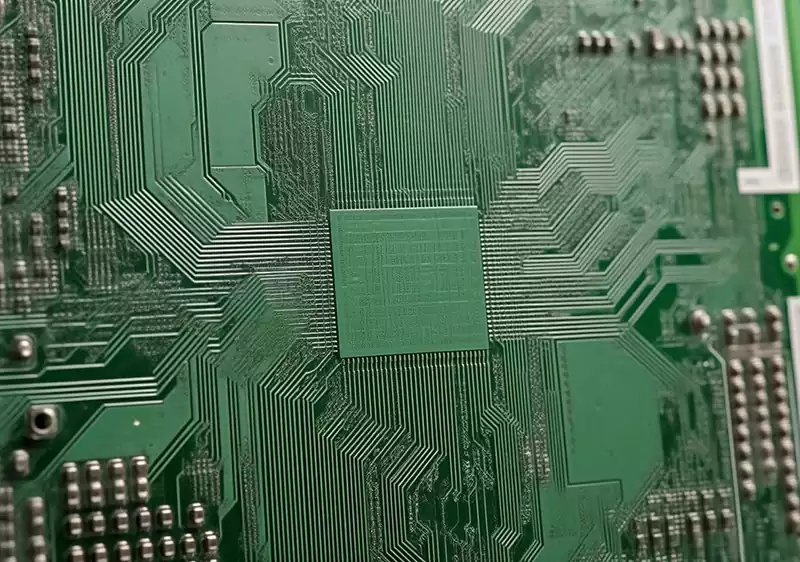
Key Process Technologies for Rigid PCBs
1.Blind and buried via process: Inter-layer interconnection is achieved via laser drilling, reducing board surface area usage by over 30% compared to traditional through-hole designs and increasing routing density. This process requires plasma cleaning and electroplating via filling techniques to ensure uniformity of the copper layer on the via walls;
2.Impedance Control: For high-speed signals (such as 5G and HDMI 2.1), the characteristic impedance is controlled within a tolerance of ±10% by adjusting the thickness of the dielectric layers, trace width and spacing, and the dielectric constant, thereby preventing signal reflection and attenuation;
3.Surface treatment: The electroless nickel-gold (ENIG) process is employed to form a nickel-gold plating layer with a thickness of 0.05–0.2 μm. Compared to organic solder mask (OSP), this offers a longer storage life (over 12 months) and superior soldering reliability.
Applications of Rigid PCBs
Consumer Electronics
Devices such as mobile phones, tablets and smart wearables have compact designs; rigid PCBs enable high-density routing and the integration of numerous components, ensuring stable operation. They are commonly used in motherboards for products from brands such as Apple and Xiaomi.
Computers and Peripherals
Motherboards for desktop and laptop computers, as well as expansion cards such as graphics cards, utilise them to integrate key components; peripherals such as printers and scanners rely on them for precise control and data transmission.
Communications Equipment
5G base stations, routers, switches and similar devices require high-speed data processing; rigid PCBs meet the requirements for high-speed signal transmission and low loss. They are also widely used in mobile terminals such as mobile phones.
Industrial Control
In automated production lines, instrumentation and power electronics equipment, rigid PCBs are resistant to vibration and interference, can withstand high voltages and currents, and ensure stable operation.
Automotive Electronics
In engine control systems, body electronics and in-car entertainment systems, rigid PCBs provide stable circuit connections, enabling centralised control and high-speed data transmission.
Aerospace
In aircraft electronics and satellite communication equipment operating in harsh environments, rigid PCBs ensure normal operation thanks to their high reliability and stability.
Rigid PCBs vs Flexible PCBs: Which to Choose?
If the product structure is fixed, does not require bending, and needs to accommodate a large number of components (such as a computer motherboard), rigid PCBs are the preferred choice—they are cost-effective, offer good stability, and facilitate component soldering and installation. For applications requiring bending or with limited space, such as foldable screen mobile phones or camera modules, flexible PCBs are more suitable, although they come at a significantly higher cost.
There is also a hybrid board (Rigid-Flex PCB), which combines the advantages of both types and is suitable for high-end equipment with complex structures. However, as the manufacturing process is complex and the cost is higher, it is generally not recommended for standard projects.
With their robust mechanical structure, stable electrical performance and mature, reliable manufacturing processes, rigid PCBs form the indispensable ‘backbone’ of modern electronic equipment. Whether in consumer electronics, industrial control or aerospace, they are ubiquitous and represent the ideal choice for ensuring the long-term, stable operation of circuit systems.