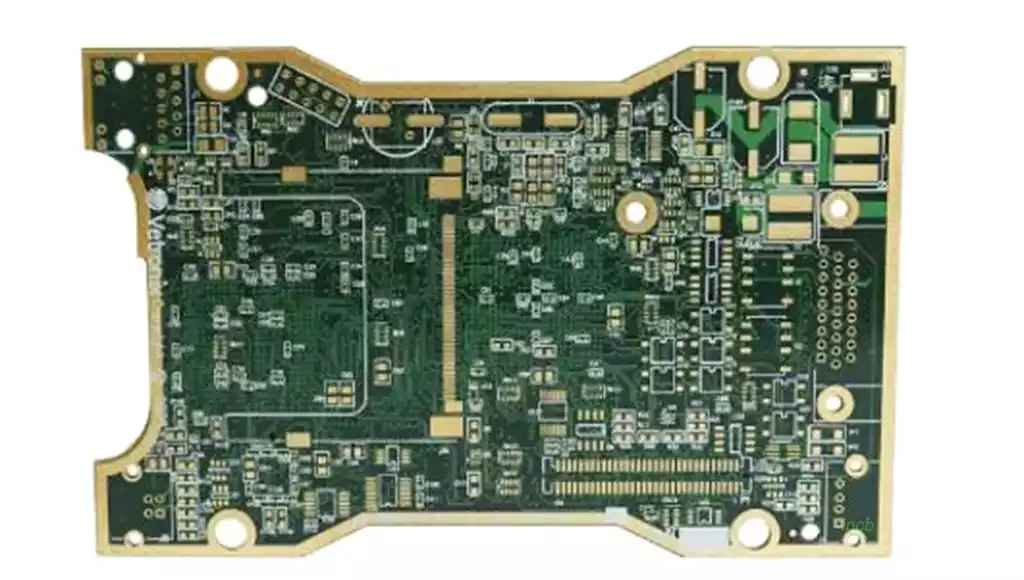
Every improvement in the precision of flexible circuit formation drives the expansion of ceramic pcb into high-end applications such as 5G communications, medical electronics and aerospace.
As the two core processes in the PCB manufacturing industry, subtractive and additive methods are not mutually exclusive; rather, they form a complementary and symbiotic technological landscape centred on the specific requirements of ceramic pcb. Understanding the differences, logic and boundaries between the two not only helps enterprises to precisely control costs and enhance competitiveness, but is also key to overcoming bottlenecks in the high-end market.
Thanks to their high-temperature resistance, high insulation and excellent thermal conductivity, ceramic pcb have become the core substrate of choice for high-end flexible circuits. The effectiveness of their integration with flexible circuits directly determines the stability and lifespan of end-user devices. Unlike ordinary substrates, the characteristics of ceramics place higher demands on circuit manufacturing processes—requiring not only tight adhesion but also a balance between precision and cost. It is against this backdrop that the subtractive and additive methods have carved out distinct market segments, each demonstrating distinct technical advantages and application scenarios.
Subtractive Method: The Cost-Effective Choice for Mass Production
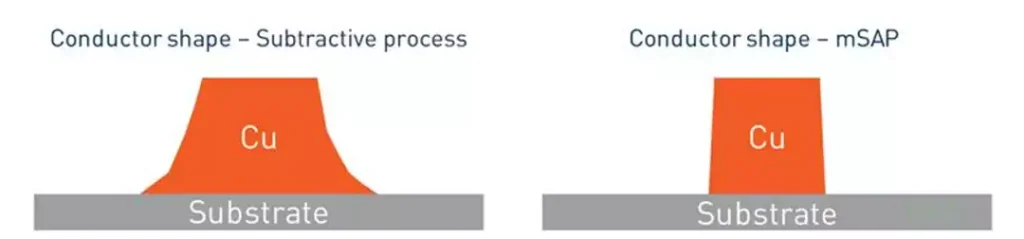
The subtractive method employs a ‘copper plating first, protection second, etching last’ logic to form the circuit, and is currently the most commonly used process for adapting ceramic pcb to flexible circuits. It requires no complex specialised equipment, features a standardised process, and can rapidly meet mass production demands, making it particularly suitable for mid-to-low-end products. The process is optimised around the ceramic substrate: copper-clad laminates with a matched coefficient of thermal expansion are selected; following drilling, electroless copper plating, electroplating and pattern transfer, side etching is precisely controlled using a specialised etching solution to ultimately complete the circuit fabrication.
The advantages of the subtraction method directly address the pain points of mass production: the technology is mature and the equipment is widely available, effectively reducing yield risks and making it suitable for high-volume demands such as automotive control modules; costs are controllable, with standard copper foil and conventional equipment maximising cost-effectiveness; and it offers strong compatibility, accommodating ceramic substrates of varying thicknesses. Its limitations include: a line width/spacing limit of only 30–50 μm, making it difficult to meet the requirements for ultra-fine circuits; low copper foil utilisation, with significant environmental pressure regarding etching waste; and insufficient edge flatness, which affects high-frequency signal stability.
Additive Method: A Precision Breakthrough for High-End Applications
The additive method employs an ‘on-demand deposition, layer-by-layer construction’ approach, depositing conductive materials directly onto the substrate surface to overcome the limitations of etching. The semi-additive process (SAP) is the mainstream approach, featuring a refined workflow: the substrate is first treated with corona or plasma to enhance adhesion; a seed layer is then formed via sputtering or electroless plating.
After applying photoresist, exposure and development reveal the electroplating areas; a uniform copper layer is deposited by controlling current density; finally, the photoresist is stripped and excess seed layer removed to ensure long-term compatibility between the circuit and the ceramic substrate.
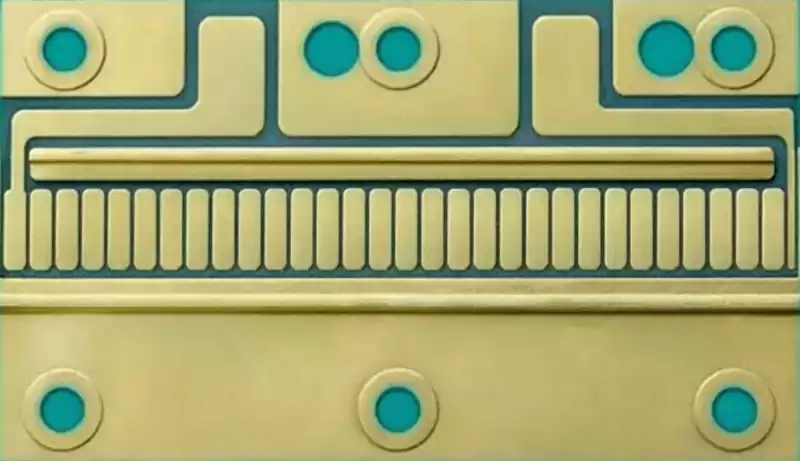
The advantages of the additive method are irreplaceable: line widths and spacings can reach 5–20 μm, perfectly meeting the requirements for ultra-fine circuits in 5G base stations, aerospace and other applications; material utilisation is nearly 100%, with no etching waste liquid, complying with green manufacturing standards; circuit edges are flat and thickness is uniform, ensuring high signal transmission stability.
Limitations include: specialised equipment is expensive, and materials such as nanosilver paste are costly; the process is highly complex, with stringent environmental parameter requirements and significant yield fluctuations; mass production efficiency is low, making it suitable for small-batch, high-end products.
Process Trade-offs and Selection Guidelines
The trade-off between subtractive and additive methods essentially stems from differing requirements across various application scenarios for ceramic pcb. Selection follows three key principles:
First, consider precision—choose the subtractive method for 30μm and above, and the additive method for 5–20μm;
Secondly, consider mass production: choose the subtractive method for high-volume, mid-to-low-end products, and the additive method for small-batch, high-end products;
Thirdly, consider the application scenario: the subtractive method is used for general consumer electronics and standard automotive modules, whilst the additive method is mandatory for 5G communications, medical imaging and aerospace. For mid-range products, a hybrid process may be adopted: the subtractive method is used for the main lines to ensure efficiency, whilst the additive method is used for fine lines to enhance precision.
As the industry evolves, both processes continue to be optimised. The subtractive method, through the use of eco-friendly etchants and parameter optimisation, reduces environmental impact and enhances precision, thereby consolidating its position in the mid-to-low-end market; the additive method, through equipment upgrades and material improvements, lowers costs and increases efficiency, expanding its applications in the high-end sector.
In the future, the two methods will not replace one another, but will instead form a pattern of ‘complementarity at the low end and breakthroughs at the high end’, jointly driving the ceramic PCB manufacturing industry towards greater refinement, environmental sustainability and high-end development.