In the selection process of RF cables and connectors, choosing the appropriate cable type is the first and most critical step. In RF transmission systems, the three most commonly used cable categories are coaxial cables, twinaxial cables, and triaxial cables. These three RF cable types have significant differences in internal construction, dimensional specifications, electrical characteristics, and application environments.
Accurately understanding the unique characteristics of each RF cable type is essential for ensuring stable RF signal transmission and achieving optimal performance under specific operating conditions. The following section provides a comprehensive analysis of the structural features and typical applications of these three major RF cable categories.
Coaxial Cable
Coaxial cable is the most widely used fundamental cable type in RF transmission systems. It features a simple yet highly practical two-conductor structure and is suitable for a wide range of conventional RF signal transmission applications.
The central conductor located at the core of the RF cable serves as the primary transmission path for RF signals. All high-frequency signals are transmitted through this conductor. Surrounding the center conductor is an external shielding layer, which is normally connected to ground and may also function as a signal return path in specific applications.
The primary purpose of the shielding layer is to provide electromagnetic protection by preventing external electromagnetic interference (EMI) and radio frequency interference (RFI) from affecting signal transmission. In complex industrial and communication environments, various electronic devices continuously generate unwanted electromagnetic radiation. The shield of a coaxial cable effectively blocks external interference from entering the cable structure, maintaining signal integrity and minimizing signal distortion, noise coupling, and transmission degradation.
Due to its stable transmission performance, mature manufacturing technology, and excellent cost-effectiveness, coaxial cable is widely used in commercial, industrial, and communication applications. Its major applications include:
1.Communication Systems
Whether used in long-distance backbone communication networks or short-distance local communication systems, coaxial cables can meet fundamental signal transmission requirements.
In traditional cable television systems, coaxial cables were widely used as the primary transmission medium, providing reliable signal delivery from broadcast facilities to end users and becoming a key component of conventional cable communication infrastructure.
2.Early Computer Local Area Networks
During the early development stage of Ethernet technology, classic network standards such as 10Base-2 and 10Base-5 utilized coaxial cables as the primary physical transmission medium.
With their reliable shielding capability and stable electrical performance, coaxial cables enabled data communication between multiple computers and represented one of the mainstream wired networking solutions at that time.
3.Analog Video Surveillance Transmission
In traditional analog CCTV systems, coaxial cables are used to transmit real-time video signals from cameras. They provide stable transmission performance for analog video streams, ensuring continuous image quality and reliable operation for conventional security monitoring systems.
4.Wireless Base Station Signal Transmission
In mobile communication base stations, coaxial cables are commonly used to connect transmitters, receivers, and external antennas. They provide efficient transmission of high-frequency RF signals, ensuring stable signal transmission and reception performance for wireless communication networks.
5.Low-Level RF Signal Transmission
For applications involving low-amplitude RF signals, coaxial cables provide reliable signal interconnection while minimizing attenuation and distortion. They are widely used in RF test equipment, communication modules, and other applications requiring accurate transmission of weak RF signals.
Twinaxial Cable
Twinaxial cable, also known as shielded twisted pair cable or twinax cable, features a unique three-layer conductor structure. Unlike coaxial cables with a two-conductor configuration, twinaxial cables are specifically optimized for differential signal transmission applications.
The internal structure typically consists of two central conductors, an insulating dielectric layer, and an outer shielding layer. In many designs, the conductors are color-coded, such as blue identification marks, to simplify installation and cable management.
The central conductors serve as the primary signal transmission paths, carrying high-speed electrical data signals. The dielectric structure maintains mechanical stability and ensures consistent signal propagation characteristics. The external shielding layer provides effective protection against EMI and RFI interference, allowing reliable signal transmission in electrically noisy environments.
With its specialized construction and impedance characteristics, typically ranging from 78Ω to 124Ω with a common reference impedance of 78Ω, twinaxial cable is mainly used for digital signal transmission applications. Its major applications include:
1.High-Speed Differential Signal Transmission
High-speed differential signaling is the primary application area for twinaxial cables.
Twinax cables transmit complementary positive and negative signals simultaneously. Through differential signal processing, common-mode noise introduced during transmission can be effectively rejected. Even in complex electromagnetic environments, differential signaling enables accurate reconstruction of the original data signal, significantly improving noise immunity and maintaining signal integrity.
Therefore, twinaxial cables are widely used in high-speed digital communication systems, data transmission networks, and advanced electronic equipment requiring reliable signal performance.
2.Conventional Non-Differential Signal Transmission
In addition to differential signaling, twinaxial cables can also support conventional single-ended signal applications, including clock distribution and signal return paths.
These applications are commonly found in internal electronic system interconnections where flexible impedance matching and stable signal routing are required. Twinaxial cables are frequently used in compact electronic devices and high-performance computing systems.
Triaxial Cable
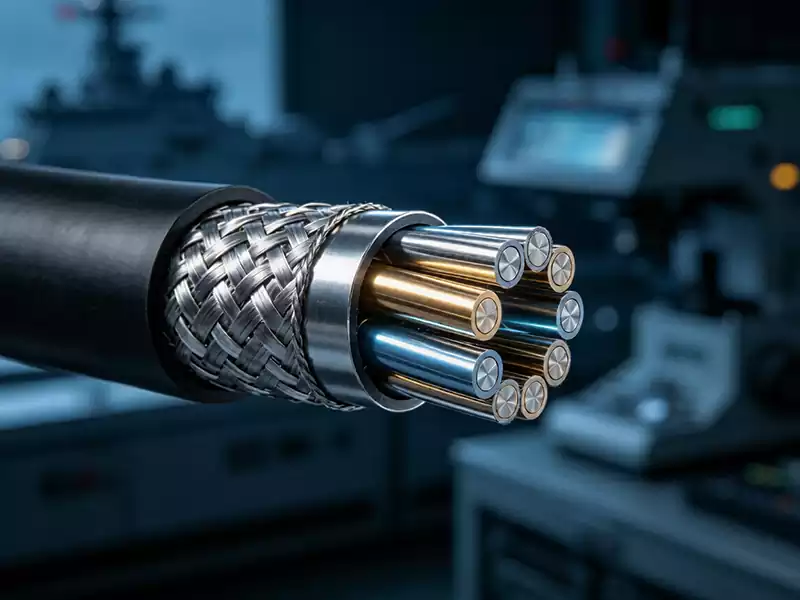
Triaxial cable, also known as double-shielded coaxial cable, is an enhanced version of conventional coaxial cable. It adopts a three-conductor-layer structure consisting of:
Center conductor + inner shield + outer shield
The dual-shielding configuration provides significantly improved electromagnetic protection compared with standard coaxial and twinaxial cables, making triaxial cables ideal for high-precision and high-noise-immunity applications.
The center conductor carries RF signals and low-level electrical signals. The additional inner shielding layer provides the first level of electromagnetic protection by blocking external interference before it reaches the signal conductor. The outer shielding layer acts as a secondary protection barrier, creating a dual-shield structure that effectively isolates internal and external electromagnetic interference.
With superior shielding effectiveness and outstanding transmission stability, triaxial cables are mainly used in advanced applications where conventional cables cannot provide sufficient performance.
Major applications include:
1.Military Shipboard Communication Systems
Military vessels contain highly integrated electronic systems and operate in extremely complex electromagnetic environments. The dense concentration of electronic equipment creates significant risks of electromagnetic interference and signal coupling.
The dual-shield structure of triaxial cables provides excellent EMI rejection performance, making them suitable for shipboard data bus systems and military communication equipment. They ensure accurate and reliable data exchange between critical systems and support coordinated operation of advanced defense and communication platforms.
2.High-End High-Definition Video Transmission
Compared with conventional coaxial cables, triaxial cables provide superior shielding effectiveness and significantly reduce transmission issues such as noise interference, image instability, and color distortion.
They are widely used in professional broadcast systems, high-end video surveillance equipment, and other applications requiring extremely high image quality and signal stability.
3.Precision Measurement and Low-Current Detection
In laboratory measurement systems and industrial low-current testing applications, weak electrical signals are highly vulnerable to external electromagnetic interference.
The dual-shield structure of triaxial cables effectively minimizes external noise coupling and enables accurate transmission of extremely small current and voltage signals. This ensures measurement accuracy and data reliability in precision testing, scientific research, and industrial inspection applications.
Coaxial cable, twinaxial cable, and triaxial cables each provide unique advantages based on their structural design, electrical performance, and shielding capabilities. These three RF cable categories have developed distinct application areas to meet different signal transmission requirements.
As electronic systems continue to evolve toward higher frequencies, higher speeds, and greater integration, RF cable technologies will continue to improve in terms of materials, manufacturing processes, impedance control, and shielding performance. These advancements will enable future RF cable solutions to support increasingly complex and high-precision transmission environments.