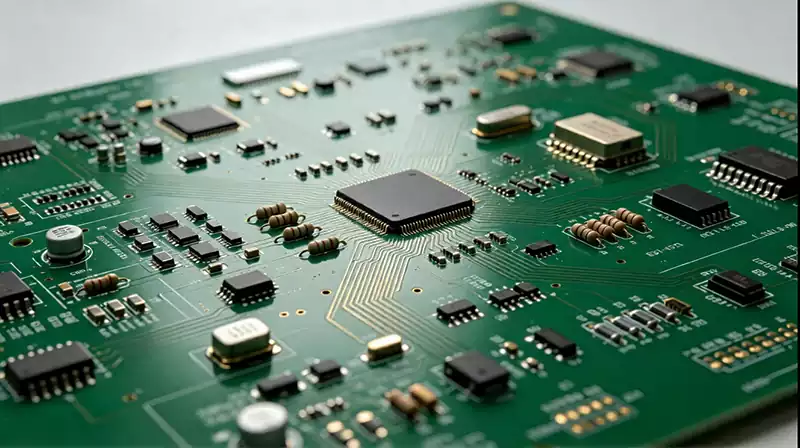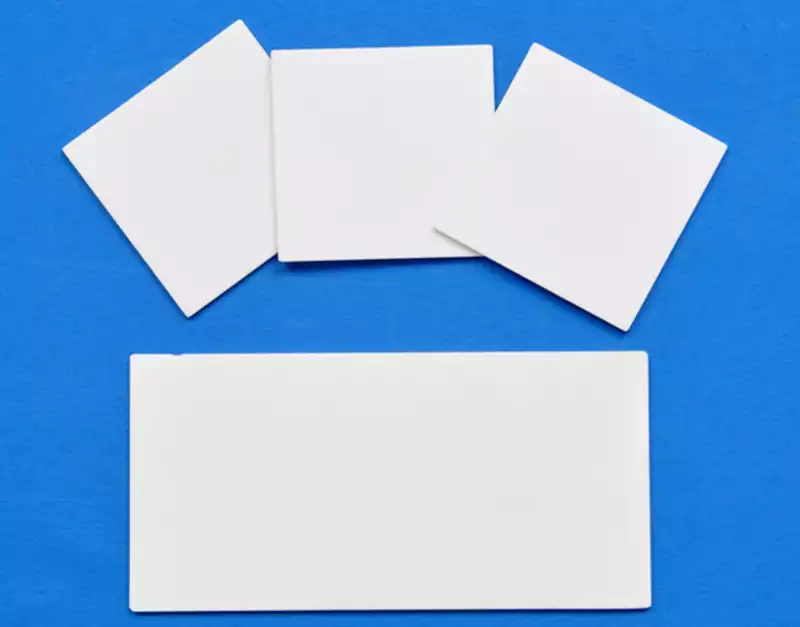
Rogers 3003 is a premium high-frequency PCB laminate developed by Rogers Corporation specifically for demanding RF, microwave, and high-speed digital applications. It has become one of the industry’s preferred substrate materials for RF and microwave systems, advanced communication equipment, military electronics, and intelligent electronic systems.
Manufactured using an environmentally friendly halogen-free material system, Rogers 3003 is based on a proprietary ceramic-filled polytetrafluoroethylene (PTFE) composite. This advanced laminate combines outstanding electrical performance, excellent mechanical stability, and reliable thermal management into a single material platform. Owing to its well-balanced performance characteristics, Rogers 3003 is widely used in high-end commercial communications, industrial precision equipment, intelligent automotive electronics, advanced medical devices, aerospace systems, and defense applications.
Unlike conventional FR-4 laminates, Rogers 3003 utilizes a modified PTFE composite reinforced with fiberglass to overcome the inherent limitations of standard PCB materials, including excessive high-frequency loss, signal distortion, insufficient thermal conductivity, and poor environmental stability. The material provides highly stable dielectric properties specifically optimized for microwave-frequency operation, significantly reducing signal attenuation, insertion loss, and electromagnetic interference while preserving excellent signal integrity.
This makes it particularly suitable for gigabit data transmission, microwave communications, and other high-speed signal transmission applications. At the same time, its efficient thermal management characteristics rapidly dissipate heat generated by active components, preventing overheating, electrical performance drift, and unexpected system failures during continuous high-power operation, thereby ensuring long-term reliability for advanced electronic equipment.
PTFE, the primary constituent of Rogers 3003, is well known for its outstanding chemical inertness and exceptional electrical insulation properties, making it one of the preferred materials for high-frequency PCB fabrication. Through proprietary material modification and composite reinforcement technologies, Rogers 3003 achieves significant improvements in both dielectric performance and mechanical strength.
Among the key electrical parameters used to evaluate high-frequency laminates, the dielectric constant (Dk) determines the propagation characteristics of electromagnetic waves through the substrate, while the dissipation factor (Df) represents dielectric energy loss during signal transmission and directly influences signal quality at microwave frequencies. Rogers 3003 delivers both a low dielectric constant and an ultra-low dissipation factor with exceptional stability across a broad range of operating frequencies and temperatures. This outstanding electrical consistency is one of the primary reasons why Rogers 3003 has become a benchmark substrate for demanding RF and microwave applications.
Performance Advantages of Rogers 3003 PCB Material
One of the most significant advantages of Rogers 3003 is its exceptional high-frequency electrical performance. Signal distortion and transmission loss are among the primary challenges in modern high-speed electronic systems, and Rogers 3003 is specifically engineered to address these issues. Its highly stable dielectric constant and ultra-low dissipation factor effectively suppress signal reflection, scattering, attenuation, and electromagnetic interference throughout RF and microwave frequency ranges.
Compared with conventional PCB materials, Rogers 3003 provides substantially higher signal transmission accuracy and stability, making it ideal for high-speed data communication, precision sensing systems, and other applications where signal integrity is critical.
Rogers 3003 also offers excellent thermal conductivity for effective heat dissipation. High-frequency, high-power circuits continuously generate considerable heat during operation, and inadequate thermal management often results in electrical parameter drift, accelerated material aging, and eventual circuit failure. With a thermal conductivity typically ranging from 0.6 to 1.0 W/m·K, Rogers 3003 efficiently transfers heat away from electronic components and copper circuitry, maintaining uniform temperature distribution across the PCB. This significantly reduces operating temperatures, minimizes thermal effects on electrical performance, and greatly improves long-term system reliability in demanding continuous-duty applications.
To withstand complex mechanical environments, Rogers 3003 incorporates a fiberglass-reinforced composite structure that compensates for the relatively low mechanical strength of pure PTFE materials. The reinforced laminate exhibits excellent compressive strength, dimensional stability, and wear resistance while maintaining outstanding rigidity. It effectively withstands vibration, mechanical impact, assembly stress, and thermal cycling without deformation or delamination. As a result, the PCB remains mechanically stable throughout manufacturing, assembly, and long-term operation, significantly extending equipment service life and improving environmental reliability.
Another important advantage of Rogers 3003 is its outstanding chemical resistance and environmental durability. Thanks to the inherent chemical inertness of PTFE, the laminate provides excellent resistance to acids, alkalis, industrial chemicals, cleaning solvents, and corrosive gases without degradation of its electrical or mechanical properties. In addition, Rogers 3003 demonstrates excellent thermal stability over a wide operating temperature range, maintaining consistent electrical characteristics without embrittlement or softening under extreme environmental conditions. These characteristics make it particularly suitable for industrial equipment, outdoor communication infrastructure, and other harsh operating environments.
Perhaps its most valuable characteristic is its exceptional performance under microwave and RF operating conditions. Unlike conventional PCB materials whose dielectric properties fluctuate significantly with increasing frequency, Rogers 3003 maintains highly stable dielectric characteristics throughout the RF and microwave spectrum. This ensures consistently low transmission loss and stable impedance characteristics even at very high frequencies, making Rogers 3003 one of the industry’s preferred substrate materials for high-frequency communication equipment, precision radar systems, and advanced microwave electronics.
Primary Applications of Rogers 3003 PCB Material
Rogers 3003 is extensively used in RF and microwave communication systems. As wireless communication technologies continue evolving toward higher frequencies, higher data rates, and lower latency, PCB materials must provide exceptional signal integrity and electrical stability. With its ultra-low dielectric loss and highly consistent electrical properties, Rogers 3003 is ideally suited for RF base stations, microwave transmission modules, RF transceivers, and other critical communication equipment. By minimizing insertion loss, transmission delay, and signal interference, it significantly improves communication efficiency and network reliability in applications including 5G, emerging 6G infrastructure, and microwave backhaul systems.
Satellite communication systems also rely heavily on Rogers 3003 because of their demanding operating environments. Satellite electronics operate at extremely high frequencies while being subjected to severe temperature cycling and harsh space conditions. Rogers 3003 combines outstanding microwave performance with excellent thermal stability and environmental durability, maintaining highly consistent electrical characteristics despite temperature fluctuations. Consequently, it is widely used in satellite communication modules, onboard RF circuitry, and spaceborne communication systems where long-term reliability is essential.
Precision radar systems represent another major application area. Radar performance depends directly on the accurate transmission, reception, and processing of high-frequency electromagnetic signals. Rogers 3003 minimizes insertion loss while preserving outstanding signal integrity, thereby improving detection range, positioning accuracy, target resolution, and interference immunity. It is widely employed in weather radar systems, automotive radar sensors, industrial radar equipment, and other high-performance sensing applications.
In military and defense electronics, equipment must continue operating reliably under extreme temperatures, severe vibration, strong electromagnetic interference, and chemically aggressive environments. Rogers 3003 combines stable electrical characteristics, superior mechanical durability, excellent weather resistance, and outstanding EMI performance to satisfy the stringent reliability requirements of defense communication systems, surveillance equipment, radar platforms, and intelligent military control systems.
Advanced medical equipment also benefits from the superior electrical performance of Rogers 3003. Diagnostic imaging systems, precision medical instruments, and patient monitoring equipment require extremely accurate signal transmission because even minimal signal distortion can affect diagnostic accuracy. The ultra-low transmission loss and exceptional signal stability provided by Rogers 3003 ensure precise transmission of high-frequency signals and medical data, making it an excellent substrate for MRI systems, CT scanners, ultrasound equipment, and other advanced medical imaging and diagnostic devices.
The rapid advancement of electric vehicles, autonomous driving technologies, and intelligent transportation systems has also created increasing demand for high-performance PCB materials. Automotive electronic systems such as millimeter-wave radar, vehicle wireless communication modules, battery management systems, and advanced driver assistance systems (ADAS) require substrates capable of operating reliably under continuous vibration, wide temperature fluctuations, and complex electromagnetic environments.
Rogers 3003 offers outstanding vibration resistance, excellent dimensional stability, efficient thermal management, and stable high-frequency electrical performance, making it an ideal PCB material for automotive millimeter-wave radar, in-vehicle wireless communication modules, and advanced automotive electronic control systems.
By combining modified PTFE technology with a fiberglass-reinforced composite structure, Rogers 3003 successfully achieves an optimal balance among low-loss high-frequency performance, efficient thermal management, and excellent mechanical strength. This unique combination of properties provides a proven and highly reliable substrate solution for demanding RF and microwave applications including satellite communications, radar systems, defense electronics, and intelligent automotive technologies, making Rogers 3003 one of the industry’s leading high-frequency PCB materials.