As one of the most fundamental and critical materials in RF hardware, RF laminates directly affect the transmission efficiency, operational stability, and service life of communication equipment. Today’s high-frequency applications operate under increasingly demanding conditions, placing stringent requirements on signal loss, thermal conductivity, temperature stability, and long-term resistance to thermal aging. Among advanced RF materials, Rogers has maintained a leading position through continuous material innovation and the development of high-performance laminate systems. Its RF laminate solutions overcome many of the performance limitations of conventional PCB materials and support the advancement of RF and microwave technologies, providing a reliable material foundation for high-end communication equipment.
A complete RF communication system consists of multiple subsystems that work together to perform different functions. Among them, the power amplifier module, low-noise receiving module, and digital communication control module are three key functional blocks responsible for signal transmission, reception, and data processing. Because these subsystems operate under significantly different conditions, their requirements for the electrical properties, thermal performance, and mechanical stability of PCB materials also vary. Rogers high-performance RF laminates are designed with tailored material properties and construction technologies to meet the specific requirements of these three critical modules, making them well suited for advanced communication equipment.
Power Amplifier Module
The power amplifier (PA) is the primary RF signal output stage in a communication system. Its main function is to amplify RF signal power, directly affecting signal coverage, transmission distance, and radiated power. Power amplifiers are widely used in high-power applications such as 5G macro base stations, microwave relay systems, and satellite transmission terminals. These systems often operate continuously under high load, elevated temperatures, and wide temperature variations, creating a risk of increased signal loss, thermal failure, and temperature-induced parameter drift. As a result, the PCB substrate used in power amplifier applications must provide a combination of low-loss electrical performance, efficient heat dissipation, and excellent thermal stability.
To address the demanding operating conditions of high-power amplifier applications, Rogers has optimized the performance of its RF laminates to provide several key advantages. Their low dielectric loss significantly reduces RF energy loss during transmission through the PCB, improving power transfer efficiency and minimizing unnecessary energy dissipation.
The materials also provide high thermal conductivity, allowing heat generated by power devices to be transferred away efficiently and reducing localized thermal accumulation. This helps lower the risk of thermal shutdown and component damage. In addition, the laminates offer excellent temperature stability. Across an operating temperature range of approximately -55°C to +125°C, key electrical properties such as dielectric constant (Dk) and dissipation factor (Df) remain relatively stable, helping minimize signal distortion and power variation caused by temperature fluctuations.
The materials also demonstrate strong long-term resistance to thermal aging. Even under prolonged high-temperature and high-frequency operation, their electrical and physical properties remain stable, helping extend the service life of communication equipment. With these combined characteristics, power amplifiers using Rogers RF laminates can maintain stable and efficient high-power output under demanding operating conditions while providing the reliability required by advanced high-power communication systems.
Low-Noise Receiving and Sensing Module
Low-noise amplifiers (LNAs) and RF receivers function as the sensing front end of a communication system. They capture weak RF signals from the surrounding environment and amplify them while introducing minimal additional noise. These components are essential in satellite receivers, precision detection radar, and long-range microwave communication systems. Because signal-to-noise ratio (SNR) and receiver sensitivity are critical performance indicators, substrate-related signal loss and electrical noise can directly affect the detection and processing of weak RF signals. This makes the receiving module one of the most demanding sections of a communication system in terms of PCB material performance and stability.
Rogers high-performance RF laminates address these challenges through ultra-low-loss characteristics and excellent environmental stability. Their low insertion loss and favorable return loss characteristics help minimize attenuation and signal distortion during transmission, preventing weak signals from being masked by system noise and improving the overall signal-to-noise ratio. This allows communication equipment to detect and process low-level RF signals from greater distances with higher accuracy.
The laminates also provide excellent thermal and environmental stability. Even under outdoor conditions involving temperature cycling, humidity, and complex electromagnetic environments, their key electrical properties remain stable without introducing significant additional signal noise. These characteristics improve receiver sensitivity and interference immunity, enabling communication systems to maintain clear, stable, and accurate signal reception under demanding operating conditions.
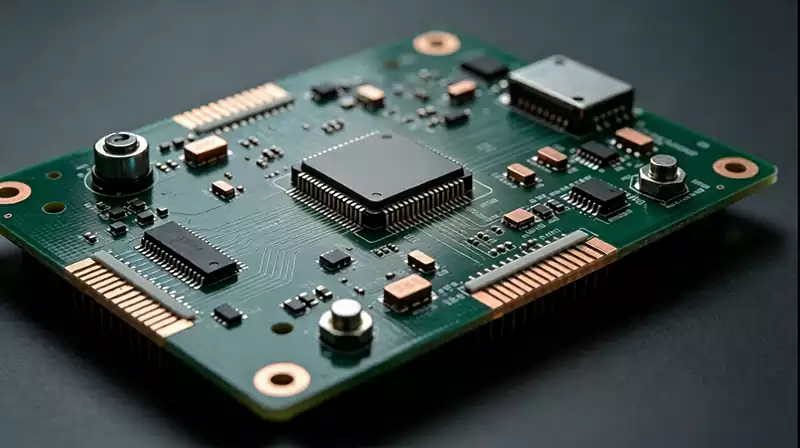
Digital Communication Control Module
With the commercialization of 5G-Advanced (5G-A), the growing adoption of millimeter-wave communications, and the rapid expansion of high-speed IoT networks, communication systems are entering an era of ultra-high-speed, high-capacity, and low-latency data transmission. Digital communication control circuits are responsible for data routing, signal transmission, and command processing, making them a critical part of high-speed communication architectures. Consequently, PCB substrates must provide increasingly stringent levels of signal integrity, transmission consistency, and crosstalk control.
Conventional communication laminates may exhibit excessive signal propagation variation, significant channel crosstalk, and relatively high conductor loss, making them increasingly unsuitable for next-generation high-speed communication systems.
Rogers ultra-low-loss RF laminates address these requirements through optimized material formulations and advanced laminate construction. Their extremely low dielectric loss and dispersion support high-frequency, high-speed data transmission and meet the bandwidth and data-rate requirements of 5G and future communication networks. The optimized material structure also helps suppress crosstalk and electromagnetic coupling between high-speed traces, preserving signal integrity throughout the transmission path and reducing the risk of data errors and transmission instability.
The laminate construction further enhances high-speed performance through the use of smooth rolled copper foil, which helps reduce conductor loss and improve overall transmission efficiency. In addition, spread-glass or low-profile glass fabric constructions with optimized glass content can reduce phase variation and signal deviation during high-frequency transmission, improving channel-to-channel consistency and uniformity in multi-channel circuits. These material and process optimizations enable digital communication control circuits to reliably support high-speed, high-capacity data exchange and provide a solid material foundation for next-generation communication networks.
Across the entire RF communication signal chain, Rogers high-performance RF laminates provide targeted material solutions for critical system modules. In power amplification, they support high-power operation and long-term thermal stability. In RF reception, they enable high-sensitivity, low-noise detection of weak signals. In digital control circuits, they support high-speed data transmission with excellent signal integrity. Compared with conventional general-purpose PCB materials, Rogers RF laminates use application-specific material engineering and laminate technologies to address key challenges in high-frequency communication systems, including signal loss, thermal management, operational stability, and signal accuracy.
Through continuous innovation in high-performance laminate technology, Rogers not only improves the performance and service life of individual communication systems but also contributes to the broader development of RF and microwave communications. Rogers RF laminates are widely used in advanced applications such as 5G networks, satellite internet, high-performance radar systems, and millimeter-wave communications, providing an essential material foundation for the development of faster, more efficient, and more reliable next-generation communication infrastructure.